Abstract
On a given curve, we obtain division polynomials for 3- and 4-torsion divisors. We also find all 3- and 4-torsion divisors by means of (i) solving the Jacobi inversion problem, and (ii) solving the division polynomials, and compare these results.
This post serves as a supplementary material to arXiv:2412.10284
Preliminaries
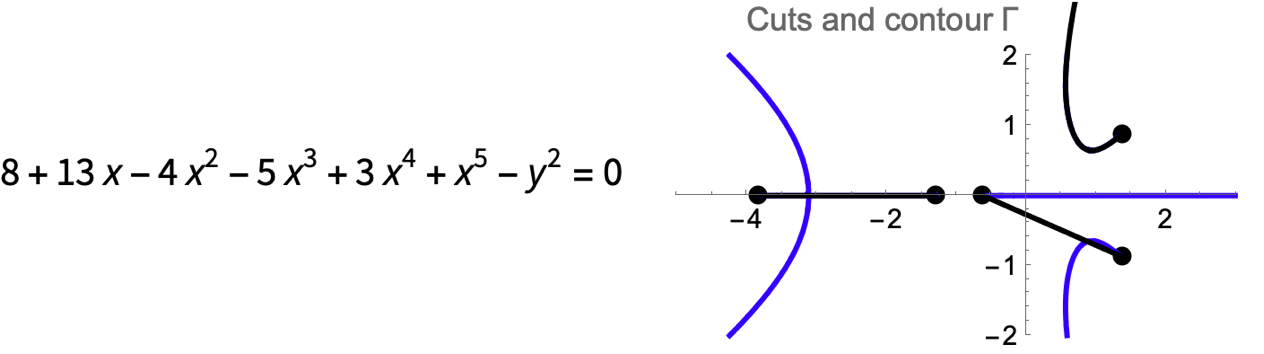
Let a genus two curve \mathcal{C} be defined by the equation
Coefficients \lambda \equiv \{\lambda_2,\lambda_4,\lambda_6,\lambda_8,\lambda_{10}\} serve as parameters of the curve.
The curve has the form of a (2,5)-curve. The Sato weights are \mathrm{wgt}\ x=2, \mathrm{wgt}\ y=5, and the indices of \lambda show their weights.
The curve possesses canonical cycles \mathfrak{a}_1, \mathfrak{b}_1, \mathfrak{a}_2, \mathfrak{a}_2, and a system of associated first and second kind differentials:
Indices of the differentials indicate their weights: \mathrm{wgt}\ u_i = - i, \mathrm{wgt}\ r_i = i.
First kind integrals along \mathfrak{a}-, and \mathfrak{b}-cycles form a lattice of periods \{\omega, \omega'\}; and we define the Jacobian variety of \mathcal{C} as \mathrm{Jac}(\mathcal{C}) = \mathbb{C}^2 / \{\omega, \omega'\}. Similarly, integrals of the second kind along \mathfrak{a}-, and \mathfrak{b}-cycles form two matrices \eta, and \eta'.
The curve \mathcal{C} is equipped with the modular-invariant, entire \sigma-function, see [2, Chap. 3],
which has the weight \mathrm{wgt}\ \sigma = - 3.
With the help of \sigma-function abelian functions are generated by
According to the Riemann vanishing theorem \sigma(u) = 0 if and only if the Abel pre-image of u is a special divisor. Let (\sigma)_0 = \{u \in \mathrm{Jac}(\mathcal{C}) \mid \sigma(u)=0\} be the theta-divisor in \mathrm{Jac}(\mathcal{C}).
Uniformization of the curve \mathcal{C}
is given by two polynomial functions of weights 4 and 5:
Actually, the Abel pre-image of u \in \mathrm{Jac}(\mathcal{C}) \backslash (\sigma)_0 is the common
divisor of zeros of the two functions \mathcal{R}_4, \mathcal{R}_5 defined by (C25Unif). This divisor is non-special.
On the other hand, the two polynomial functions \mathcal{R}_4, \mathcal{R}_5 can be considered as elements of the ring \mathbb{C}[x,y]/f(x,y;\lambda), namely
and \alpha_2, \alpha_4, \beta_3, \beta_5 serve as coordinates on \mathrm{Jac}(\mathcal{C}), and satisfy the equations which define the Jacobian variety, see [1, Theorem 3.2]:
We call \alpha_2, \alpha_4, \beta_3, \beta_5 the Mumford coordinates of a non-special divisor.
Divisors
Every class of equivalent divisors on \mathcal{C} has a representative
P_1 + P_2 - 2 \infty, and P_1, P_2 are not in involution, that is P_2 \neq -P_1.
Such a representative is called a reduced divisor. Since the poles are located at infinity,
which serves as the basepoint, it is convenient to define every reduced divisor by its positive part,
as follows
- non-special D_2 = (x_1,y_1)+(x_2,y_2) of degree 2,
- special D_1=(x_1,y_1) + \infty of degree 1,
- neutral O = 2\infty of degree 0, u(2\infty)=0.
Addition and duplication on \mathcal{C}
is described in detail in arXiv:2412.10284 , Sect.4. We will use final formulas in terms of the Mumford coordinates.
n-Torsion divisors
Let D \in \mathcal{C}^2 be a reduced divisor, special or non-special.
We say that D is an n-torsion divisor, if n D \sim O, where O = 2\infty
denotes the neutral divisor, and D
generates a cyclic group of order n:
C_n = \langle O, D \rangle.
This definition implies the following criterion.
Theorem.
A divisor D \in \mathcal{C}^2 is n-torsion when the following holds
(i) (k+1) D \sim - k D, if n = 2k+1; or
(ii) k D \sim - k D, if n=2k.
Remark.
n-Torsion divisors are the Abel pre-images of points of order n on \text{Jac}(\mathcal{C}),
that is, of u[\varepsilon] \in \text{Jac}(\mathcal{C}) computed
from characteristics [\varepsilon] of order n by
u[\varepsilon] = \omega \varepsilon + \omega' \varepsilon'.
Condition (i) in Theorem implies
Relations for \beta-coordinates in this case are trivial.
Condition (ii) implies that k D is
2-torsion, that is
if k D is non-special. If k D is special, then
k D \sim \,(x_{k D}, y_{k D}) ,
and instead of (EvenTorsCond) we have
Relations for \alpha-coordinates in case (ii) are trivial.
Equations (OddTorsCond) and (EvenTorsCond) written
in terms of \alpha_2^{[D]}, \alpha_4^{[D]}, \beta_3^{[D]}, \beta_5^{[D]}
can be considered as division polynomials in Mumford coordinates.
2-Torsion divisors
are defined by the condition
y_i = 0, which implies that x_i are x-coordinates of branch points.
That is, 2-torsion divisors are Abel pre-images of half-periods on \text{Jac}(\mathcal{C}).
Among fifteen 2-torsion divisors, ten are composed of two finite branch points,
and correspond to even characteristics. The remaining five 2-torsion divisors
are composed of infinity and one finite branch point,
and correspond to odd characteristics.
3-Torsion divisors
There are exist 80 characteristics of order 3, and the corresponding divisors are all non-special.
Let D_{2Q} = (x_1,y_1)+(x_2,y_2) be a 3-torsion divisor, which means that
2 D_{2Q} \sim \,- D_{2Q}.
From (OddTorsCond) we find the criterion
At the same time, \beta_3^{[2Q]} = - \beta_3^{[Q]}, \beta_5^{[2Q]} = - \beta_5^{[Q]}.
Therefore, 80 3-torsion divisors split into 40 pairs D_{2Q} , -D_{2Q} .
In each pair \alpha-coordinates are the same.
Applying the duplication law we obtain
the equations which define 3-torsion divisors in terms of Mumford coordinates
(\alpha_2^{[Q]} \equiv \alpha_2, \alpha_4^{[Q]} \equiv \alpha_4):
where parameters \gamma_k are expressed in terms of \alpha_2, \alpha_4, \beta_3, \beta_5.
Expressions in terms of x-, y-coordinates are derived below.
4-Torsion divisors
There exist 240 characteristics of order 4 excluding half-integer characteristics.
Let \mathfrak{E} denote the set of these 240 characteristics.
Each characteristic of \mathfrak{E} produces a 4-torsion divisor D_{2Q}=(x_1,y_1)+(x_2,y_2),
which is non-special. The 240 characteristics of \mathfrak{E} split into 15 collections
of 16 characteristics each, such that for all [\varepsilon] is a collection
[2\varepsilon] is a particular half-integer characteristic. Recall, that half-integer characteristics produce
five special and ten non-special divisors.
We split \mathfrak{E} into two parts:
-
\mathfrak{E}_{\text{non-spec}} = \{[\varepsilon] \in \mathfrak{E} \mid \mathcal{A}^{-1}(u[2\varepsilon]) \,{=}\, D_2,\, \deg D_2 \,{=}\, 2\}
of cardinality 160, the divisor D_2 \sim 2 D_{2Q} is characterized by its
Mumford coordinates \alpha_2^{[2Q]}, \alpha_4^{[2Q]},
\beta_3^{[2Q]}, \beta_5^{[2Q]}; -
\mathfrak{E}_{\text{spec}} = \{[\varepsilon] \in \mathfrak{E} \mid \mathcal{A}^{-1}(u[2\varepsilon]) \,{=}\, D_1,\, \deg D_1 \,{=}\, 1\} of cardinality 80,
the divisor D_1 \sim 2 D_{2Q} is characterized by x-, y-coordinates: D_1 = (x_{2Q},y_{2Q}).
\end{itemize}
Divisors D_{2Q} produced from characteristics of \mathfrak{E}_{\text{non-spec}}
satisfy the conditions
obtained from (EvenTorsCond). In the Mumford coordinates of
D_{2Q} the equalities acquire the form
(\alpha_2^{[Q]} \equiv \alpha_2, \alpha_4^{[Q]} \equiv \alpha_4)
where \gamma_k are expressed in terms of \alpha_2, \alpha_4, \beta_3, \beta_5.
Divisors D_{2Q} produced from characteristics of \mathfrak{E}_{\text{spec}}
satisfy the condition y_{2Q} \,{=}\, 0, which follows from (EvenTorsCond’),
and in terms of the Mumford coordinates of D_{2Q} acquires the form
where \gamma_k are expressed in terms of \alpha_2, \alpha_4, \beta_3, \beta_5.
References
1
Buchstaber, V. M., Enolskii, V. Z., Leykin, D. V.,
Hyperelliptic Kleinian Functions and Applications, preprint ESI 380 (1996), Vienna
2
Buchstaber, V. M., Enolskii, V. Z., Leikin, D. V., Multi-dimensional sigma-function, 2012,
arXiv 1208.0990
 – you have earned Featured Contributor Badge