Hi everyone,
I was trying to fit the following points:
ListPlot[points]
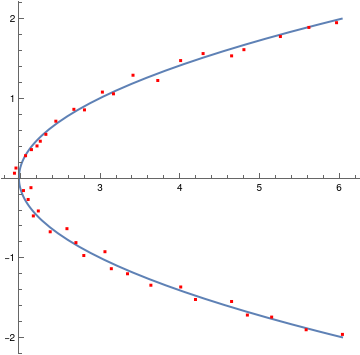
The objective is to reach a function that fits the points, something similar to this:
In my understanding, this looks like a right-pointing parabola:
right-pointing parabola
So I tried this function, but it didn’t work (the fit was inaccurate):
curveFit= Plot[57.01032231556321` +4.524767722795246` *(-29.0814390274144`+x)^2,{x,28,29.33},PlotStyle->Orange];

Show[points, curveFit]
So I decided to try to fit an ellipse or circle instead, but I don’t know how to do it in an automated way(maybe like a Monte Carlo simulation). so I drew an ellipse on top of the points:
h=29.01(*x-coordinate of the center*);
k=57.175(*y-coordinate of the center*);
a=0.13(*radius along the x-axis*);
b=0.2(*radius along the y-axis*);
ellipse = ParametricPlot[{h+a Cos[t],k+b Sin[t]},{t,0,2 Pi},PlotRange->All,AxesLabel->{"x","y"},AxesOrigin->{h-a,k-b},PlotStyle->Orange]

Show[ellipse, points]
I hope anyone can guide me on the right way to proceed.
Thanks in advance.
I have two updates:
I was able to fit equations in this link as follows:
Also, I discovered that I can use the drawing tool to draw ellipses on the points and then convert the cell with the plot (without the original) to input, then it will give the equation for the ellipse in terms of Graphics[Circle[{29.009734682576344, 57.18617339634879}, {0.12473528321493177, 0.2126919292376499}]]
But still, these two approaches are not the “best fit”, it just a better guess.
Mario, here is one way:
(* generation of similar data: *)
dd = .1;
data = Table[{2 + x^2 + RandomReal[{-dd, dd}], x + RandomReal[{-dd, dd}]}, {x, -2, 2, .1}];
(* working on x- and y-component seperately: *)
{datax, datay} = Transpose[data];
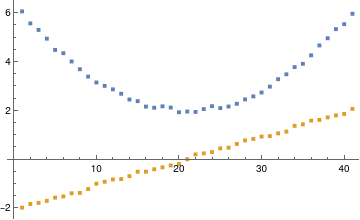
(* we then have: *)
ListPlot[{datax, datay}]
(* this then can be fitted in a regular way: *)
modelx = x2 t^2 + x1 t + x0;
modely = y1 t + y0;
paramsx = FindFit[datax, modelx, {x0, x1, x2}, t];
paramsy = FindFit[datay, modely, {y0, y1}, t];
func[t_] = ({modelx, modely} /. paramsx) /. paramsy;
ParametricPlot[func[t], {t, 1, Length[data]}, Epilog -> {Red, Point[data]}]
Does that help? Regards – Henrik
[1]: https://community.wolfram.com//c/portal/getImageAttachment?filename=dataxdatay.png&userId=32203
[2]: https://community.wolfram.com//c/portal/getImageAttachment?filename=dataxdatay1.png&userId=32203
Can you supply more specifics about your objective in “fitting” ? Here are some examples:
-
If the objective is to provide a curve that is an approximation of
the the data with a formula (parabola, ellipse, or something else),
how close must that approximation be?
-
If the objective is to predict future points, what is the mechanism
for generating the current data and future data?
-
If the objective is “I’ll know it when I see it”, then know that we can’t read your mind. I say this because of your statement “But still, these two approaches are not the ‘best fit’, it just a better guess.”
I am the one who posted it there as well  because I was desperate for a reply. Not sure if it was the right thing to do. I am new to the platform.
Well thank you for your questions they helped me to think better about my objective.
The motion is a rotation of a robot about a center point. But there is an error that’s why this ellipse is formed. i.e. it should be a point rather than an ellipse.
The data source is from sensor position data, then it is transformed using a transformation matrix to the center.
The objective is to predict the error so I would predict the motion without relaying on the sensor, just the difference between angles.
Thank you so much Henrik. I will try it and let you know.
I don’t have a problem with posting things simultaneously but you really need to give the associated links in each post. Otherwise, suppose at one post someone answers the question. Then at the other post you’re wasting folks limited time because the question has already been answered. Or there might be a comment or partial answer that allows someone on another site to give a complete answer if they knew to look where you’ve also posted the same question.