Have some weekend fun figuring out when you share a day in life allowing a factorization that has an equal number of prime factors as other people around you. Take on the challenge to find the asymptotic probability that a day with common given prime factor count will appear in the future given the differences between birthdays and the calendar date you are interested in.
Best regards,
Fabian
3 Likes
Hi Fabian,
Cool idea! I have been trying it out on extended family members birthdates.
A more functional way to generate addDays.
addDays =
 Subsets[bDates, {2}] // Map[-DateDifference[Sequence @@ ##] & /* QuantityMagnitude]
1 Like
Thanks Rohit, always interesting to learn how to write better WL code, both Subsets and Sequence were new for me!
Hint: The probability to randomly hit a day with a prime factor count of 2 if the number chosen is M is about Log[Log[M]/Log2-1]/Log[M].
There are more exact asymptotic forms but it may get rather messy. Here a numerical comparison for this approximate probability with a numerical one when averaging over the closest 10^4 integers as a function of M:

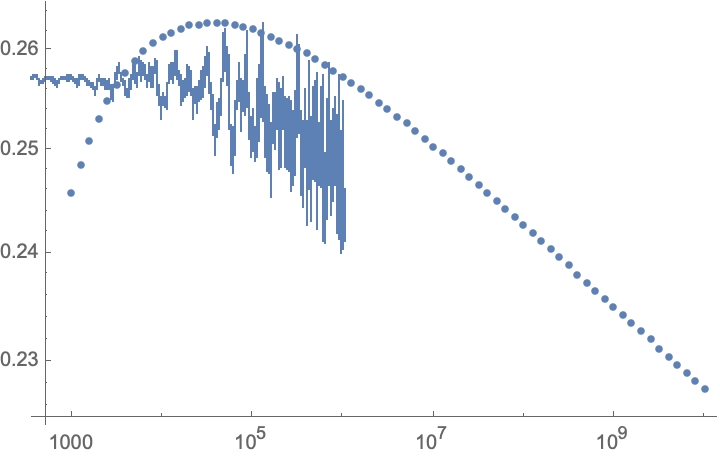
For a 3-prime factor count I cannot get out a closed form expression but an integral that can be evaluated numerically:
\!\(
\*SubsuperscriptBox[\(\[Integral]\), \(2\),
SuperscriptBox[\(M\), \(1/3\)]]\(\(-
\*FractionBox[\(Log[
\*FractionBox[\(Log[p]\), \(Log[
\*FractionBox[\(M\),
SuperscriptBox[\(p\), \(2\)]]]\)]]\), \(p\ Log[
\*FractionBox[\(M\), \(p\)]]\ Log[p]\)]\) \[DifferentialD]p\)\)
and the numerical comparison is given in the following figure:

Easier to read.
\large\int_2^{\sqrt[3]{M}} -\frac{\log \left(\frac{\log (p)}{\log \left(\frac{M}{p^2}\right)}\right)}{p \log (p) \log \left(\frac{M}{p}\right)} \, dp
1 Like
 – you have earned Featured Contributor Badge

Your exceptional post has been selected for our editorial column Staff Picks http://wolfr.am/StaffPicks and Your Profile is now distinguished by a Featured Contributor Badge and is displayed on the Featured Contributor Board. Thank you!
1 Like