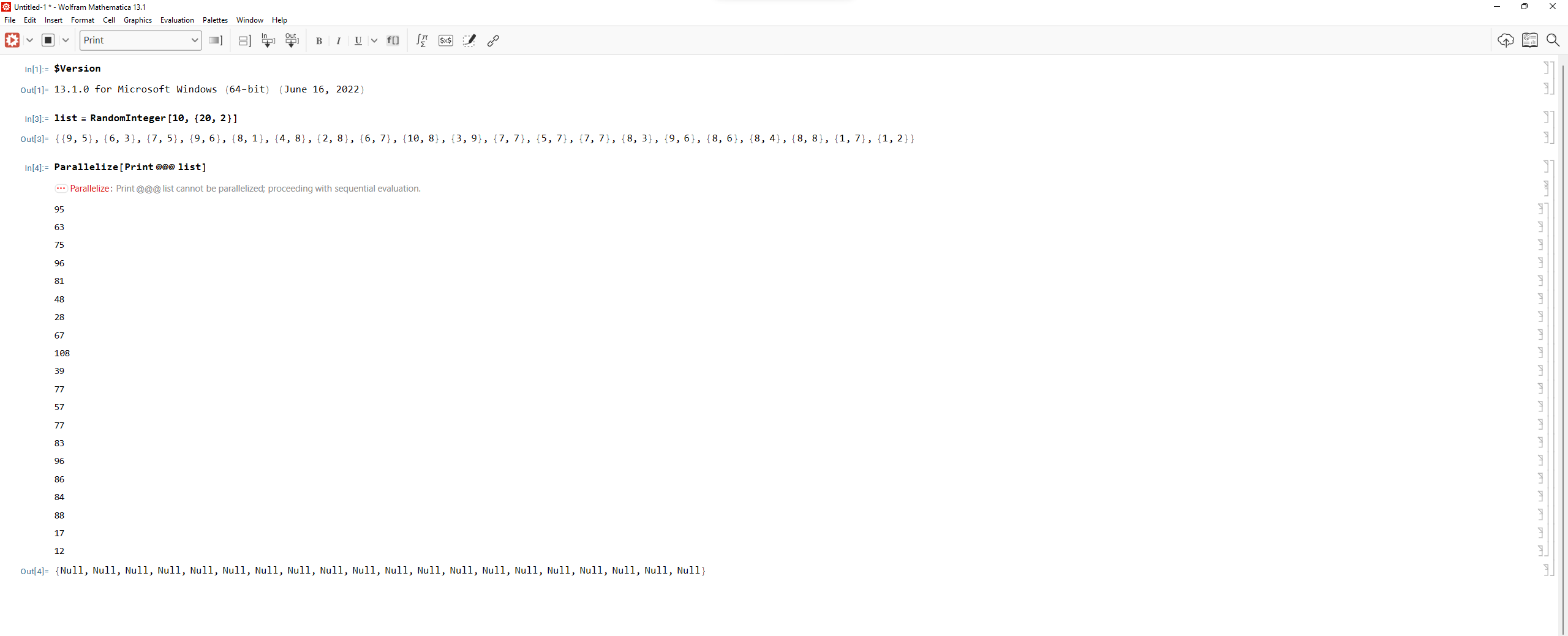
How to evaluate parallelized with @@@?

Hello,
I am curious how to evaluate parallelized with @@@.
For example:

a = RandomInteger[9, {10000000, 3}]
b = ReplaceAll[0 -> 1][a]
c=(Total[{#1 + #2, #2*#3, #3/#1}]) & @@@ b

This is just a case. In many situations, I need to save time when evaluating them with @@@, so I hope to use parallelize with @@@, but I can’t, as I change to

Parallelize[Total[{#1 + #2, #2*#3, #3/#1}] & @@@ b]

The error is:

Perhaps do something like this:

ParallelMap[Apply[Total[{#1 + #2, #2*#3, #3/#1}] &], b]

ParalllMap is terrible. Don’t use it.

b = ReplaceAll[0 -> 1][RandomInteger[9, {100000000, 3}]];
Plus @@ (Total[{#1 + #2, #2*#3, #3/#1}] & @@@ b) // Timing
Plus @@ ParallelMap[Apply[Total[{#1 + #2, #2*#3, #3/#1}] &], 
   b] // Timing

Out are

{346.641, 4047515637259/1260}
{3845.88, 4047515637259/1260}

What version of Mathematica are you using? Parallelize works with @@@ for me.

In[1]:= $Version

Out[1]= "13.0.1 for Mac OS X x86 (64-bit) (January 28, 2022)"

In[2]:= list = RandomInteger[10, {20, 2}];

In[3]:= Parallelize[Print @@@ list];

(kernel 4) 108

(kernel 3) 58

(kernel 2) 59

(kernel 1) 210

(kernel 4) 10

(kernel 3) 31

(kernel 2) 08

(kernel 1) 02

(kernel 4) 86

(kernel 3) 29

(kernel 2) 22

(kernel 1) 27

(kernel 4) 88

(kernel 3) 77

(kernel 2) 11

(kernel 1) 108

(kernel 4) 63

(kernel 3) 82

(kernel 2) 84

(kernel 1) 1010

In1:= $Version

Out[1]= "13.1.0 for Microsoft Windows (64-bit) (June 16, 2022)"
In[3]:= list = RandomInteger[10, {20, 2}]

Out[3]= {{9, 5}, {6, 3}, {7, 5}, {9, 6}, {8, 1}, {4, 8}, {2, 8}, {6, 
  7}, {10, 8}, {3, 9}, {7, 7}, {5, 7}, {7, 7}, {8, 3}, {9, 6}, {8, 
  6}, {8, 4}, {8, 8}, {1, 7}, {1, 2}}

In[4]:= Parallelize[Print @@@ list]

During evaluation of In[4]:= Parallelize::nopar1: Print@@@list cannot be parallelized; proceeding with sequential evaluation.

During evaluation of In[4]:= 95

During evaluation of In[4]:= 63

During evaluation of In[4]:= 75

During evaluation of In[4]:= 96

During evaluation of In[4]:= 81

During evaluation of In[4]:= 48

During evaluation of In[4]:= 28

During evaluation of In[4]:= 67

During evaluation of In[4]:= 108

During evaluation of In[4]:= 39

During evaluation of In[4]:= 77

During evaluation of In[4]:= 57

During evaluation of In[4]:= 77

During evaluation of In[4]:= 83

During evaluation of In[4]:= 96

During evaluation of In[4]:= 86

During evaluation of In[4]:= 84

During evaluation of In[4]:= 88

During evaluation of In[4]:= 17

During evaluation of In[4]:= 12

Out[4]= {Null, Null, Null, Null, Null, Null, Null, Null, Null, Null, \
Null, Null, Null, Null, Null, Null, Null, Null, Null, Null}

Weird, I still can’t.

Yes, I can reproduce the problem in 13.1. I am surprised that it does not work in that version. I would report the problem to Wolfram Support and ask if the change is intentional.

If you have replies from WL, I hope you can send me a copy. I am weird about why using ParallelMap takes even more than ten times time than not using ParalleleMap?

Zhenyu, the term ‘I would’ is an idiomatic (proxy) way of saying ‘you should’. So I think that Szabolcs is suggesting that you should report this problem to Wolfram.

Hello,
May you tell me why I would is an idiomatic way of saying you should and when I would means I would?
Thanks.

Think of it as a way of saying “If I were you I would …”, different from “I will …”.

If you think that is confusing, consider how confusing it is for someone learning 中文 when they come across 加油 or 老马识途 :slight_smile:

Thanks a lot. So, if one says “I would”, one exactly says “If … I would”. Am I right? In Chinese, there are a lot of this implied meaning。