elnik6
January 13, 2021, 1:52pm
1
I am trying to solve the integral resulting from a convolution between a stretched single exponential decay and a gaussian function.
In the simpler case using just a single exponential decay function:
F[t] = exp^(-t/τ)
and a Gaussian function:
R[t] = 1/(σ*Sqrt(2*π)*exp^(-t^2/(2*σ^2))
I obtain the convolution integral:
with Mathematica the solution of this integral is:
which I know is the correct result.
Now, if I try to change a bit the exp function importing the beta parameter and therefore make it a streched exponential,
F[t] = exp^[(-t/τ)^b] , 0<=b<=1
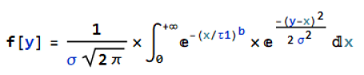
the convolution integral is:
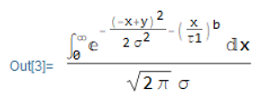
for this integral I do not get a solution
but, the same expression.https://community.wolfram.com//c/portal/getImageAttachment?filename=6643aaaa.PNG&userId=2160886 https://community.wolfram.com//c/portal/getImageAttachment?filename=vvvv.PNG&userId=2160886 https://community.wolfram.com//c/portal/getImageAttachment?filename=9001aaaa.PNG&userId=2160886 https://community.wolfram.com//c/portal/getImageAttachment?filename=2725Capture.PNG&userId=2160886
ahmed
January 13, 2021, 2:22pm
2
Yes, you should always define the range of your parameters.Integrate
Then you add in it the option Assumptions where you will be able to define the range of b and sigma.
elnik6
January 14, 2021, 9:04am
3
Thank you for your answer.
I defined the the range of the stochastic parameters with Assumptions :
0 < σ && 0 <= b <= 1 && 0 < τ
and I use the expression Integrate to solve the integral for: {x, 0, +[Infinity]}
Integrate[
1/(\[Sigma] Sqrt[2 \[Pi]]) E^(-(x^b)/\[Tau]^b) E^(-(y - x)^2/(
2 \[Sigma]^2)), {x, 0, +\[Infinity]},
Assumptions -> 0 < \[Sigma] && 0 <= b <= 1 && 0 < \[Tau]]
but, again it doesn’t give an output solution, but the initial expression.
When Mathematica returns the input as the output, it means that the calculation returned unevaluated. This often means that the function does not have the methods available to solve the problem symbolically, or it is mathematically impossible to obtain a symbolic solution (not all sums, integrals, or differential equations have symbolic solutions after all).