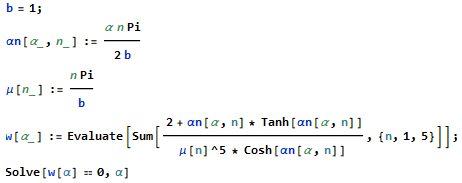
[?] Solve problem with Sum function?

Hi,

I’m trying to find out the value of alpha for which the function w(alpha) is equal to zero. The solve function does not return any value. How can I resolve the issue?

Any assistance will be highly appreciated.
[1]: https://community.wolfram.com//c/portal/getImageAttachment?filename=Alpha.PNG&userId=1772296

In[10]:= Limit[w[[Alpha]], [Alpha] → [Infinity]]

Out[10]= 0

In[11]:= Limit[w[\[Alpha]], \[Alpha] -> -\[Infinity]]

Out[11]= 0

For transcendental equation it is better to give bounds for the variables:

Solve[w[\[Alpha]] == 0 && 0 < \[Alpha] < 100, \[Alpha], Reals]

By the way, the delayed evaluation (:=) cancels out with Evaluate. Immediate evaluation (=) is simpler and (I expect) equivalent.

Hi, thanks for the input.
However, the Solve function still returns empty curly brackets { }. When I plot the value of w[\Alpha] against Alpha, the plot is asymptotic to both the x and y axes.
This is the entire equation for which I’m trying to find the value of Alpha

x varies from -0.5a to 0.5a, while y varies from 0 to b.
Is there an error in my syntax or what alternatives can I use?

You should use the Code Sample icon (first one) when posting code.

Apologies. Here’s the code.

q = 15.904;
v = 0.12157;
E1 = 18904;
b = 1830;
a = 1*b;
h = .04*b;

D1 = (E1 h^3)/(12 (1 - v^2)); 
w[x_, y_] = 
  q/(24*D1)*(y^4 - 2* b * y^3 + b^3 * y) + (2*q)/(D1*b) * 
    Evaluate[
     Sum[( ((n Pi)/b * x  *Sinh[(n Pi)/b * x] - 
         Cosh[(n Pi)/b * 
            x]*(2 + (\[Alpha] n Pi)/(2 b)* 
             Tanh[(\[Alpha] n Pi)/(2 b)]))  Sinh[(n Pi)/b* y])/(((
        n Pi)/b)^5 * Cosh[(\[Alpha] n Pi)/(2 b)]), {n, 1, 5}]];
(*Boundary conditions*)
w[0, 0] == 0;
w[0, b] == 0;
w[-0.5*a, b] == 0;
w[0.5*a, b] == 0;
w[-0.5*a, 0] == 0;
w[0.5*a, 0] == 0;
w[-0.5*a, 0.5*b] == 0;
w[0.5*a, 0.5*b] == 0;

Empty brackets means no solution exists. For example

Solve[x + 1 == x, x]

boundary conditions are for differential equations

Hello Matthew,

for me it is by no means clear what you want to do.
What is the w[alpha] you are talking about? In your last post I see only w[ x, y ].

If the “Boundary Conditions” are the equations you want to be fulfilled with a certain alpha that seems to be impossible.

With (giving your w [ x, y ] from above, but as function)

q = 15.904;
v = 0.12157;
E1 = 18904;
b = 1830;
a = 1*b;
h = .04*b;

D1 = (E1 h^3)/(12 (1 - v^2));
w[x_, y_] := 
  q/(24*D1)*(y^4 - 2*b*y^3 + b^3*y) + (2*q)/(D1*b)*
    Evaluate[
     Sum[(((n Pi)/b*x*Sinh[(n Pi)/b*x] - 
           Cosh[(n Pi)/b*
              x]*(2 + (\[Alpha] n Pi)/(2 b)*
               Tanh[(\[Alpha] n Pi)/(2 b)])) Sinh[(n Pi)/b*
           y])/(((n Pi)/b)^5*Cosh[(\[Alpha] n Pi)/(2 b)]), {n, 1, 
       5}]];

some equations are true for any alpha:

w[0, 0]
w[.5 a, 0]

Out[170]= 0

Out[171]= 0

For dealing with other equations I define a new function

f[x_, y_, a_] := w[x, y] /. \[Alpha] -> a

and find

f[-.5 a, b, 1340]
f[-.5 a, b, 1360]

Out[155]= 1.01387*10^6

Out[156]= -459226.

Here we have different signs, therefore I can do a bisection

eps = 10^-6;
xxx = 10;
a1 = 1340;
a2 = 1360;
While[
 xxx > eps,
 a3 = (a1 + a2)/2;
 If[
  Sign[f[.5 a, b, a3]] == Sign[f[.5 a, b, a2]],
  a2 = a3,
  a1 = a3];
 xxx = Abs[a2 - a1]
 ]
a3 // N
f[.5 a, b, a3]

1353.4

0.0386934

0.0386 is not zero, ok, but decreasing eps should give better values.
So w[ .5 a , .5 b ] == 0 is almost fulfilled.

But w [ -.5 a, .5 b ] is not

f[-.5 a, .5 b, a3]

Out[26]= -9041.8

In fact I doubt that you can achieve all your “Boundary Conditions” with a single alpha

Thank you for the insight. Let me try to rephrase the equation so that a single value of [Alpha] can be achieved