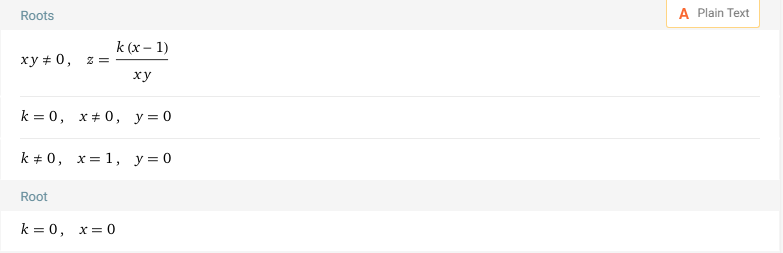
What do these “roots” mean? I’ve seen in step-by-step solutions that the roots are obtained when when the expression equals zero. Is this true for this example as well?
Yes, roots are obtained by setting the expression equal to zero. When you have many variables, there are usually several ways to express all the possible roots. W|A is showing one of them in the first “pod” (four lines; not sure why the 4th line gets an extra “Root” header).
So, are the roots the just values of the variables for which the given expression equals zero?
Yes.
If you are wondering about nomenclature and the definitions of terms, I am loathe to enter into a discussion. Meanings evolve, even in the language of mathematics, which seems likely to be more conservative than natural languages. There is no governing authority in mathematics that dictates terminology. Most people learn it by trying to communicate with others and adjusting their mode of expression when appropriate. This includes reading books and being corrected by your teachers.
“Roots” originally was used in a more restricted sense but has come to mean the solutions to an equation f(x)=0, usually of one variable. In that case, the roots are usually discrete points on a number line, possibly depending on unknown constants. Personally, I wouldn’t use the term “root” to describe the solution set to xyz+(1-x)k=0, which is treated as an equation in four variables by W|A. But there is no doubt that the “roots” shown by W|A constitute the solutions of this equation. That is, when you plug in the values for the variables, the given expression is zero. (Unspecified variables are free to take on any value. For instance, if k and x are zero, then y and z may be any number.)