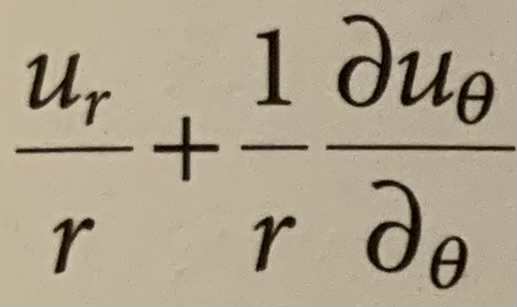
Hello,
I have two PDEs (strainDisp11 & strainDisp22) in 2 variables x1 and x2.
strainDisp11 is a PDE with the partial differential term in x1
whereas, strainDisp22 is a PDE with the partial differential term in x2
I am trying to solve these two PDEs separately using DSolve (Last two command lines in the attached file), however, the solution is not generated along with the required arbitrary functions C11 which should be f1[x2] and C11 which should be f2[x1] in the respective solutions of the PDEs.
Attached is Notebook for your reference. Appreciate your help.
A Tip:
Don’t use Subscript , because causes problems.
Thanks!
Very much appreciated.
Hello,
I have two PDEs in 2 variables ‘r’ and ‘theta’. I am trying to solve these two PDEs separately using DSolve (The last two command lines in the attached file). The solution is generated as expected for the 1st PDE (Integration with respect to variable ‘r’), however, the solution is not generated for the 2nd PDE (Integration with respect to ‘theta’).
I cannot understand why Mathematica does not solve all the terms and has replaced ‘theta’ by K1 in the unsolved integral with limits?
Attached is Notebook for your reference. Appreciate your help.
Maybe:
solDispRR = DSolve[strainDispRR == 0, uR, {r, \[Theta]}] // Flatten;
solDisp\[Theta]\[Theta] =
  DSolve[strainDisp\[Theta]\[Theta] == 0, u\[Theta], {r, \[Theta]}] //
    Flatten;
uRFunctionTemp = uR[r, \[Theta]] /. solDispRR[[1]]
u\[Theta]FunctionTemp = (u\[Theta][r, \[Theta]] /.
      solDisp\[Theta]\[Theta][[1]] /. solDispRR[[1]]) // Activate //
  ExpandAll
Looks like MMA can’t integrate, a workaround:
u\[Theta]FunctionTemp = (Integrate[#, {K[1],
       1, \[Theta]}] & /@ (u\[Theta]FunctionTemp[[1, 1]])) +
  u\[Theta]FunctionTemp[[2]]

 (*Integrate[-C[1][K[1]], {K[1], 1, \[Theta]}] + (2*P*\[Nu]^2*Log[r]*(Sin[1] - Sin[\[Theta]]))/(Pi*\[DoubleStruckCapitalE]) +
  (2*P*\[Nu]*(-Sin[1] + Sin[\[Theta]]))/(Pi*\[DoubleStruckCapitalE]) + (2*P*\[Nu]^2*(-Sin[1] + Sin[\[Theta]]))/(Pi*\[DoubleStruckCapitalE]) +
  (2*P*Log[r]*(-Sin[1] + Sin[\[Theta]]))/(Pi*\[DoubleStruckCapitalE]) + C[1][r]*)
In this line:
Integrate[-C[1][K[1]], {K[1], 1, \[Theta]}]
what answer do you expect?
The

expression is not complicated

So as I want the DSolve (Integration with respect to Theta) to result in three terms as follows;

But, I cannot understand why is MMA causing a definite integral with limits [1 to Theta], besides changing the variable ‘Theta’ to ‘K1’