Group Abstract Group Abstract

Message Boards Message Boards

Evaluation of a predict model for values of outside of used data?

Dear all,

How do I evaluate this model for other values for x. If x=1.2, then what will be the value of y?

y = {0.44, 0.33, 0.3, 0.3, 0.32, 0.34, 0.4, 0.53, 0.68, 0.83};

x = {0.04`, 0.08`, 0.12`, 0.16`, 0.2`, 0.24`, 0.32`, 0.48`, 0.64`, 
   0.8`};

tuples = Thread[Transpose[{x}] -> y];

train = Take[tuples, 7];

test = Take[tuples, -3];

cfunc = Predict[train, Method -> "NeuralNetwork", 
   PerformanceGoal -> "Quality"];

(* y predicted for training data *)

yptrain = Map[cfunc, train[[All, 1]]];

(* y predicted for testing data *)

yptest = Map[cfunc, test[[All, 1]]];

(* y observed for testing data *)
POSTED BY: M.A. Ghorbani
11 Replies
POSTED BY: Henrik Schachner

Hello!

I don't like much black boxes too, but I think the origin of the problem lies in the way training and test sets were built. Defining

train = RandomSample[tuples, 7];
test = Complement[tuples, train];

and plotting the prevision

ListPlot[{Map[Flatten@Apply[List, #] &, train], 
  Map[Flatten@Apply[List, #] &, test], 
  Transpose[{{0.27, 0.9, 1, 1.1, 1.2, 1.3, 1.4, 1.5}, yPredictions}]},
  PlotStyle -> {Black, Green, Red}, 
 PlotLegends -> {"Training data", "Test data", "Predictions"}]

you should obtain something correct.

POSTED BY: Claude Mante
POSTED BY: M.A. Ghorbani
Posted 5 years ago

Hi Mohammad,

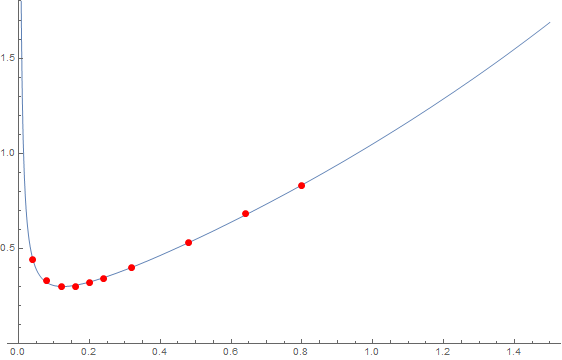
Using a simple neural network will generate a much better fit than Predict with Method -> "NeuralNetwork".

y = {0.44, 0.33, 0.3, 0.3, 0.32, 0.34, 0.4, 0.53, 0.68, 0.83};
x = {0.04, 0.08, 0.12, 0.16, 0.2, 0.24, 0.32, 0.48, 0.64, 0.8};

points = Transpose[{x, y}];
trainingData = Rule @@@ points;

net = NetChain[{32, Tanh, 1}]
trained = NetTrain[net, trainingData]

Show[
 ListPlot[points, PlotLegends -> LineLegend[{"Data"}]],
 Plot[trained[x], {x, 0, .8}, PlotLegends -> LineLegend[{"Trained"}]],
 Plot[trained[x], {x, 0.8, 1.2}, PlotStyle -> Red, PlotLegends -> LineLegend[{"Extrapolated"}]],
 PlotRange -> All]

enter image description here

But, as @Jim Baldwin said "Don't extrapolate with black box functions". If you have a model that you expect the data to follow, try fitting.

POSTED BY: Rohit Namjoshi

Thank you so much, Rohit.

How do I evaluate the error or accuracy of this network for training and test data?

y = {0.44, 0.33, 0.3, 0.3, 0.32, 0.34, 0.4, 0.53, 0.68, 0.83};
x = {0.04, 0.08, 0.12, 0.16, 0.2, 0.24, 0.32, 0.48, 0.64, 0.8};

points = Transpose[{x, y}]

data = Rule @@@ points

train = Take[data, 7]
test = Take[data, -3]

net = NetChain[{32, Tanh, 1}]

trained = NetTrain[net, train]
POSTED BY: M.A. Ghorbani
Posted 5 years ago

With such a small dataset, excluding 30% from training is likely to produce worse results. You can evaluate the deviations at each x value and then compute StandardDeviation or whatever metric you want.

trained = NetTrain[net, trainingData]
deviations = y - trained[x];
StandardDeviation@deviations

To train on a subset

{train, test} = ResourceFunction["TrainTestSplit"][trainingData, "TrainingSetSize" -> Scaled[.7]];
trained = NetTrain[net, train]

Use the test subset to evaluate the quality of the model

measurements = 
 NetMeasurements[trained, test, 
   {"StandardDeviation", "MeanDeviation", "RSquared", "MeanSquare"}]
POSTED BY: Rohit Namjoshi
Posted 5 years ago

A wonderful solution. Thank you, Rohit.

How to get network output (simulated data) in a list for the train and test data?

POSTED BY: Alex Teymouri
Posted 5 years ago

Hi Alex,

Unless you have a much larger dataset I would not split it into train / test. The results are much worse compared to using all of the data, and will be very sensitive to the random selection. I did not call SeedRandom before the random split, so your results will probably be very different.

predictOnTrained = MapAt[trained[#] &, train, {All, 2}]
predictOnTest = MapAt[trained[#] &, test, {All, 2}]

ListPlot[{points, List @@@ predictOnTrained, List @@@ predictOnTest},
 PlotLegends -> {"Data", "Train Predictions", "Test Predictions"},
 PlotStyle -> ColorData[112]]

enter image description here

POSTED BY: Rohit Namjoshi
Posted 5 years ago

I updated my previous response by adding in the prediction for x=0.27. But I get 0.369748. (I'm using Mathematica 12.2.)

POSTED BY: Jim Baldwin
Posted 5 years ago

You might not like the values but to get values just do what you did for predicting the test and training values:

yPredictions = Map[cfunc, {{0.27}, {0.9}, {1}, {1.1}, {1.2}, {1.3}, {1.4}, {1.5}}]
ListPlot[{Transpose[{x[[1 ;; 7]], y[[1 ;; 7]]}], 
  Transpose[{x[[8 ;; 10]], y[[8 ;; 10]]}], 
  Transpose[{{0.27, 0.9, 1, 1.1, 1.2, 1.3, 1.4, 1.5}, yPredictions}]},
  PlotStyle -> {Black, Green, Red}, PlotLegends -> {"Training data", "Test data", "Predictions"}]

Test data, training data, and predictions

This is non-Mathematica advice: Don't extrapolate with black box functions.

POSTED BY: Jim Baldwin

Jim, Thank you for your help and advice,

For x=0.27 the below solution is correct?

 y = Map[cfunc, {{0.27}}]

  {0.362546}
POSTED BY: M.A. Ghorbani
Reply to this discussion
Community posts can be styled and formatted using the Markdown syntax.
Reply Preview
Attachments
Remove
or Discard