Paul,
Yes, I guess there is a way, but my approach is empirical - but mathematically non-rigorous.
You can construct a matrix mat
ker = {1, 0, 0, 0, 0, 0, 1, -1};
init = {3, 4, 5, 8, 11, 12, 13, 19};
mat = DiagonalMatrix[{1, 1, 1, 1, 1, 1, 1}, 1];
mat[[8]] = Reverse@ker;
mat // MatrixForm
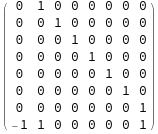
which propagates your series for one term:
mat.init
(*  Out:  {4,5,8,11,12,13,19,20}  *)
Consequently the power of this matrix propagates for e.g. 10 terms:
mp = MatrixPower[mat, 10];
mp . init
(*  Out:  {24,27,28,29,35,36,37,40}  *)
The last line of this matrix gives the respective next term, and depending on the power this line shows a certain pattern:
Last /@ Table[MatrixPower[mat, n], {n, 1, 24}] // TableForm
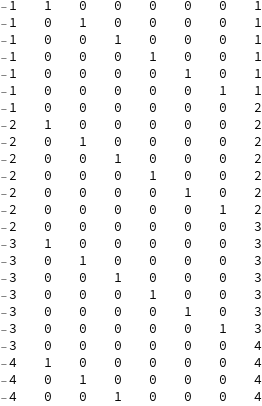
From this it is easy to deduce a simple function to check if a number is an element of the series:
seriesMemberQ[z_] := MemberQ[(z - #)/16 & /@ Rest@init, _Integer]
So, lets check numbers in the neighbourhood of your number in question:
{#, seriesMemberQ[#]} & /@ Range[132858836366990, 132858836366999] // TableForm
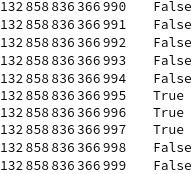
The immediate answer is: No, your number 132858836366993 is not element of the series, sorry!



