The Core Idea: Physics as Discretization Error In continuous calculus, Green's Theorem ( $\int_R dA = \oint_{\partial R} ds$) is exact. However, when applied to a discrete lattice with resolution limits, this equality fails. There is a "residue" or "defect" left over because the discrete boundary cannot perfectly capture the bulk interactions.
I have been working on a model suggesting Physical Law is this residue.
Specifically, I observe the discrete Green's Theorem on a recursive lattice (a Pentatope characteristic network). When this lattice attempts to fold from Dimension 4 (Bulk) to Dimension 3, the "counting error" forces specific constants to emerge.
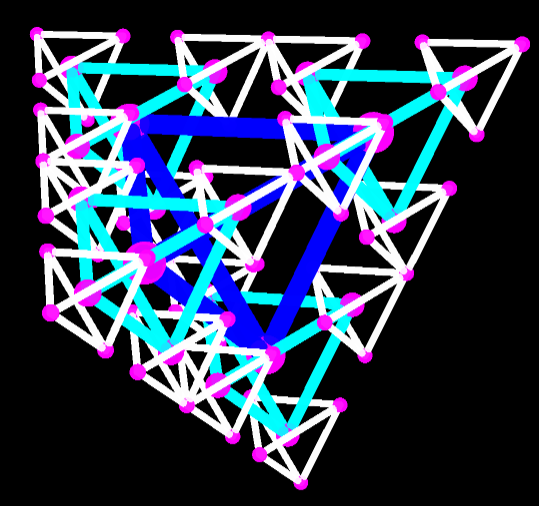
The Results (Zero Import) Remarkably, this geometric residue yields values that match fundamental constants to high precision, without manual tuning:
- Fine Structure Constant ( $\alpha$): Matches to within $0.00002\%$ (0.014$\sigma$) (derived from the impedance mismatch of the fold).
- Nuclear Stability: The geometric residues scale to predict the Binding Energies of the Periodic Table (e.g., He-4, O-16, U-235) purely from the entropy of the lattice edges.
- Cosmic Structure: The ratio of Dark Matter to Baryonic Matter matches Planck 2018 data with 0.01% precision.
- Dark Energy: Matches the vacuum tension of the bulk with 0.002% deviation.
Why I am posting here I come from a CFD/Aerospace background (Ph.D.), where we constantly deal with discretization errors. This "rabbit hole" is the direct result of chasing the residual while developing a CFD method free of approximations for many years. I have been trying to "break" this model, but the geometric coherence holds up across scales (from Quantum to Cosmic). And, I believe this community and Wolfram's theory is remarkably closely aligned.
Reproducibility I have attached the full Wolfram Notebook below. It performs the exact calculations from first principles (zero imports, self-contained derivation). The full theory is available on Zenodo https://doi.org/10.5281/zenodo.17957211.
I would appreciate your thoughts: Does this specific "Green's Theorem Residue" map to any topological defects you see in hypergraph rewriting?
Charles Cook, Ph.D.