Introduction
What is a fun, exciting, and engaging way to study the periodic table? One possible answer is Eka-Periodica: A Chemical Elements Game. Eka-Periodica is a board game designed to support both students and instructors in learning and teaching the periodic table through interactive, strategic, and enjoyable gameplay. Instead of memorizing symbols and properties passively, players actively engage with chemical elements, reinforcing their understanding through play.
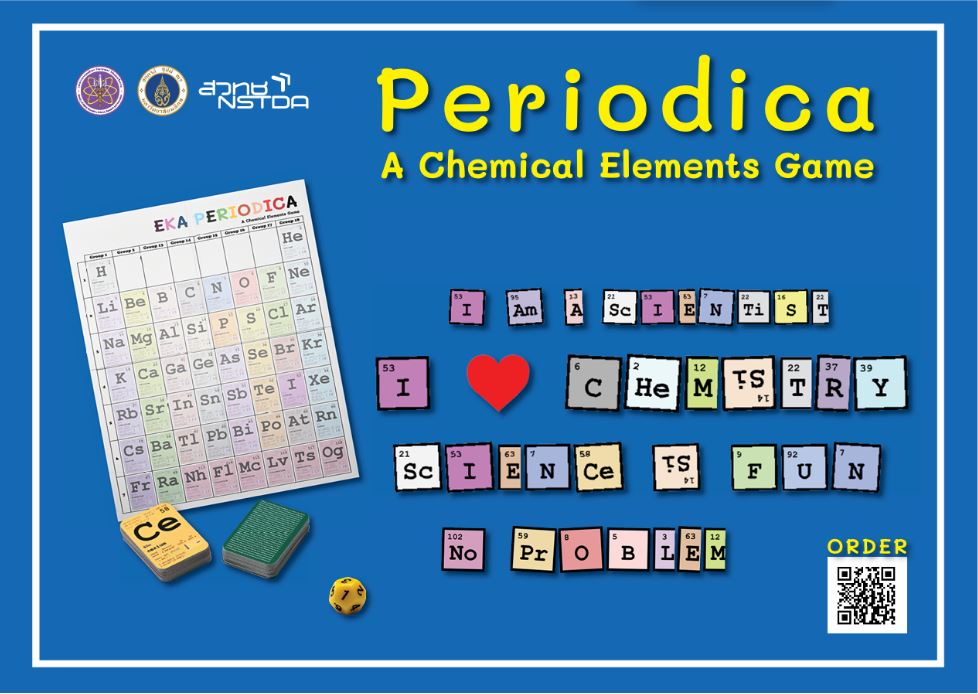
This notebook presents a simulation of the Eka-Periodica game, serving two main purposes. First, it provides an alternative and intuitive explanation of the game rules, especially for new players who may find written rulebooks difficult to visualize. By walking through the game step by step, from the initial setup, player actions, and special card mechanics to the end-game conditions, the notebook allows readers to clearly understand how the game progresses in practice.
Second, the simulation demonstrates how the game mechanics relate to learning outcomes. By modeling player decisions and card interactions programmatically, this notebook highlights how Eka-Periodica encourages logical thinking, pattern recognition, and familiarity with the periodic table in a dynamic environment.
Rules
General Concept
- Setup: Each player is randomly dealt the same number of cards. The deck consists mainly of Element cards, with a small number of Special cards (Periodic Table) included to ensure even distribution.
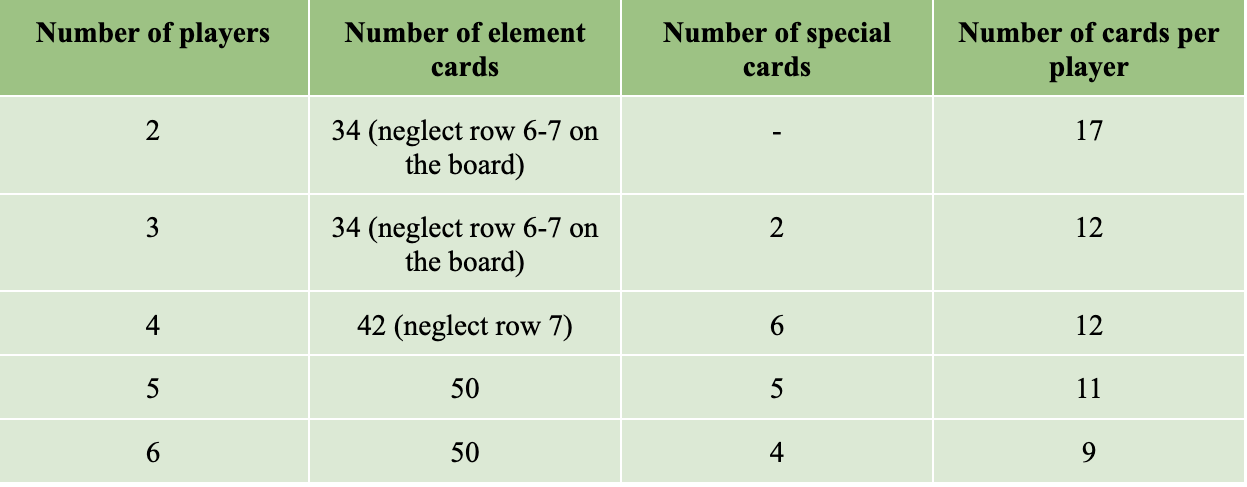
- Playing Cards: Players take turns placing card(s) onto the board. During a single turn, a player may place multiple cards if they are adjacent elements from the same group. Special cards may be used as substitutes for any Element cards that have already been placed on the board.
- Card Transfer: After completing their turn—including passing if no available cards can be placed or if the player chooses not to place a card—the active player rolls a die. Based on the result, the active player must take up to one card from the next player and add it to their hand.
If the active player has no cards remaining in their hand, they immediately win, and are removed from the game, and do not need to roll the die.
Similarly, if the next player’s last remaining card is taken as a result of a die roll, that player also wins and is removed from the game.
4 . Winning the Game: A player wins when they have no cards remaining in their hand. The game continues until only one player still holds cards. That player loses the game.
Specific operations
0 . Current Position: The most recently placed card on the board defines the current position. All placement rules are determined by this position. The current position must be clearly marked using a rubber band or another suitable marker.
1 . First Turn: The player who holds the Hydrogen (H) card takes the first turn. On this turn, only the H card may be played.
2 . Card Placement (After the First Turn): Players take turns in clockwise order; the next player is the player to the left of the current player. On their turn, a player may choose one of the following actions:
Current Group Placement: Place one or more adjacent Element cards from the same group as the current position, arranged from top to bottom, extending only into periods below the current position.
OR
Other Group Placement: Place one or more adjacent Element cards from the same group, arranged from top to bottom, in any group to the right of the current group.
Exception: If the current group is the rightmost unfilled group (initially Group 18 and shifting left as groups become filled), the player may instead place one or more adjacent cards from the same group in any unfilled group to the left.
3 . Special Cards: A Special card may represent any Element card that has already been placed on the board.
A Special card may be placed starting from the current position. Therefore, possessing a Special card guarantees that the player can place at least one card—namely, the Special card at the current position.
Special cards may be used alone or in combination with other cards, in any order, during the same turn.
Simulation
The user can try to play the game from this simulation and understand the rules of the game. This simulation comes from pages 24-28 in the game manual.
The simulation provides a “Next Turn” button for each player to end their turn and move to the next player. It also functions as a checkpoint button for the game to be saved. The “Undo” button is for allow user to go backward to the previous turn. The “Redo” button will lead the user to the next turn. It will be activated once the user clicks on the “Undo” button. The “Random Play” button will let the computer randomly play with the user. The button will be deactivated once there is no next move in the current turn.
Below, the GIF simulates the game of four players. Every player received 12 cards at the beginning. 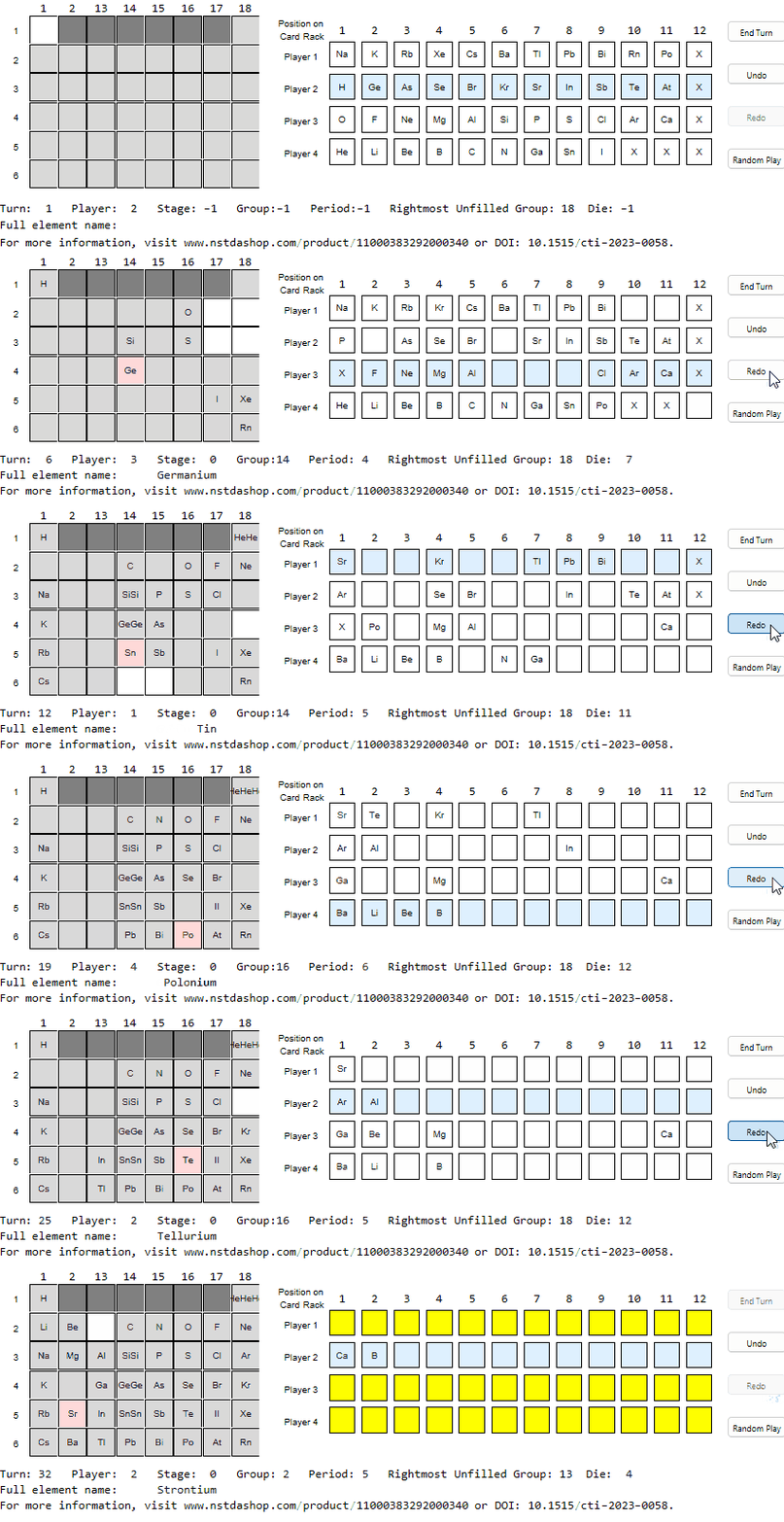
Sequences in the GIF
- Each player received 12 cards
- Player 2, who has the “H” card, is the first one to play. Player 2 placed the “H” card onto the periodic table. Then, receive the “Si” card from Player 3 by toasting the dice.
- Player 3 placed the “O” card and the “S” card, respectively. Then, Player 3 received the “X” card from Player 4.
- Player 4 placed the “I” card and received the “Po” card from Player 1
- Player 1 placed the “Xe” and “Rn” cards and received the “Kr” card from Player 2.
- Player 2 placed the “Si” and “Ge” cards and received the “P” card from Player 3.
- Player 3 placed the “F” and “Cl” cards and did not receive any cards from Player 4 because there was no card in that position.
- Player 4 placed the “He” card and received the “Ba” card from Player 1.
- Player 1 placed the “Na”, “K”, “Rb”, and “Cs” cards and received the “Sr” card from Player 2.
- Player 2 placed the “P”, “As”, and “Sb” cards and received the “Ar” card from Player 3.
- Player 3 placed the “X” (as “He”) and “Ne” cards and received the “Po” card from Player 4.
- Player 4 placed the “C”, “X”(as “Si”), “X” (as “Ge”), and “Sn” cards and did not receive any cards from Player 1.
- Player 1 placed the “X” (as “Sn”) and “Pb” cards and received the “Te” card from Player 2.
- Player 2 placed the “Br”, “X” (as “I”), and “At” cards and did not receive any cards from Player 3.
- Player 3 placed the “X” (as “He”) card and received the “Ga” card from Player 4.
- Player 4 placed the “N” card and did not receive any cards from Player 1.
- Player 1 placed the “Bi” card and did not receive any cards from Player 2.
- Player 2 placed the “Se” card and received the “Al” card from Player 3.
- Player 3 placed the “Po” card and did not receive any cards from Player 4.
- Player 4 did not have an available card and received the “Tl” card from Player 1.
- Player 1 placed the “Kr” card and did not receive any cards from Player 2.
- Player 2 placed the “In” card and did not receive any cards from Player 3.
- Player 3 did not have an available card and received the “Be” card from Player 4.
- Player 4 placed the “Tl” card and did not receive any cards from Player 1.
- Player 1 placed the “Te” card and did not receive any cards from Player 2.
- Player 2 placed the “Ar” card and received the “Ca” card from Player 3.
- Player 3 placed the “Be” and “Mg” cards and did not receive any cards from Player 4.
- Player 4 placed the “Ba” card and did not receive any cards from Player 1.
- Player 1 did not have an available card and did not receive any cards from Player 2.
- Player 2 placed the “Al” card and did not receive any cards from Player 3.
- Player 3 placed the “Ga” card and became the first winner.
- Player 4 placed the “Li” card and did not receive any cards from Player 1.
- Player 1 placed the “Sr” card and became the second winner.
- Player 2 did not have an available card and received the “B” card from Player 4. Then, Player 4 had an empty hand and became the third winner.
Product
Check-in Periodica: A Chemical Elements Game at NSTDA shop www.nstdashop.com/product/11000383292000340
CITE THIS NOTEBOOK
Eka Periodica game simulation
by Sittha Phloi-Montri and Taweetham Limpanuparb
Wolfram Community, STAFF PICKS, January 17, 2026
 Attachments: