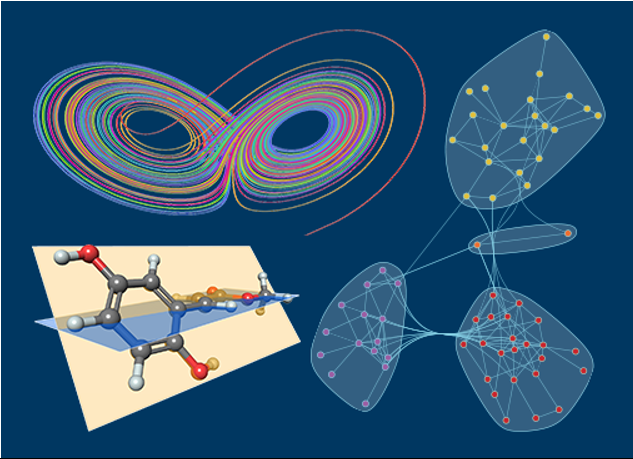
We are excited to launch our new webinar series: Using Computation in Your Research and Teaching!
For 70 years we've had programming languages---which are all based on telling computers, in their terms, what to do. Now we have something much bigger and broader: computational language. Wolfram Language, the ultimate computational language, lets us to create a "computational X" for all imaginable fields X.
This webinar series is inspired by this concept, that we can take any field and operationalize it in computational terms! We want to show you, whether you are a researcher, professional, or student, how you can inject modern computation into your field, and equip yourself with the computational superpowers that Wolfram Language provides.
Each session will be 1 hour, and will interactively guide you through thought-provoking explorations designed for a wide range of technical abilities.
The series begins on Thursday 12th March 2026, so be sure to sign up to a session (or a few) quickly!
Thursday, March 12, 2026 11am-12pm CT (4--5pm GMT) - Computational Physics and Astrophysics with Wolfram Language
Thursday, March 19, 2026 11am-12pm CT (4--5pm GMT) - Engineering Computation with Wolfram Language
Thursday, March 26, 2026 11am-12pm CT (4--5pm GMT) - Computational Social Science with Wolfram Language
Tuesday, April 7, 2026 11am-12pm CT (5--6pm BST) - Computational Economics with Wolfram Language
Tuesday, April 14, 2026 11am-12pm CT (5--6pm BST) - Mathematics Computation with Wolfram Language
Tuesday, April 21, 2026 11am-12pm CT (5--6pm BST) - Computational Chemistry and Bioscience with Wolfram Language
Why join?
Ask questions directly to the Wolfram developers who make use of this powerful computation every day
Gain hands-on experience in applying computation to your field
Receive a recording directly to your inbox even if you can't attend live
Check out the series and sign up for individual sessions here. All sessions will start at 11AM Central Time.
We hope to see you there. In the meantime, check out Stephen Wolfram's blog post and TED Talk which explores this concept of 'Computational X'.




