This is a great explanation - thanks for sharing!
In a wonderful book about integrals (Inside Interesting Integrals) the preface (!) mentions an integral sequence of a different kind, showing the same surprising effect - but without any explanation given! The more grateful I am for the enlightenment given by that nice post. Using this I am trying an explanation for a similar type of integral as in the book:

The Fourier transform of the left term gives a box-function with width 5 and height 1/5:
FourierTransform[Sin[5 Pi x]/(5 Pi x), x, \[Kappa], FourierParameters -> {0, -2 Pi}] // Simplify
(*  Out:  1/10 (Sign[5/2-\[Kappa]]+Sign[5/2+\[Kappa]])   *)
and the Fourier transform of the product terms gives two Delta functions, shifted by
$\pm1/n$
FourierTransform[Cos[2 Pi x/n], x, \[Kappa], FourierParameters -> {0, -2 Pi}]
(*   Out:  1/2 DiracDelta[1/n-\[Kappa]]+1/2 DiracDelta[1/n+\[Kappa]]    *)
For the sequence of integrals we find:
exprs = Table[{"N=" ~~ ToString[nn] ~~ ":",
    Inactivate[Integrate[Sin[5 Pi x]/(5 Pi x) Product[Cos[2 Pi x/n], {n, 1, nn}], {x, -Infinity, Infinity}], Integrate]}, {nn, 0, 7}];
result = {#1, TraditionalForm[#2], "=", Activate[#2]} & @@@ exprs;
Style[TableForm[result], 18]
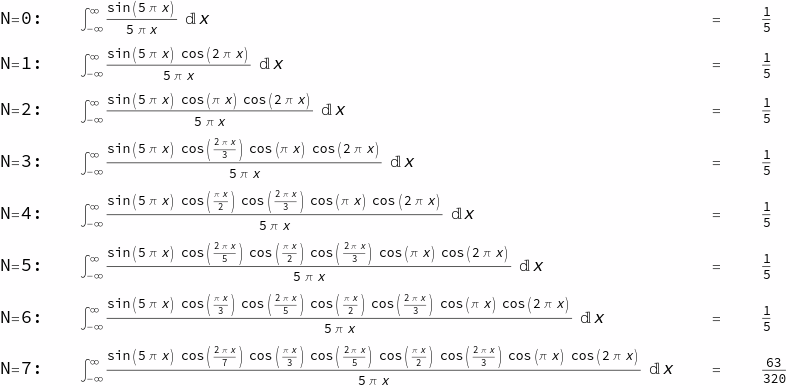
Having the great Fourier explanation from the OP in mind, this is now easy to understand: A convolution of box function (or any other function) with a shifted Delta function just gives the original box function - but shifted! All shifts look like this:
mkShift[c_List, i_] := Flatten[{# - 1/i, # + 1/i} & /@ c]
shifts = FoldList[mkShift, {0}, Range[7]];
TableForm[NumberLinePlot[#, PlotRange -> {-3, 3}, GridLines -> {{2.5}, None}, ImageSize -> 400] & /@ shifts]
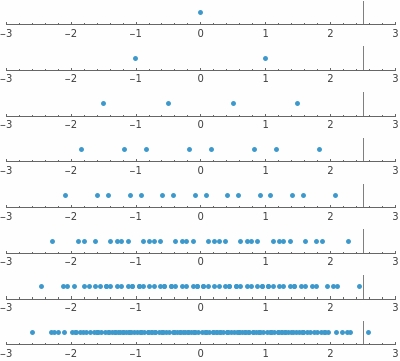
From all box functions generated by the nested convolutions after N steps the most shifted ones are shifted by the amount of
$H_N$ (because we have
$\delta(\kappa-1/n)$ - and therefore a single shift is 1/n).
And when not all boxes overlap any longer with the center, the "irregularity" occurs - here after step N=6:

So, if one wants an integral sequence where the "irregularity" happens exactly when N=100, one has to choose a box width of something between:
2 HarmonicNumber /@ {99., 100.}
(*  Out:   {10.354755,10.374755}  *)
that means using e.g.
$\frac{\sin(10.36\pi x)}{10.36\pi x}$ will do it.