There is this basic similarity test $Tr(A^k) = Tr(B^k)$ for $k=1..d$ for symmetric matrices allowing to conclude existence of orthogonal $O$ such that $AO = OB$.
Practical question is how (if possible?) to generalize it (finally to tensors, but at least) to non-symmetric matrices e.g. including transpositions?
Checking Jacobian criterion for $Tr(A^k (A^T)^j) = Tr(B^k (B^T)^j)$ for $k=1..d, j=0..k-1$ at least for up to d=5 has sufficient number of independent invariants ( $d(d+1)/2$) - is it sufficient condition in general dimension? If not, how to extend it?
Used Mathematica code using Jacobian criterion to find the number of independent invariants, assuming upper-diagonal as in Schur decomposition, getting $d(d+1)/2$ as required up to $d=5$:
d = 5; M = Table[If[i > j, 0, Subscript[a, Row[{i, j}]]], {i, d}, {j, d}];
inv = Table[Tr[MatrixPower[M, k].MatrixPower[Transpose[M], l]] , {k, d}, {l, 0, k - 1}];
MatrixRank[jac = Table[D[Catenate[inv], v], {v, Variables[inv]}]]
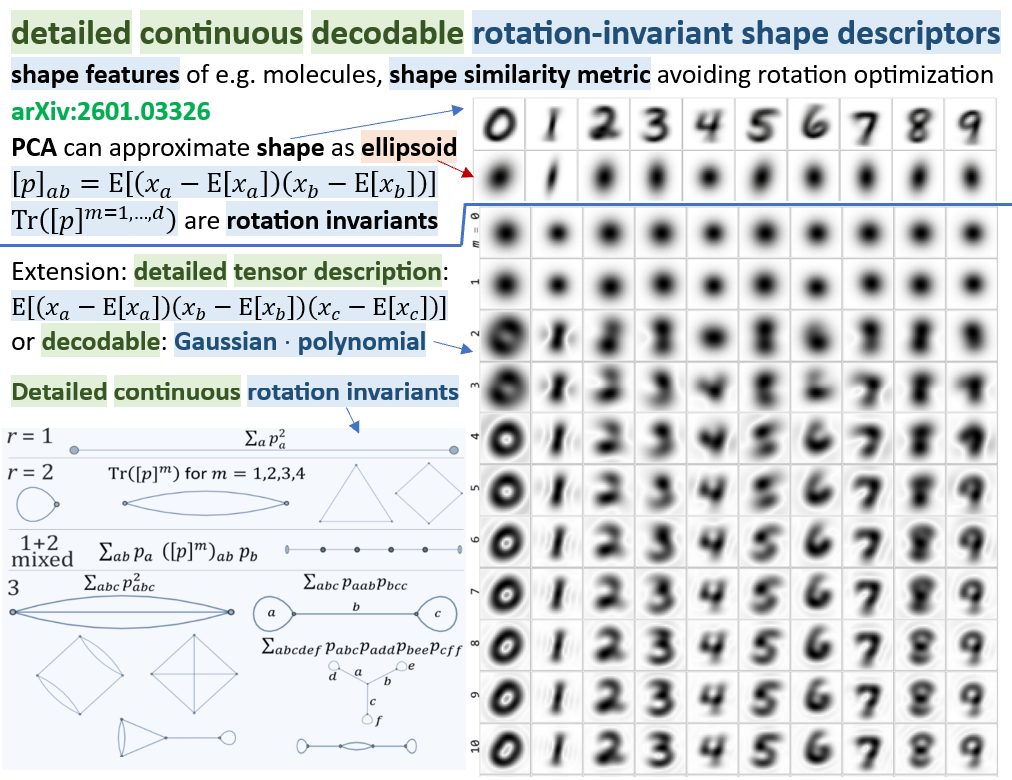
Motivations ( https://arxiv.org/pdf/2601.03326 ), especially if reaching also for tensors, is complete shape description up to rotation e.g. for chemoinformatics, medical imaging: