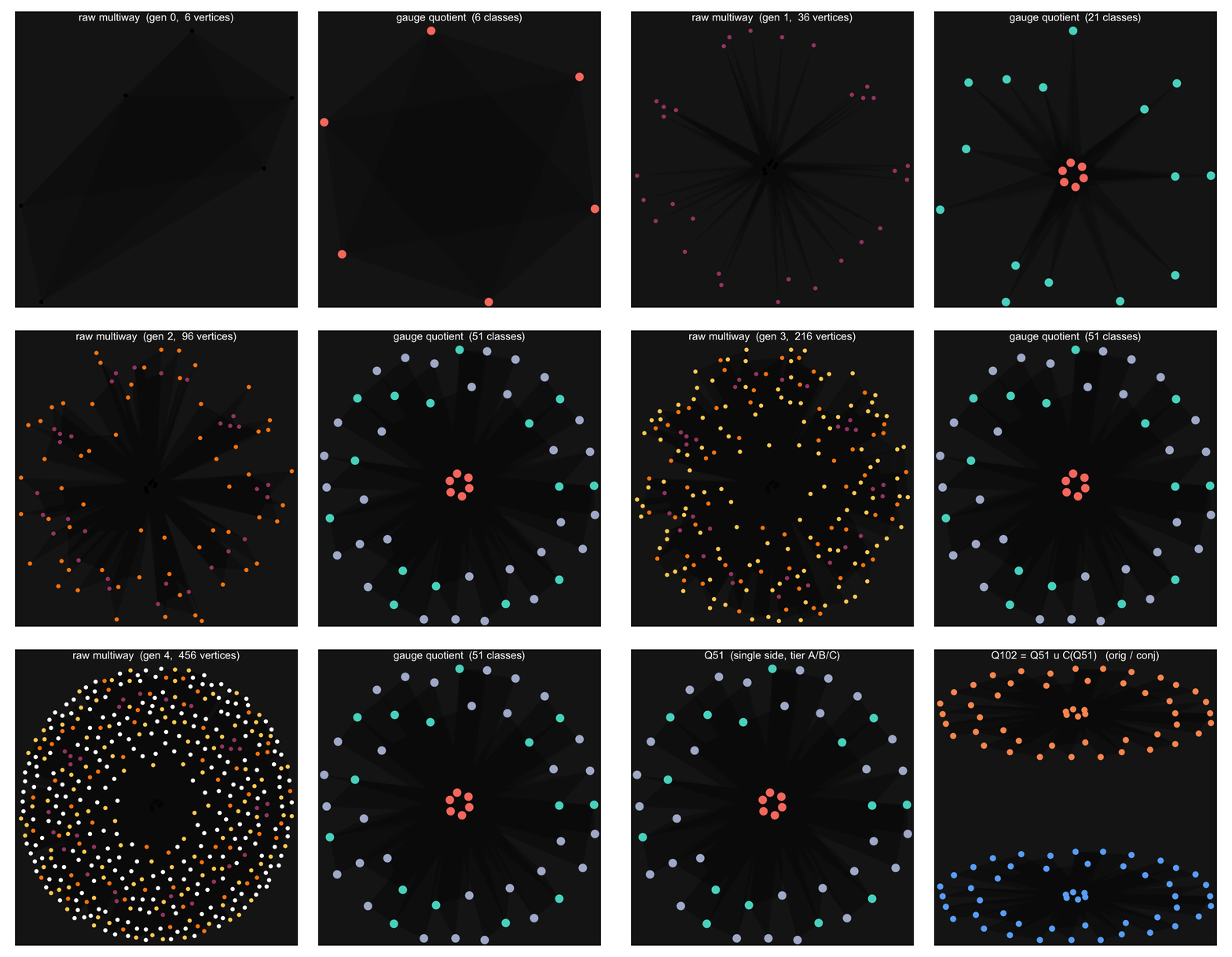
Start with a bare hypergraph rewriting system in the spirit of the Wolfram Physics Project: featureless atoms, ternary edges, one local rewrite. Now add a single demand: that the system be closed to efficient causation in Robert Rosen's sense, so every producer in the system is itself produced by the system. That one demand is not free. It forces a chain of structure, and what grows out of it is the object in the animation above: a 6-vertex seed that grows, collapses to a 51-class gauge quotient, and doubles under charge conjugation to a 102-vertex object that carries the sign data of a real spectral triple of KO-dimension 6.
Everything here is exact - Gaussian integers, no floating point, no random seed - so the headline count is reproducibly 102. The full notebook is attached.
What is Rosen closure?
Robert Rosen was a theoretical biologist who asked what minimally separates an organism from a machine. His answer: a machine is built and maintained from the outside (its blueprint, its factory, its repairman are all external) whereas a living system is closed to efficient causation. "Efficient cause," in Aristotle's sense, is the thing that brings something about; closure means every process that produces or maintains a part of the system is itself produced by some part of the system. The system makes its own makers, and nothing in its organization is entailed from outside. Rosen formalized this as an (M,R) system (a metabolism together with repair-and-replication maps that the system must generate itself) and the consequence that matters here is that closure forces a self-referential fixed point: the system has to be able to produce its own production rules. That self-reference is the entire engine. A Wolfram model's rewrite rule is imposed from outside; demanding closure instead turns the rule into something the decorated hypergraph must reproduce internally and that single requirement (next section) is what forces three functional roles, ternary edges, and a continuous ℂ³ colour, with essentially no freedom left.
This is deliberately not a stock WolframModel, and that distinction is the whole point. So, let me start there.
Why it isn't a stock Wolfram model
A WolframModel rewrites bare hypergraphs: atoms are featureless, and rules are pure connectivity patterns. The moment you impose Rosen closure, the bare atoms are obstructed out of every featureless option and forced to carry a continuous colour. The forcing chain (each link the unique survivor of an obstruction):
- closure needs exactly three functional roles → edges are ternary (arity 3);
- no discrete labelling can satisfy closure → every finite decoration is exhaustively obstructed (all 256 binary rules fail; ℤ₂, ℤ₃, …, ℤ₈ all fail);
- the only continuous composition that closes is a cross product on a 3-vector (Hurwitz);
- and the field must be ℂ, not ℝ → the self-referential edge needs an isotropic unit vector (
v·v = 0), which ℝ³ has none of and ℂ³ does, e.g. (1, i, 0)/√2.
So the colour isn't an attribute bolted onto a Wolfram model, it's what closure does to one. Each vertex carries a colour ψ ∈ ℂ³, and the composition rule is forced to be:
compose[a_, b_] := Conjugate[Cross[a, b]] (* conj(a × b), exact, unnormalised *)
(the conjugation is what keeps it SU(3)-equivariant). The gauge quotient identifies vertices whose colour vectors are linearly dependent over ℂ exactly, with no threshold:
rayEquivQ[a_, b_] := AllTrue[Cross[a, b], # == 0 &] (* a ~ b ⇔ a × b = 0 *)
Putting a colour on the atoms makes this a decorated (attributed) hypergraph rewriting system (close in spirit to @Ray Aschheim's color spin networks, but here the colour, the dimension 3, the cross product, and the conjugation are all forced, not posited).
Exactness matters: 98 vs 102
Because the quotient is by exact ray-equivalence over ℤ[i], the construction is fully deterministic and reproducible. This is not a cosmetic choice: a Float64 fidelity-threshold version of the same construction merges four genuinely-distinct rays and reports 98 instead of 102. Exact Gaussian-integer arithmetic gives 102 every time. (For the related question of detecting equivalence on hypergraphs approximately, cf. @Regen Petu-Stiles's work on approximate isomorphism. The contrast between exact and thresholded equivalence is exactly where the 98-vs-102 discrepancy lives).
Six canonical Gaussian-integer rays seed the system, on the complete ternary topology K₆³ (all 120 ordered triples of distinct vertices):
icsBase = {{2+I, 1, 3-I}, {1, 2+I, 1-2 I}, {1-I, 3, 2+I},
           {3, 1-I, 1+2 I}, {1+2 I, 2-I, 1}, {2, 1+I, 3}};
Growth to Q102
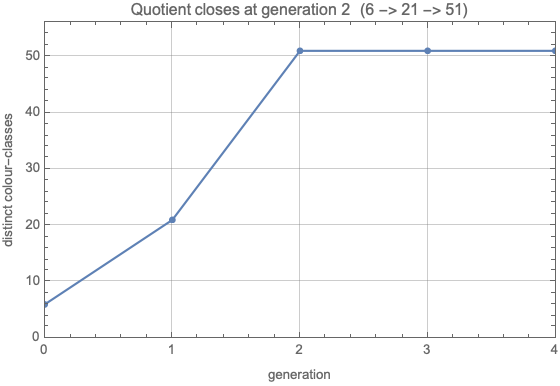
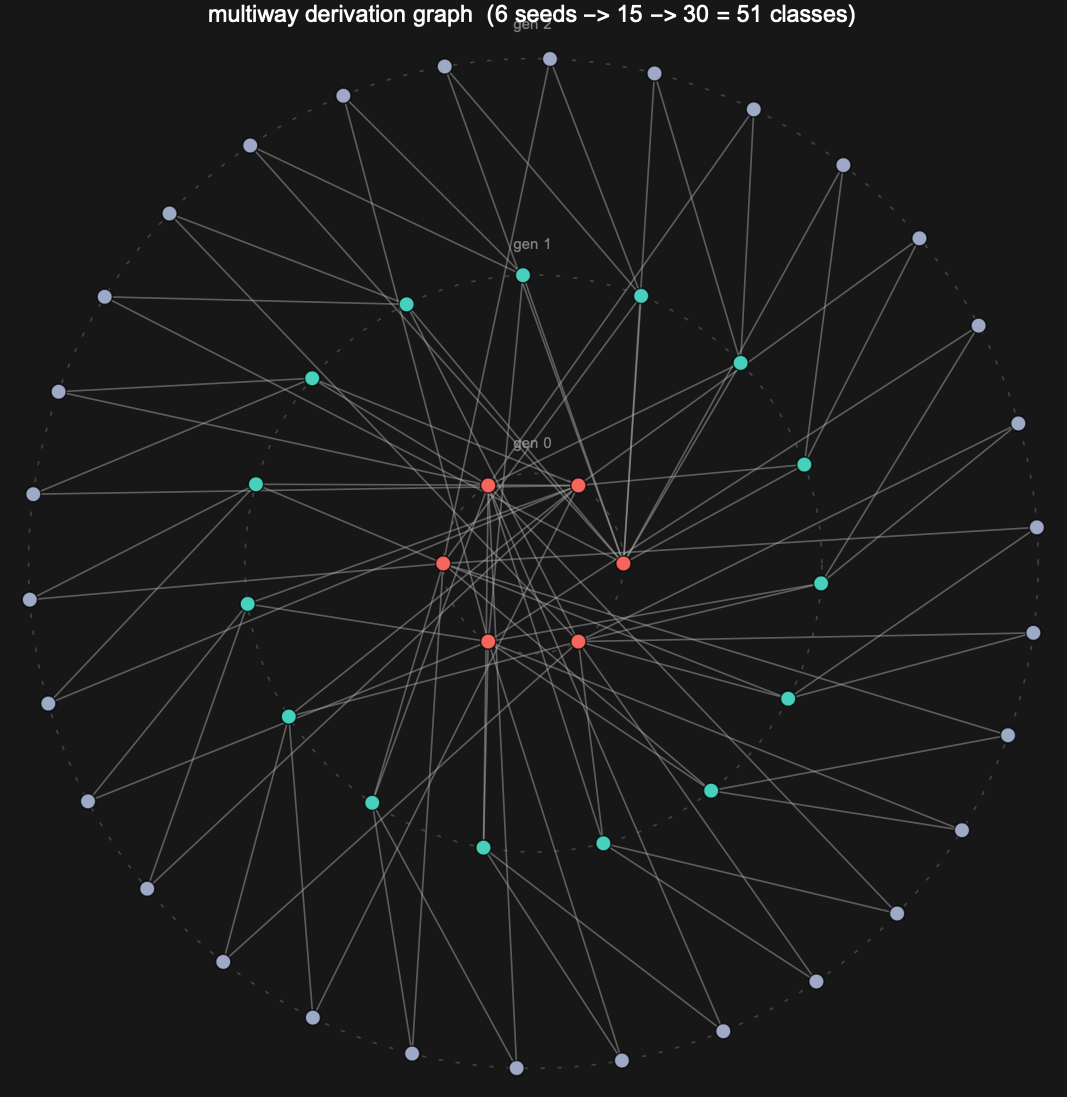
The multiway grows; the colour quotient closes almost immediately. Distinct colour-classes per generation: 6 → 21 → 51 → 51 → 51 — a fixed point at generation 2.
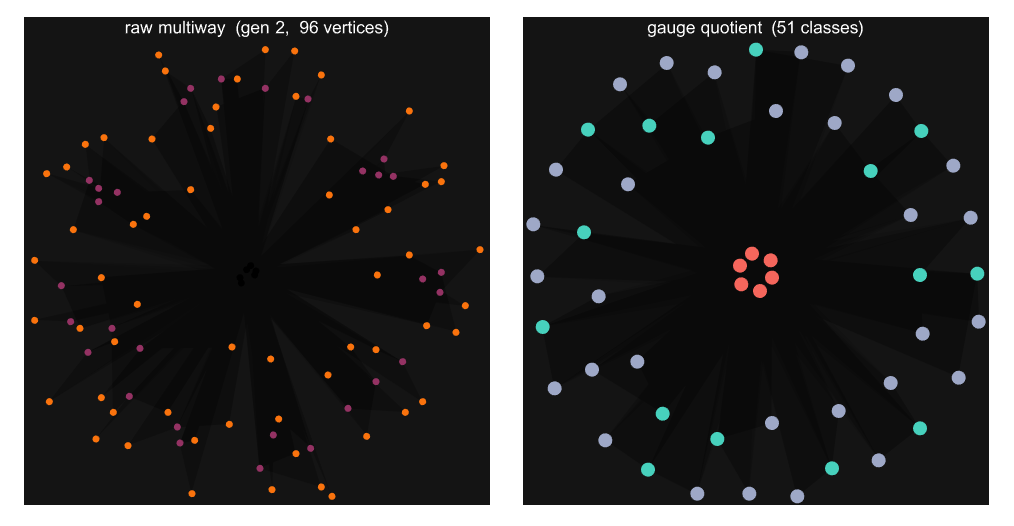
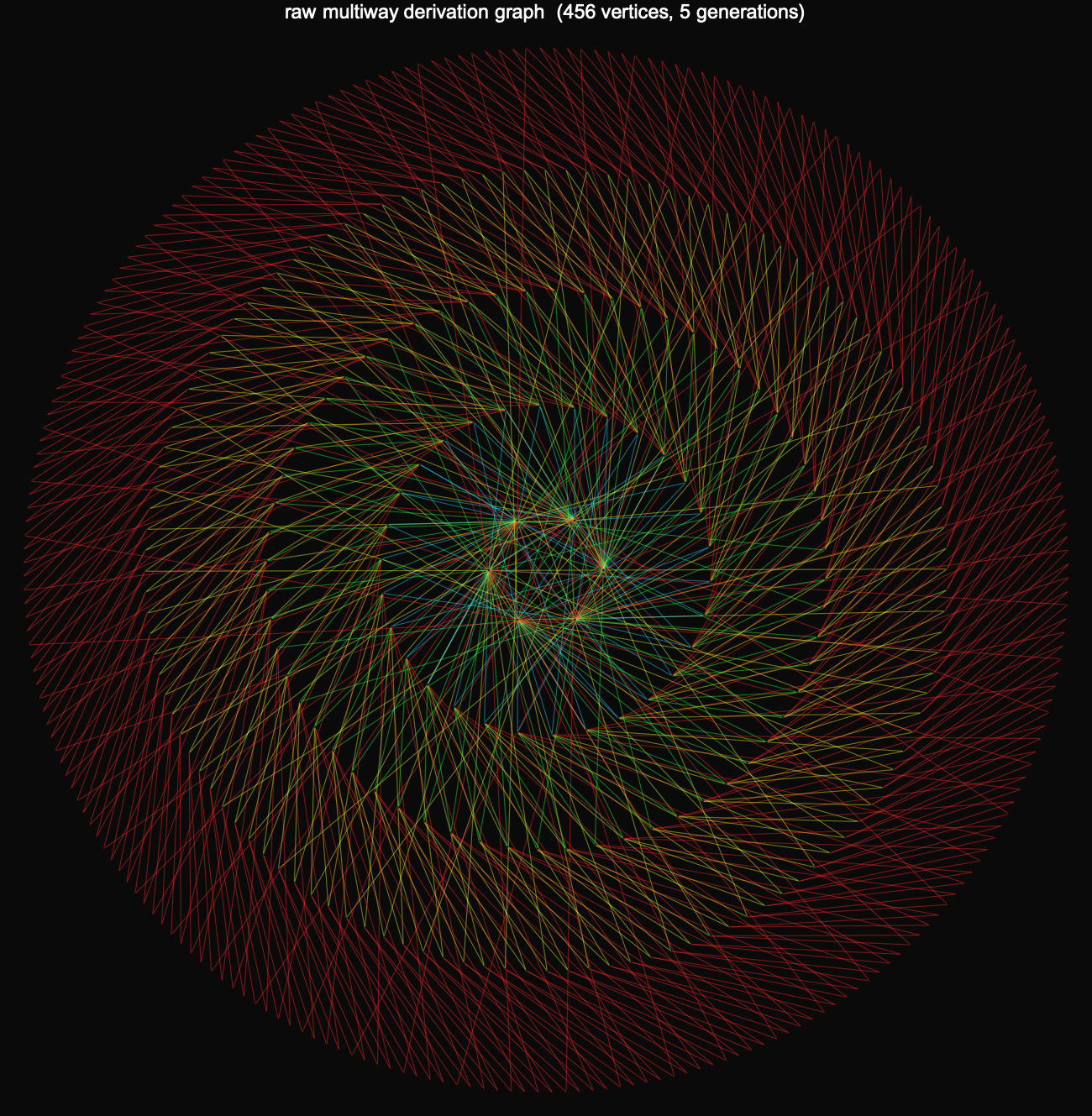
Side by side: the raw multiway (left, coloured by generation) explodes to 456 vertices, while its exact gauge quotient (right, tier A/B/C) closes at 51.
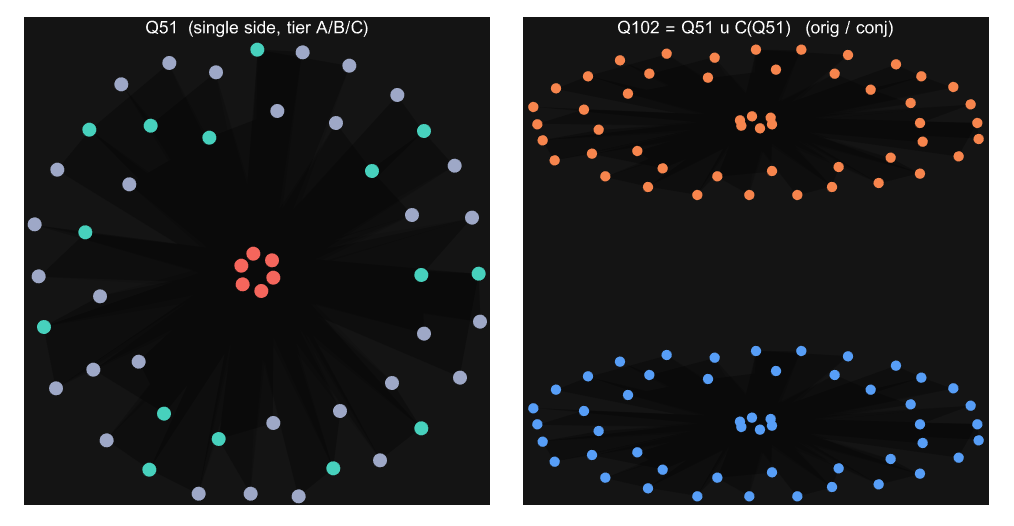
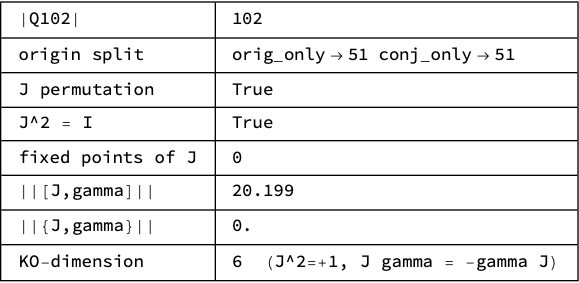
The charge-conjugation closure then doubles it. Growing the conjugate multiway from the conjugated initial colours and re-quotienting together gives Q102 = Q51 ∪ C(Q51) = 102 vertices = 51 orig + 51 conj (zero self-conjugate):
KO-dimension 6
The involution J that swaps the two halves is a fixed-point-free permutation with J² = +I, and it anticommutes with the orig/conj grading γ (so {J, γ} = 0). Those are exactly the sign data of a real spectral triple of KO-dimension 6. Thi is the same KO-dimension the Standard Model's internal space carries in Connes' noncommutative geometry. The notebook checks it directly:
The multiway as a derivation graph
Every non-seed vertex is produced by composing two parents, so each edge runs from an earlier generation to a later one. Drawn as concentric rings (one per generation), the multiway becomes a derivation graph: 6 seeds at the centre generating a ring of 15, then a ring of 30 and closing at 51.
The full raw multiway (all 456 vertices over five generations) as a derivation mandala (vertices coloured by generation):
All the gauge sectors on one hypergraph
The colour sector gives SU(3). But the full gauge group [SU(3) × SU(2) × U(1)_Y] × SU(3)_gen is the automorphism group of the decoration functor — derived from closure on the possibilistic layer, not from the NCG bridge (the spectral triple handles anomaly cancellation, not the group). The other sectors ride on the same hypergraph as extra fibres; the colour quotient is unchanged:
- SU(2)_weak — a doublet
w ∈ ℂ² rotated by an SU(2) element built from the colour cross-product. The weak sector is literally driven by colour (it's the stabilizer of the colour output direction). This is the one float layer.
- U(1)_Y — the residual phase of the weak doublet; not a separate layer.
- SU(3)_gen — a generation amplitude
g ∈ ℤ[i]³ composing exactly like colour, so its own ray-quotient is a second, independent Q51: a decoupled family symmetry.
- ℤ₂ spinor — a sign
ε per vertex, the product of its three source signs (the chirality double-cover).
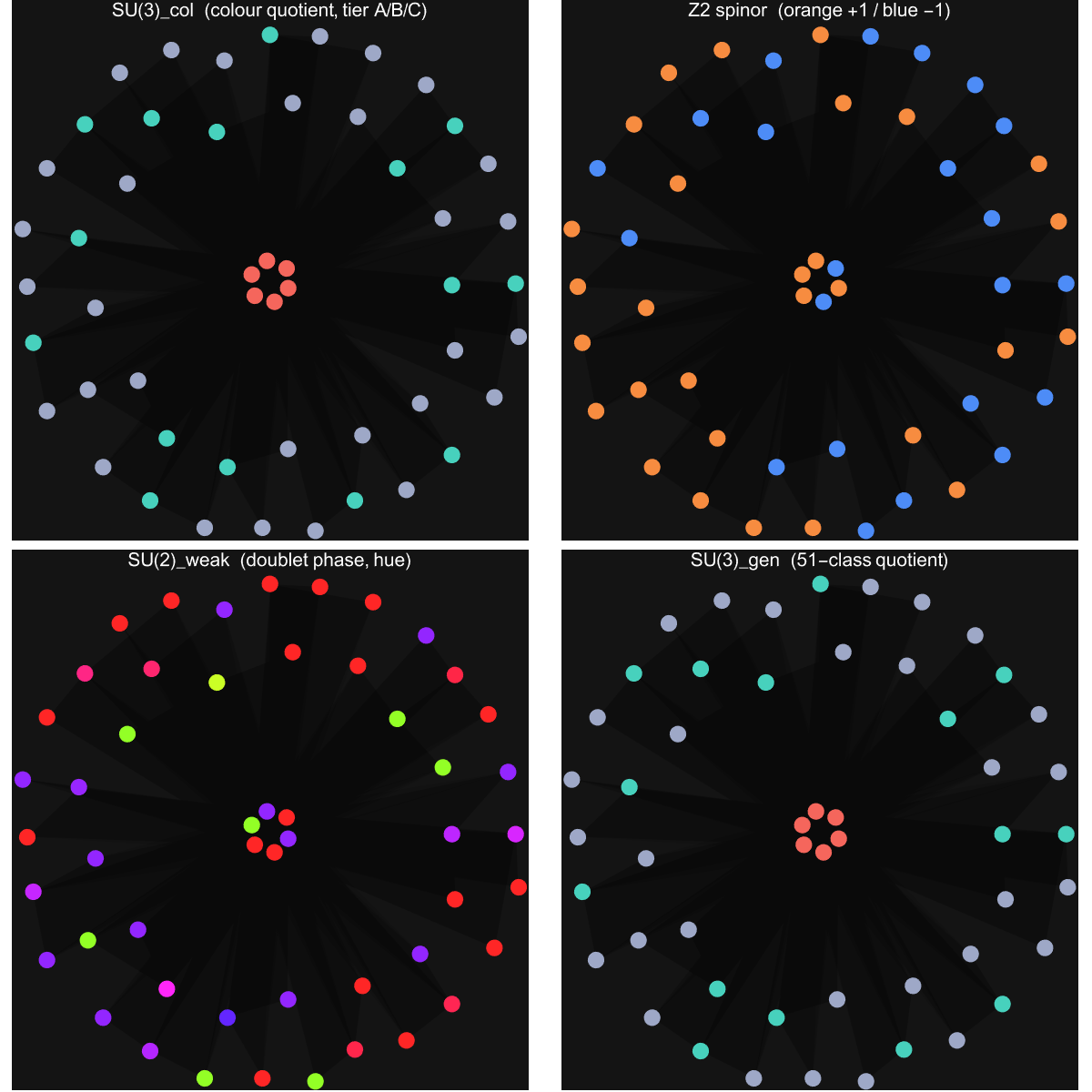
Three sectors as fibres on the identical colour-quotient Q51, plus generation as its own parallel quotient. (Unlike exceptional-group "theory of everything" embeddings [cf. @J Gregory Moxness's H₄/E₈ work] here the gauge group is derived by obstruction, not embedded in a larger group.)
A few things to keep straight:
- This is an independent research program ("Closure Forces Structure"), adjacent to the official Wolfram Physics Project. The shared substrate is hypergraph rewriting; the extra ingredient is Rosen closure.
- The notebook reproducibly verifies the structural facts (51, 102, the KO-dimension-6 signs, the four gauge-sector decorations). The forcing arguments (discrete obstruction, Hurwitz, isotropy, the gauge-group derivation) are theorems in the accompanying paper, not claims the notebook proves by itself.
- One layer, the weak doublet, is float (an SU(2) rotation with
cos θ, sin θ from θ = Arg⟨ψ₁|ψ₂⟩); everything else is exact Gaussian-integer arithmetic.
- The object is studied by observation (slicing and characterizing the static multiway and its quotients) not by instantiating it as a running dynamical system.
Run it yourself
The attached notebook is self-contained and evaluates top to bottom (≈ a minute; the 456-vertex layout is the slow step). It prints a verification table you can check against the numbers above, then draws every figure in this post including an interactive generation slider:
Manipulate[frameAt[G], {{G, 4, "generation"}, 0, 4, 1}]
To export the animation:
Export["q102_growth.gif", Append[growthFrames, closurePanel], "DisplayDurations" -> 1.2]
Comments, criticism, and especially attempts to break it are welcome.
References / related Community posts:*
AI Usage
Claude Opus 4.8 (Anthropic) assisted in the drafting of Wolfram code and generation of figures and text used in this post.