Note: The introduction to this discussion isn't complete. Please revisit when the video and explanation of the Mathematica animation has been added.
This discussion focuses on understanding Einstein’s gravity and general relativity by factoring spacetime curvature into dynamic space-stretching and time-dilation components.
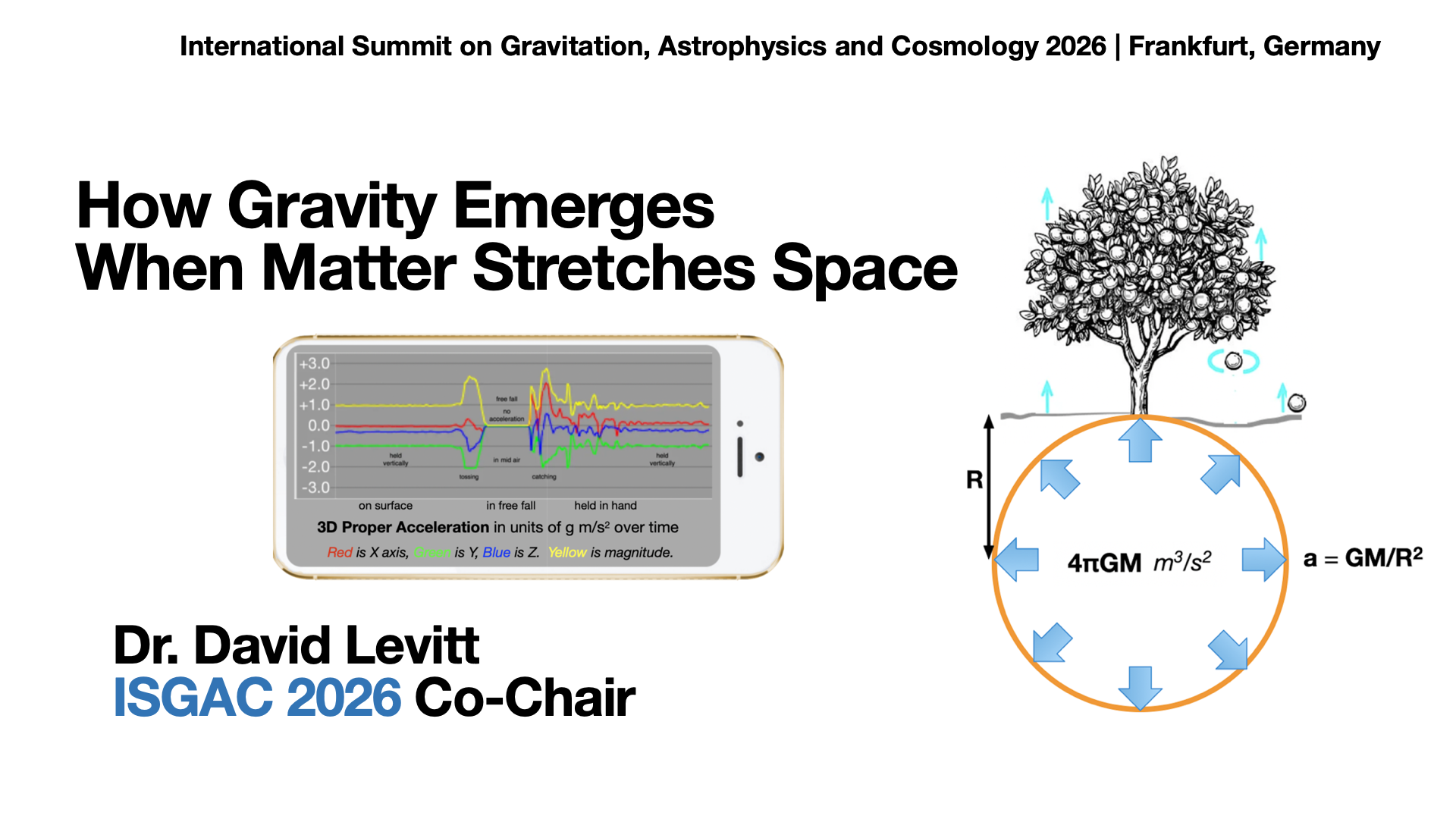
Mathematica has helped develop and demonstrate a simpler approach to understanding Einstein’s idea that gravity is a fictitious force governed by the stretching of space and time by matter — often called space-time curvature. These combine to provide a complete account of gravitational acceleration. For terrestrial gravity we present this in terms of the real force of the outward acceleration of the space containing earth's surface, rather than the fictitious force, Newton's attraction of free-falling objects.
In the long run this direct approach makes relativity's role in everyday gravity much easier to explain and teach, by highlighting the roles of space stretching and the fictitious force in Newton’s gravity formulation; the smaller role of time-dilation; and viewing geometry in ways that are often overlooked or made complicated in traditional GR curricula.
Stephen Wolfram soon proposed this can be a potentially rich source for computing projects clarifying gravity and curvature in Mathematica for Summer Students and alumni. I agree this seems like a strong match.
Newtonian Gravity Meets 21st Century Relativity
More generally, 21st century digital technology — from mobile accelerometers to 3D animation to artificial intelligence — are radically improving our understanding of gravity.
Partly because mobile accelerometers weren’t common, 20th century relativity professors often wound up summarizing Einstein’s gravity as “almost the same as Newton’s except for effects of time-dilation” — not “Einstein realized gravity is a push not a pull, and that Newton’s attractive force on free-falling objects is an illusion”.
A typical GR course would avoid even the simplest math to describe earth’s outward surface proper acceleration, and how variations in the lengths of meters can result in gravity. So most relatively students didn’t openly consider the physics of:
“Earth’s surface accelerates outward at 1 g.”**
We address that in this discussion and the attached links, videos and documents.
With a 21st century perspective, some of my colleagues consider
Earth’s surface accelerates outward at 1 g
a kind of General Relativity Koan — a provocative litmus test of whether a student has embraced Einstein’s non-Euclidean geometry, or remains anchored in a Newtonian reality.
In today’s world, addressing these issues explicitly offers a surprising and ultimately simpler and much more intuitive idea of how the stretching of space governs our experience of gravity.
Let’s discuss it here.
Documents and Links
I’ve been creating Mathematica notebooks, videos, articles and a presentation to kick off the discussion, attached and linked below. I'm preparing a technical paper for peer review and publication in physics journals, and looking forward to feedback.
- presentation: How Gravity Emerges When Matter Stretches Space from ISGAC 2026
- article: Accelerometers Complete Feynman’s Gravity Lecture
- early 3D Animation via 3JS shows how stretching of lengths is perceived as attractive force
- Mathematica Notebook: shows gravity as continuous stretching of lengths, including orbits
- video: meter-stretching animation for Upending Einstein’s Gravity generated by Notebook
Notes
- The 3D Animation via 3JS shows apparent attraction but not curvature toward the massive object, which is corrected and demonstrated more clearly in the Mathematica animation.
- Some figures and narration describe exponential stretching as periodic doubling of lengths. For correct results and simpler math, these should be updated to use e-folding periods (factors of the natural log base e -= 2.718) rather than doubling periods (factors of 2).
 Attachments: