Introduction
In this post I use Wolfram technologies and Wolfram Language syntax to investigate an exact algebraic chain connecting the constants 4096, 1729, and an eighteenth-root operator arising in my mathematical investigations.
The purpose of this post is to illustrate symbolic computation and high-precision numerical verification using Wolfram technologies. All symbolic computations presented below are expressed in Wolfram Language syntax and verified using Wolfram computational technologies.
Step 1. Exact symbolic identity
expr = (Sqrt[2 - Sqrt[3]] - Sqrt[2 + Sqrt[3]])^24;

FullSimplify[expr]
Output:
4096
Step 2. Hardy–Ramanujan number
ramanujan = 27*Sqrt[expr] + 1;

FullSimplify[ramanujan]
Output:
1729
Step 3. Eighteenth-root operator
operator = (expr + ramanujan)^(1/18);

N[operator,50]
Output:
1.618762396...
Step 4. Comparison with the Golden Ratio
N[GoldenRatio,50]

N[operator - GoldenRatio,50]
The second command computes the numerical difference between the algebraic operator and the Golden Ratio.
Step 5. High-precision computation
N[operator,100]
This confirms the stability of the numerical value at arbitrary precision.
Visualization
Plot[
 (4096 + 1729)^(1/x),
 {x,10,25},
 PlotRange->All,
 AxesLabel->{"Exponent","Value"}
]
The graph illustrates how the algebraic operator evolves as the exponent varies.
Conclusion
This post illustrates how Wolfram Language can be used for
exact symbolic computation,
arbitrary precision arithmetic,
numerical verification,
visualization of algebraic operators.
The complete symbolic chain 4096
↓
1729
↓
(4096 + 1729)^(1/18)
↓
1.618762396...
is obtained through Wolfram technologies using Wolfram Language syntax.
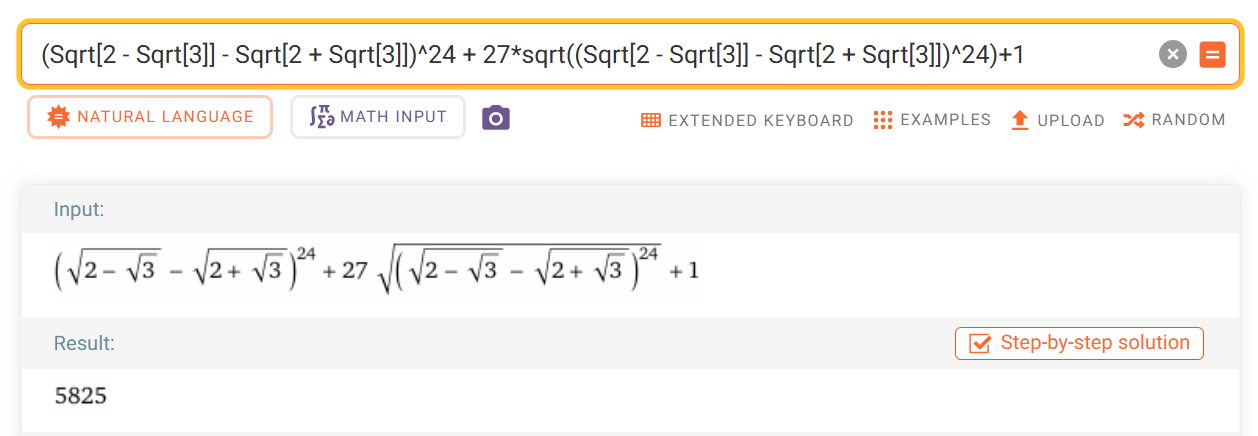
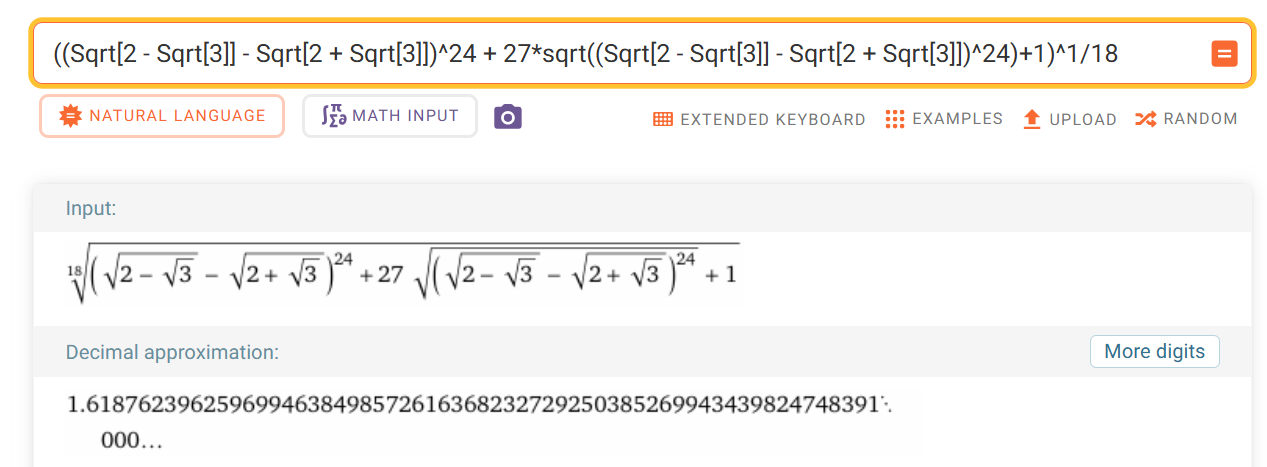
The accompanying Wolfram|Alpha evaluations confirm the exact symbolic identities and the corresponding high-precision numerical values, illustrating the effectiveness of Wolfram technologies for symbolic mathematical exploration.