Group Abstract Group Abstract

Message Boards Message Boards

0
|
3.1K Views
|
1 Reply
|
0 Total Likes
View groups...
Share
Share this post:

Expectation with Conditional Random variable

Posted 6 years ago

Given an Exponentially Distributed Random Variable $X\sim \exp(1)$. I need to find E[P_v] in Mathematica, where $P_v$ is given as:

$$ P_v= \left\{ \begin{array}{ll} a\left(\frac{b}{1+\exp\left(-\bar \mu\frac{P_s X}{r^\alpha}+\varphi\right)}-1\right), & \text{if}\ \frac{P_s X}{r^\alpha}\geq P_a,\\ 0, & \text{otherwise}. \end{array} \right. $$

My Take:

First, let's solve the equation for $P_v$. For that, let's assume g(x) to be:

$$g(x) = \frac{P^0}{\exp(\overline{\mu}P_{th} + \varphi)}\left( \frac{1+\exp(-\overline{\mu}P_{th} + \varphi)}{1 + \exp(-\overline{\mu}P_s x r^{-\alpha} + \varphi)} - 1\right),$$

Then,

$$ P_v = \begin{cases} g(x) & x \geq \frac{P{th}}{Ps}r^\alpha\ 0 & x < \frac{P{th}}{Ps}r^\alpha \end{cases} $$

Then, with the knowledge that the PDF for Exponentially distributed RV is $f(x) = e^{-\lambda x}$ (with $\lambda = 1$ for our case), we can find $\mathbb{E}[P_v]$. (I am not sure if the following is correct or not).

$$ \mathbb{E}[P_v]= \int_Q^\infty g(x)f(x)dx \ \ \ \ \ \ \ \ \ \ \ (1) $$ where $Q = \frac{P_{th} r^{\alpha}}{P_s}$. Now, I solved Eq. (1) in Mathematica but did not get the solution. The Figure below shows my try in Mathematica.

F1 = Po/E^(-\[Mu] Pth + \[CurlyPhi])*((+ E^(-\[Mu] Pth + \[CurlyPhi]))/(+ E^(-\[Mu] Ps X r^(-\Alpha])  \[CurlyPhi])) - 1);

F2 = E^(-X);

F = F1*F2;

Q = (Pth r^\[Alpha])/Ps;    

Final = Integrate[F, {Y, Q, \[Infinity]}]
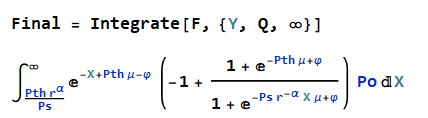
enter image description here

POSTED BY: S J
Posted 7 days ago

It's usually best to start variable names with lowercase letters. Here is what I think you want for the mean of $P_v$:

Integrate[a (b/(1 + Exp[-\[Mu] ps x/r^\[Alpha] + \[CurlyPhi]]) - 1) Exp[-x], 
  {x, pa r^\[Alpha]/ps, \[Infinity]}]
(* -a E^(-((pa r^\[Alpha])/ps)) + a b r^\[Alpha] ((E^(-((r^\[Alpha] \[CurlyPhi])/(ps \[Mu]))) \[Pi] Csc[(\[Pi] r^\[Alpha])/(ps \[Mu])])/
(ps \[Mu]) + (E^(-((pa r^\[Alpha])/ps) + pa \[Mu] - \[CurlyPhi]) Hypergeometric2F1[1, 1 - r^\[Alpha]/(ps \[Mu]), 
      2 - r^\[Alpha]/(ps \[Mu]), -E^(pa \[Mu] - \[CurlyPhi])])/(r^\[Alpha] - ps \[Mu])) *)

$$a b r^{\alpha } \left(\frac{e^{\bar{\mu} P_a-\frac{P_a r^{\alpha }}{P_s}-\varphi } \, _2F_1\left(1,1-\frac{r^{\alpha }}{P_s \bar{\mu} };2-\frac{r^{\alpha }}{P_s \bar{\mu} };-e^{P_a \bar{\mu} -\varphi }\right)}{r^{\alpha }-\bar{\mu} P_s}+\frac{\pi e^{-\frac{\varphi r^{\alpha }}{\bar{\mu} P_s}} \csc \left(\frac{\pi r^{\alpha }}{\bar{\mu} P_s}\right)}{\bar{\mu} P_s}\right)-a e^{-\frac{P_a r^{\alpha }}{P_s}}$$

POSTED BY: Jim Baldwin
Reply to this discussion
Community posts can be styled and formatted using the Markdown syntax.
Reply Preview
Attachments
Remove
or Discard