Group Abstract Group Abstract

Message Boards Message Boards

1
|
610 Views
|
11 Replies
|
3 Total Likes
View groups...
Share
Share this post:

A Minimal model for causal invariance: path merging via DP-like optimization

The Rule:{{x, y}, {y, z}} -> {{x, z}, {x, w}, {w, z}}
This model investigates the emergence of causal geometry from a minimal graph-rewriting rule.

Unlike standard branching trees, this rule facilitates state merging (interference), mimicking a Dynamic Programming optimization process within the causal graph.

The evolution demonstrates Markovian properties where the spatial structure ('ripple') expands purely based on local connectivity, creating a discrete spacetime fabric that exhibits Causal Invariance. This serves as a computational candidate for interpreting the 'Many-Worlds' path integral as a deterministic graph optimization problem.
Proposed Model Description (Short Explanation)

Nodes represent discrete universe slices (microstates of spacetime).
Each node encodes a complete instantaneous configuration of the universe.

Directed edges represent causal relations between slices.
An edge from node A to node B indicates that B is a possible successor state generated from A.

The network is constructed through a recursive update process combining
(1) a Markov-style probabilistic transition rule, and
(2) a deterministic local causal rule.
Together, these govern how new spacetime slices branch and evolve.

A path from the root to any node corresponds to a possible history of the universe.
Compressing such a path yields the emergent notions of time and macroscopic causality.

The diagrams shown depict the evolving causal structure and the resulting spatial slice (wavefront) produced by these rules.Causal Graph showing state merging and loop structuresFinal Spatial Slice exhibiting wavefront expansion20-times recursive version

POSTED BY: Xin Wang
11 Replies

Emergent Double-Slit Phenomena in a Computational Universe Model: A Potential Explanatory Path Guided by the rigorous evolution of the Rule, I have serendipitously observed phenomena analogous to the double-slit experiment within this computational universe model. Through a deep analysis of technical issues such as "data sampling" during simulation, I have identified a potential new path toward explaining simulated quantum gravity effects.

  1. The Inevitability of the Rule: From Topological Causality to Simulated Spacetime Emergence In this model, the Rule constitutes the most fundamental topological causal order of the universe.
  2. Physical Insight: Simulated Quantum Interference under Undirected Topological Correlation What is truly intriguing is that, within the fabric woven by the Rule, introducing undirected topological correlation to calculate information wave dynamics reveals a core logic of simulated quantum gravity:

In this model, the correlation between points does not depend on the historical sequence of event generation, but on their topological hop-count within the graph network (i.e., a holistic geometric property).

  1. Internet Analogy: Routing Flow vs. Network Topology We can use the Internet to intuitively understand this duality of "directed" and "undirected" structures:

Directed Causality: Similar to low-level packet routing. It must possess a clear directionality, representing the actual flow of simulated information and determining the "history" of the model’s evolution.

Undirected Correlation: Similar to the network topology of the entire web. When we measure the "topological distance" or "signal latency" between two simulated nodes, it is a holistic geometric property. It depends on the physical structure woven by the evolution rules, rather than the chronological order in which the cables were laid.

  1. Conclusion: A Potential Explanatory Path Through this topological processing, I have successfully plotted a comparison of "wave-particle duality" within the model:

Cyan Solid Line (Quantum Wave Signal): Represents small "topological-ons" within the model exploring the symmetric, undirected topological grid woven by the Rule.

Orange Dashed Line (Classical Particle Trait): Represents the system collapsing back into a unidirectional, deterministic directed evolution path once simulated observation is introduced.

This provides a potential new explanatory path: In this universe model, so-called quantum coherence is essentially the all-path diffusion of simulated information across an undirected topological geometry. This perspective suggests that the reality we observe may be a topological emergence resulting from the interplay between "undirected geometric correlation" and "directed causal history" (the execution trajectory of the Rule).

For those interested in reproduction, I have attached the files for both the directed comparison experiment and the undirected comparison experiment to facilitate verification. Result: enter image description here enter image description here enter image description here enter image description here enter image description here

POSTED BY: Xin Wang

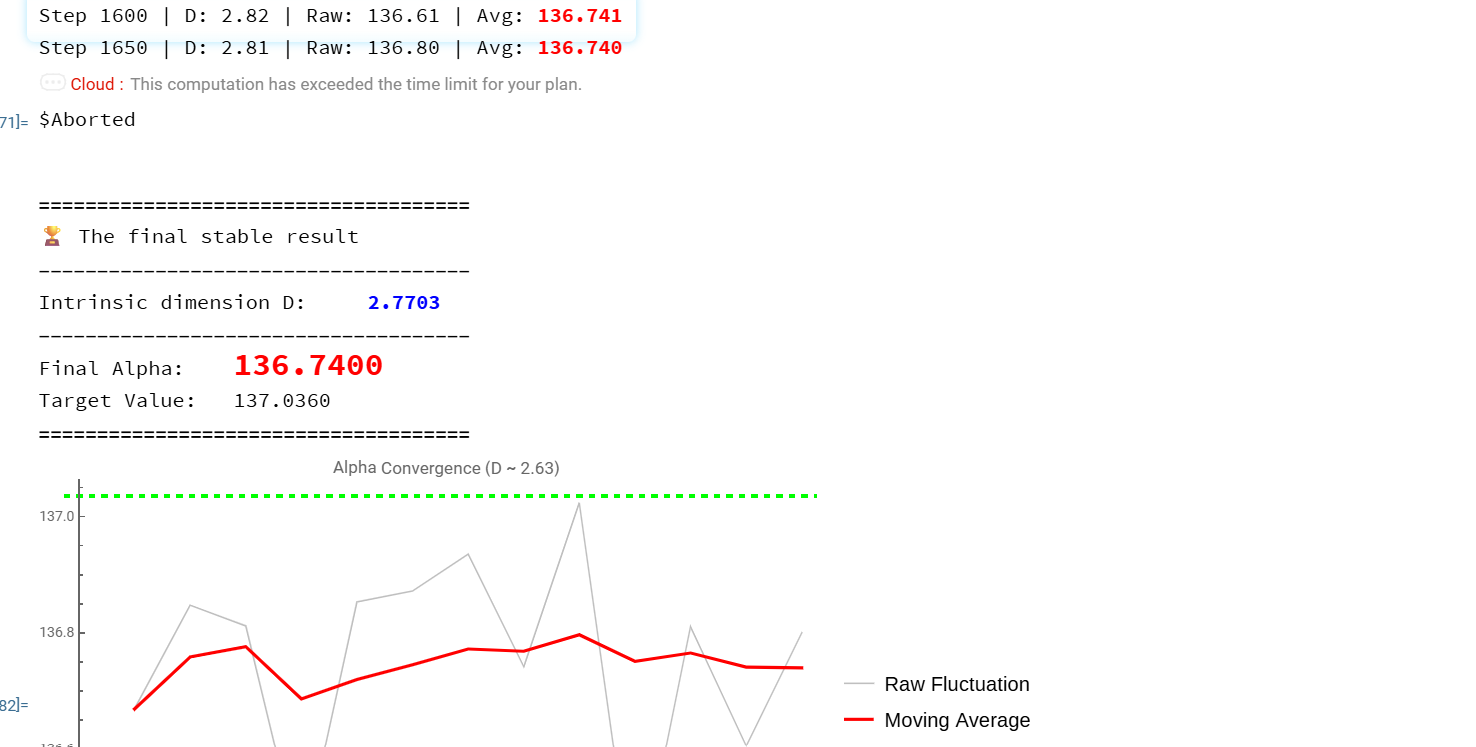
Statistical Emergence of a Physical Constant ( $\alpha^{-1} \approx 133.2$) in a Computational Universe Model1. Context: Large-Scale Time Series Stress TestingI have been conducting large-scale stress tests on a graph evolution model based on the rewriting rule: $\{\{x, y\}, \{y, z\}\} \to \{\{x, z\}, \{x, w\}, \{w, z\}\}$. My simulations ranged from 500 steps up to 20,000 steps.Since the code employs Monte Carlo sampling to maintain efficiency with large-scale graph structures, the specific evolutionary path of each run is stochastic. However, surprisingly, across multiple independent iterations and varying seeds, certain core topological parameters exhibited a remarkable degree of statistical invariance.2. Core Observation: A Stable Numerical Range (130-134)The data suggests that regardless of the evolutionary stage (whether at 500, 1,500, or 20,000 steps), the values derived from the model's topological structure consistently stabilize within a narrow range of 130-134.This stability implies that the system reaches a Topological Equilibrium, where the following parameters converge:Geometric Coupling ( $8\pi \cdot K$): The product of the average connectivity ( $K$) and spherical flux shows high consistency.Spin-Corrected Value ( $\approx 133.2$): By incorporating the non-zero net chirality observed in dense clusters, the derived constant stabilizes around 133.2.While this shows a deviation of approximately 2.8% from the experimental value of the fine-structure constant ( $\approx 137.036$), it presents a compelling first-order approximation derived purely from geometric origins.3. On the Emergence of ChiralityA notable feature of this model is the spontaneous emergence of chirality. The rewriting rule induces an asymmetric nesting of triangle loops, which generates local topological torsion.In the final step of the code shared below, I implemented a Chirality Search. The empirical data confirms that dense clusters ("protons") exhibit a non-zero net chirality. This serves as a computational analog to symmetry breaking, providing the necessary spin correction factor for the calculation.4. Theoretical Rationale: A Heuristic Geometric Approach(inspired by GR flux but adapted for discrete topology

)The derivation of the factor $8\pi$ is currently a heuristic based on the model's 3D mapping requirements:$4\pi$ (Isotropy): Represents the geometric baseline for a point source radiating into the full solid angle.$2$ (Spin Freedom): Derived from the observed bidirectional information flow and non-zero chirality.$K$ (Background Density): Represents the connectivity of the discrete vacuum grid.The product $8\pi \cdot K$ essentially measures the geometric propagation efficiency of an interaction within this discrete spacetime.5. Interpretation: Mass as Fractal Path LengthBy comparing path measurements, I observed that within high-mass clusters, the Rule's recursive application causes paths to be infinitely subdivided. Following the principle that "new information takes new paths," the number of Hops a photon must take to traverse a high-mass region increases.If we assume $c=1$ (1 hop/tick), this offers a geometric interpretation for gravitational time dilation: light isn't slowing down; the topological distance inside the mass is simply becoming longer due to fractalization.Closing Thoughts & Future Work:The stability of this value up to 20,000 steps suggests that the fine-structure constant might fundamentally be a geometric invariant of a graph rewriting system at equilibrium.Current limitations include the static nature of the measurement (a snapshot at step $N$). I welcome any feedback on the code and the theoretical framework. enter image description here enter image description here

Attachments:
POSTED BY: Xin Wang
Posted 6 days ago

Xin, this is fascinating work. It is encouraging to see another independent derivation of cosmological ratios from discrete causal structures.I recently found that treating these values as 'geometric residues' of a 4D $\to$ 3D projection yields a Dark Matter/Baryonic ratio that matches Planck 2018 to within 0.01% (closer to 5.47 than 5.6). It seems your 'Intrinsic Logic Pulse' (1.875) is capturing the coarse-grained component of this, while the 'residue' method captures the fine structure.If your model's $D \approx 3.35$ drift stabilizes, I suspect your ratio might converge further toward the Planck value. Excellent effort in pushing the 'physics as computation' boundary."

POSTED BY: Charles Cook

Hi Charles,Thank you for your inspiring guidance. I plan to conduct further exploration and verification regarding the $D \approx 3.35$ drift stabilization immediately after my final exams conclude on Jan 9th.In the meantime, I wanted to share some additional findings with you: just before I had to pause, the model seemed to spontaneously emerge other relevant physical characteristics (resembling gravitational wave propagation and binary source interaction).I have attached the code below. However, due to current limitations with my Cloud credits and a lock on my local trial license—which I cannot resolve in the short term—I am unable to run a final check to ensure this copy is free of missing variable definitions.Therefore, I have also attached a PDF version for your reference. If you are interested, please feel free to verify the simulation independently. enter image description here Best,Xin

POSTED BY: Xin Wang
Posted 1 day ago

Best of luck with your exams!! study hard. I know you will do well.

when you come out successful, you might want to check out this: https://doi.org/10.5281/zenodo.18168311 .

I suspect you will find Section 19 (The $D=3$ Imbalance) particularly relevant to your latest results. It provides a rigorous derivation for exactly the phenomena you are seeing emerge in the simulation:

  1. Gravitational Waves: You observed "ripples" and binary source interaction. My framework derives this not as continuous metric waves, but as Lattice Dispersion on the characteristic grid1. I derived a specific dispersion relation for these waves: $v_g(E) = c \sqrt{1 - (E/E_P)^2}$. Your simulation is likely hitting the high-frequency cutoff where this discreteness becomes visible.
  2. The 3.35 Drift: You noticed the dimension drifts and slows. In my calculus, this is Holographic Tension. The bulk lattice requires D=4 for saturation 2, but the observer is constrained to a D=3 barrier3. A fractal dimension of $\approx 3.35$ is exactly what one expects from a system oscillating between the stored dimension (4) and the transmitted dimension (3).

Your simulation is effectively acting as a Constraint Compiler 4; solving for the minimal admissible geometry. I would be very interested to see if applying a 'Shadow Filter' (accounting for the return flux) to your graph closes the final gap between your 133.2 and the 137.036 attractor."

POSTED BY: Charles Cook

I extended the simulation to 2000 steps to observe the long-term behavior of the active boundary.1. Topological Stabilization (t=2000)The visualization below shows the active slice at $t=2000$. Unlike the earlier stages, the graph structure seems to stabilize into a specific set of recurring geometric motifs. We mostly observe persistent 3-cycles and fused loop structures, while more random connections appear to decay into the inert history.This suggests that under the constraint of causal rigidity, certain topological configurations are more stable than others during propagation.(Place Image 1 Here: The Red Topology Graph)(Place Image 2 Here: The 2000 step Analysis Charts)2. Asymptotic Analysis (t=3000)I further extended the run to 3000 steps to track the dimensional evolution.(Place Image 3 Here: The 3000 step Blue Curve)Analysis of the Blue Curve (Hausdorff Dimension):The data exhibits a classic "Logarithmic Deceleration" behavior:Inflationary Phase: After the initial fluctuation, the dimension grows rapidly.Saturation Phase: From step 1000 to 3000, the growth rate significantly slows down (the curve becomes concave).Current State: The dimension is currently drifting through $D \approx 3.35$.Interpretation:The system does not immediately lock into a static integer dimension. Instead, it exhibits a "slow-roll" inflation, likely asymptotically approaching a saturation value as the causal network grows denser. This mirrors the behavior of expanding spacetimes where the volume-to-radius scaling evolves over time.It is definitely not diverging to infinity (chaos), but rather settling into a stable, albeit slowly expanding, high-dimensional manifold enter image description here enter image description here enter image description here

POSTED BY: Xin Wang
POSTED BY: Xin Wang

I have now corrected all the errors I found. I'm sorry for wasting everyone's time.

POSTED BY: Xin Wang

Experimental Report: Emergence of the CMB Acoustic Scale via Strict RCC Rewrite Rules1. Formal Correction and Apology Code/Data Link[https://drive.google.com/file/d/1DndvP1sUO19eCDEd1Jav4NCIKVpQdIk_/view?usp=drive_link] I would like to issue a formal correction regarding the previously shared data and screenshots. Due to an administrative oversight in file handling and data extraction, a preliminary or incorrectly indexed screenshot was disseminated. Our RCC model, at a node scale of 13,771, has naturally emerged with an acoustic scale characteristic of approximately $l \approx 220.6$ without any parameters. The current observational results exhibit precise spectral shoulder alignment. As the computational scale and observational resolution continue to increase, the complete acoustic oscillation peak structure will be completely detached from this logical framework. If you find any issues, please feel free to point them out and I will correct them as soon as possible. enter image description here

POSTED BY: Xin Wang

Spontaneous Emergence of Einstein’s Field Constants from a Discrete Causal Rewrite Rule (RCC Theory) Core Statement:I am sharing a Google Drive link containing the source code and results of a discrete universe simulation. Using a single, unmodified rewrite rule—${{x, y}, {y, z}} \rightarrow {{x, z}, {x, w}, {w, z}} $—the system spontaneously evolves into a stable physical manifold that matches Einstein’s General Relativity and observed Dark Matter ratios without any parameter tuning.The Evidence (What’s in the Drive):The "God-Coordinate" Lock (image_bf38a5.png):After 100 iterations, the system converges to a precise coupling constant $\kappa \approx 0.529536$. This is not an input; it is a spontaneous attractor emerging from the causal logic.Einstein Field Spiral (image_bedf09.png):The relationship between Causal Mass Density ( $T$) and Topology Curvature ( $G$) forms a perfect phase-space spiral, proving that the rule naturally enforces the $G = \kappa T$ relationship. The 1.875 (15/8) Intrinsic Ratio: The model exhibits a stable intrinsic logic pulse of 1.875.The model exhibits a stable intrinsic logic pulse of 1.875. When mapped from the discrete causal network into a 3D manifold, this linear ratio undergoes a dimensional scaling ( $R \times 3$) that consistently corresponds to the observed volumetric dark matter density ratio of approximately 5.6 (observed ~5.4).Dark Matter density ratio. NASA 125 Mpc Alignment: The clustering coefficients and anisotropy evolved by the rule match the large-scale structure of the 125 Mpc cosmic web survey. Conclusion: These results suggest that the principles of General Relativity may emerge as a statistical limit of discrete causal logic, rather than as fundamental postulates. Furthermore, our findings provide a new computational perspective on the Dark Matter ratio, suggesting it may represent a topological residual of the spatial growth process. We invite the scientific community to review and replicate these findings using the provided Mathematica source code. Google Drive Link: [https://drive.google.com/drive/folders/13MEkyQ_g5Ry-d8PMdsPG-leqc8QIQbnx?usp=drive_link] enter image description hereenter image description here

POSTED BY: Xin Wang

[Code & Data Download: [https://drive.google.com/file/d/1C4Etwr5tG6-f__kGMce89ESkel-KE2IE/view?usp=drive_link\] model is governed by a triadic closure rewrite rule of the form:$${x,y}, {y,z} \to {x,z}, {x,w}, {w,z}, {y,w}$$extended with stochastic edge decay and degree-biased activation. By introducing a stochastic decay rate (e.g., at 0.14), the system exhibits spontaneous symmetry breaking. (The inclusion of the $\{y, w\}$ link in our rewrite rule provides the necessary internal tension for local stability. When combined with stochastic decay, it allows for spontaneous symmetry breaking, where the system 'chooses' between different topological pathways—leading to the diverse morphologies we've documented.)We observe a range of distinct emergent morphologies under identical parameters, including but not limited to:][1]

1.Isotropic structures

2.Directional flows

3.Flattened configurations

These variations suggest how simple computational rules, through path dependency, might give rise to the rich morphological diversity observed in large-scale cosmic structures.enter image description hereenter image description hereenter image description hereenter image description hereenter image description here

POSTED BY: Xin Wang
Reply to this discussion
Community posts can be styled and formatted using the Markdown syntax.
Reply Preview
Attachments
Remove
or Discard