Hi!
I've got a graphs of system of equations and parallelepipeds on it.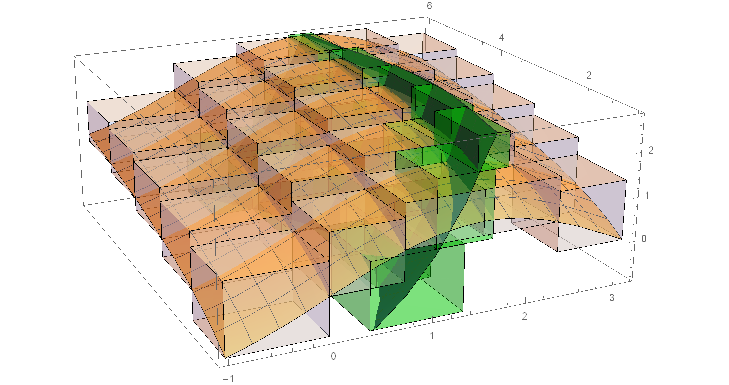
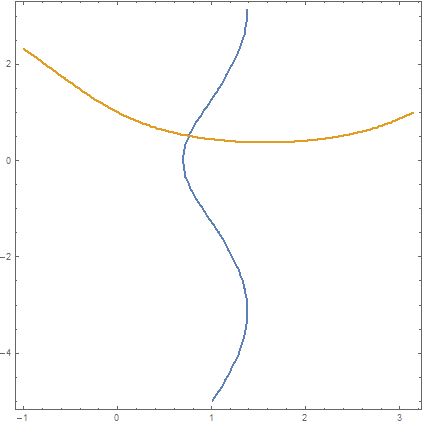 Tell me, please how to plot a projection of parallelepipeds?
l = Plot3D[Sin[x] + Log[y], {x, -1, 3.14}, {y, 1, 6},
   PlotStyle -> Opacity[0.7]];
e = Plot3D[Cos[y] + Exp[x] - 3, {x, -1, 3.14}, {y, 1, 6},
   ColorFunction -> "DarkRainbow"];

(*l1=Graphics3D[{Opacity[0.9],Parallelepiped[{-1,-1,0},{{7,0,0},{0,3,\
0},{0,0,5}}]},Axes\[Rule]True]*)
l1 = Graphics3D[{Opacity[0.3],
    Parallelepiped[{-1,
      1, -0.85}, {{1, 0, 0}, {0, 1, 0}, {0, 0, 1.6}}]}, Axes -> True];
l2 = Graphics3D[{Opacity[0.3],
    Parallelepiped[{-1,
      2, -0.16}, {{1, 0, 0}, {0, 1, 0}, {0, 0, 1.25}}]}, Axes -> True];
l3 = Graphics3D[{Opacity[0.3],
    Parallelepiped[{-1, 3,
      0.25}, {{1, 0, 0}, {0, 1, 0}, {0, 0, 1.15}}]}, Axes -> True];
l4 = Graphics3D[{Opacity[0.3],
    Parallelepiped[{-1, 4,
      0.55}, {{1, 0, 0}, {0, 1, 0}, {0, 0, 1.05}}]}, Axes -> True];
l5 = Graphics3D[{Opacity[0.3],
    Parallelepiped[{-1, 5, 0.77}, {{1, 0, 0}, {0, 1, 0}, {0, 0, 1}}]},
    Axes -> True];

l6 = Graphics3D[{Opacity[0.3],
    Parallelepiped[{0, 1,
      0.01}, {{0.75, 0, 0}, {0, 1, 0}, {0, 0, 1.35}}]}, Axes -> True];
l7 = Graphics3D[{Opacity[0.3],
    Parallelepiped[{0, 2,
      0.7}, {{0.75, 0, 0}, {0, 1, 0}, {0, 0, 1.07}}]}, Axes -> True];
l8 = Graphics3D[{Opacity[0.3],
    Parallelepiped[{0, 3,
      1.1}, {{0.75, 0, 0}, {0, 1, 0}, {0, 0, 0.95}}]}, Axes -> True];
l9 = Graphics3D[{Opacity[0.3],
    Parallelepiped[{0, 4,
      1.4}, {{0.75, 0, 0}, {0, 1, 0}, {0, 0, 0.89}}]}, Axes -> True];
l10 = Graphics3D[{Opacity[0.3],
    Parallelepiped[{0, 5,
      1.6}, {{0.75, 0, 0}, {0, 1, 0}, {0, 0, 0.86}}]}, Axes -> True];

l11 = Graphics3D[{Opacity[0.3],
    Parallelepiped[{0.75, 1,
      0.69}, {{0.82, 0, 0}, {0, 1, 0}, {0, 0, 1}}]}, Axes -> True];
l12 = Graphics3D[{Opacity[0.3],
    Parallelepiped[{0.75, 2,
      1.37}, {{0.82, 0, 0}, {0, 1, 0}, {0, 0, 0.72}}]}, Axes -> True];
l13 = Graphics3D[{Opacity[0.3],
    Parallelepiped[{0.75, 3,
      1.77}, {{0.82, 0, 0}, {0, 1, 0}, {0, 0, 0.6}}]}, Axes -> True];
l14 = Graphics3D[{Opacity[0.3],
    Parallelepiped[{0.75, 4,
      2.05}, {{0.82, 0, 0}, {0, 1, 0}, {0, 0, 0.55}}]}, Axes -> True];
l15 = Graphics3D[{Opacity[0.3],
    Parallelepiped[{0.75, 5,
      2.29}, {{0.82, 0, 0}, {0, 1, 0}, {0, 0, 0.5}}]}, Axes -> True];

l16 = Graphics3D[{Opacity[0.3],
    Parallelepiped[{1.57, 1,
      0.69}, {{0.82, 0, 0}, {0, 1, 0}, {0, 0, 1}}]}, Axes -> True];
l17 = Graphics3D[{Opacity[0.3],
    Parallelepiped[{1.57, 2,
      1.37}, {{0.82, 0, 0}, {0, 1, 0}, {0, 0, 0.72}}]}, Axes -> True];
l18 = Graphics3D[{Opacity[0.3],
    Parallelepiped[{1.57, 3,
      1.77}, {{0.82, 0, 0}, {0, 1, 0}, {0, 0, 0.6}}]}, Axes -> True];
l19 = Graphics3D[{Opacity[0.3],
    Parallelepiped[{1.57, 4,
      2.05}, {{0.82, 0, 0}, {0, 1, 0}, {0, 0, 0.55}}]}, Axes -> True];
l20 = Graphics3D[{Opacity[0.3],
    Parallelepiped[{1.57, 5,
      2.29}, {{0.82, 0, 0}, {0, 1, 0}, {0, 0, 0.5}}]}, Axes -> True];

l21 = Graphics3D[{Opacity[0.3],
    Parallelepiped[{2.39, 1,
      0.01}, {{0.75, 0, 0}, {0, 1, 0}, {0, 0, 1.35}}]}, Axes -> True];
l22 = Graphics3D[{Opacity[0.3],
    Parallelepiped[{2.39, 2,
      0.7}, {{0.75, 0, 0}, {0, 1, 0}, {0, 0, 1.07}}]}, Axes -> True];
l23 = Graphics3D[{Opacity[0.3],
    Parallelepiped[{2.39, 3,
      1.1}, {{0.75, 0, 0}, {0, 1, 0}, {0, 0, 0.95}}]}, Axes -> True];
l24 = Graphics3D[{Opacity[0.3],
    Parallelepiped[{2.39, 4,
      1.4}, {{0.75, 0, 0}, {0, 1, 0}, {0, 0, 0.89}}]}, Axes -> True];
l25 = Graphics3D[{Opacity[0.3],
    Parallelepiped[{2.39, 5,
      1.6}, {{0.75, 0, 0}, {0, 1, 0}, {0, 0, 0.89}}]}, Axes -> True];


e1 = Graphics3D[{Opacity[0.3], Green,
    Parallelepiped[{0.4,
      1, -0.914}, {{0.97, 0, 0}, {0, 1, 0}, {0, 0, 1.5}}]},
   Axes -> True];
e2 = Graphics3D[{Opacity[0.3], Green,
    Parallelepiped[{1.07, 1,
      0.586}, {{0.6, 0, 0}, {0, 1, 0}, {0, 0, 1.5}}]}, Axes -> True];
e3 = Graphics3D[{Opacity[0.3], Green,
    Parallelepiped[{1.48, 1,
      2.086}, {{0.33, 0, 0}, {0, 1, 0}, {0, 0, 0.76}}]}, Axes -> True];

e4 = Graphics3D[{Opacity[0.3], Green,
    Parallelepiped[{0.88,
      2, -0.914}, {{0.6, 0, 0}, {0, 1, 0}, {0, 0, 1.5}}]},
   Axes -> True];
e5 = Graphics3D[{Opacity[0.3], Green,
    Parallelepiped[{1.36, 2,
      0.586}, {{0.42, 0, 0}, {0, 1, 0}, {0, 0, 1.5}}]}, Axes -> True];
e6 = Graphics3D[{Opacity[0.3], Green,
    Parallelepiped[{1.67, 2,
      2.086}, {{0.24, 0, 0}, {0, 1, 0}, {0, 0, 0.76}}]}, Axes -> True];

e7 = Graphics3D[{Opacity[0.3], Green,
    Parallelepiped[{0.95,
      3, -0.914}, {{0.54, 0, 0}, {0, 1, 0}, {0, 0, 1.5}}]},
   Axes -> True];
e8 = Graphics3D[{Opacity[0.3], Green,
    Parallelepiped[{1.42, 3,
      0.586}, {{0.37, 0, 0}, {0, 1, 0}, {0, 0, 1.5}}]}, Axes -> True];
e9 = Graphics3D[{Opacity[0.3], Green,
    Parallelepiped[{1.72, 3,
      2.086}, {{0.19, 0, 0}, {0, 1, 0}, {0, 0, 0.76}}]}, Axes -> True];

e10 = Graphics3D[{Opacity[0.3], Green,
    Parallelepiped[{0.58,
      4, -0.914}, {{0.83, 0, 0}, {0, 1, 0}, {0, 0, 1.5}}]},
   Axes -> True];
e11 = Graphics3D[{Opacity[0.3], Green,
    Parallelepiped[{1.17, 4,
      0.586}, {{0.55, 0, 0}, {0, 1, 0}, {0, 0, 1.5}}]}, Axes -> True];
e12 = Graphics3D[{Opacity[0.3], Green,
    Parallelepiped[{1.53, 4,
      2.086}, {{0.34, 0, 0}, {0, 1, 0}, {0, 0, 0.76}}]}, Axes -> True];

e13 = Graphics3D[{Opacity[0.3], Green,
    Parallelepiped[{0.12,
      5, -0.914}, {{1.05, 0, 0}, {0, 1, 0}, {0, 0, 1.5}}]},
   Axes -> True];
e14 = Graphics3D[{Opacity[0.3], Green,
    Parallelepiped[{0.93, 5,
      0.586}, {{0.6, 0, 0}, {0, 1, 0}, {0, 0, 1.5}}]}, Axes -> True];
e15 = Graphics3D[{Opacity[0.3], Green,
    Parallelepiped[{1.388, 5,
      2.086}, {{0.3, 0, 0}, {0, 1, 0}, {0, 0, 0.76}}]}, Axes -> True];

Show[l, l1, l2, l3, l4, l5, l6, l7, l8, l9, l10, l11, l12, l13, l14,
  l15, l16, l17, l18, l19, l20, l21, l22, l23, l24, l25];
Show[l, e, e1, e2, e3, e4, e5, e6, e7, e8, e9, e10, e11, e12, e13,
  e14, e15];

Show[l, l1, l2, l3, l4, l5, l6, l7, l8, l9, l10, l11, l12, l13, l14, \
l15, l16, l17, l18, l19, l20, l21, l22, l23, l24, l25, e, e1, e2, e3, \
e4, e5, e6, e7, e8, e9, e10, e11, e12, e13, e14, e15]
Show[l, e];
here I plotted a projection of equations
  ContourPlot[{Cos[y] + Exp[x] - 3 == 0, Sin[x] + Log[y] == 0,
      Parallelepiped[{0.4,
        1, -0.914}, {{0.97, 0, 0}, {0, 1, 0}, {0, 0, 1.5}}]}, {x, -1,
      Pi}, {y, -5, Pi}]



