Group Abstract Group Abstract

Message Boards Message Boards

0
|
13.2K Views
|
11 Replies
|
2 Total Likes
View groups...
Share
Share this post:

Determine branch cuts of say log[Z^3]?

Posted 10 years ago

I am determining branch cuts of complex valued functions and i would like Mathematica to check my work...Is this possible?

POSTED BY: Patrick Rose
11 Replies

In this case, ContourPlot can do the trick.

     f[z_] := Log[z^3];
     With[{z = x + I y}, ContourPlot[Im[f[z]], {x, -2, 2}, {y, -2, 2}, ClippingStyle -> Automatic, ExclusionsStyle -> {Black, Dashed}, 
     Axes -> True, Frame -> False, Contours -> 1, ContourShading -> None,ContourStyle -> None, AxesLabel -> {"Re[z]", "Im[z]"}]]
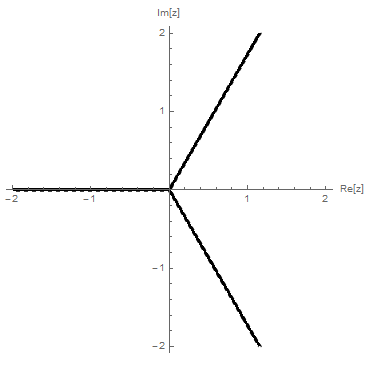

enter image description here

POSTED BY: Mariusz Iwaniuk
Posted 10 years ago

I just Google'd. Someone seems to know this function. See the link:

https://mathematica.stackexchange.com/questions/109089/branch-cuts-of-sqrt

Succes.

POSTED BY: Wiel Aerts

Package ComplexAnalysis does not appear in the list of Standard Extra Packages, no file ComplexAnalysis.m seems to be in $InstallationDirectory, and the Documentation Center includes no entry for either ComplexAnalysis or BranchCuts!

However, if one evaluates an expression using function BranchCuts in context ComplexAnalysis, then

 ?ComplexAnalysis`BranchCuts

does reveal a usage message.

Very strange!

POSTED BY: Murray Eisenberg
Posted 10 years ago

That is the perfect code I needed. Thank you so much!!! and thanks to everyone. You are all so smart and nice. best wishes

POSTED BY: Patrick Rose

Very cool! Where/how did you find the function?

POSTED BY: Sander Huisman
Posted 10 years ago

Is the following code sufficient for you (I found by accident):

ComplexAnalysis`BranchCuts[Log[z^3], z];
Assuming[ {x, y} \[Element] Reals, Simplify[% /. z -> x + I y] ]

The output is than:

(x < 0 && 
   y == 0) || (x > 
    0 && (y + Sqrt[3] Abs[x] == 0 || y == Sqrt[3] Abs[x]))

I could not find a proper way the make a nice plot (ContourPlot and RegionPlot don't give result).. Somebody?

Succes

POSTED BY: Wiel Aerts
Posted 10 years ago

thank you so much Mr Huisman.

I am aware of the arbitrary way branch cuts can be defined.

Commonly though the Log[Z] function is defined on the principal branch with the branch cut being the origin and the negative real axis.

I used your code and graphed Log[Z] and it appears the branch is at y=0 and x<=1.

Why is this?

I thought it should be at y=0 and x<=0.

thanks in advance best wishes

POSTED BY: Patrick Rose

As David said, they are indeed somewhat arbitrary... You can see the branch cuts using a plot:

Plot3D[Arg@Log[(x + I y)^3], {x, -4, 4}, {y, -4, 4}]

where z has been replaced by x+ I y, and we take e.g. the Real (Re) or Imaginary (Im) or Argument (Arg) part...

POSTED BY: Sander Huisman
Posted 10 years ago

i do not wish for a Riemann surface representation...just a 2d plot of the branch cuts like i have seen in Maple

POSTED BY: Patrick Rose
Posted 10 years ago

branch lines using the principal value say for log[z^3] are the negative x axis and the rays at pi/3 and negative pi/3 in this and other cases with log[g[x]] there is one answer...Maple has a function that determines and graphs these..

Is there a similar function in Mathematica yes or no :)

thanks best wishes

POSTED BY: Patrick Rose
Reply to this discussion
Community posts can be styled and formatted using the Markdown syntax.
Reply Preview
Attachments
Remove
or Discard