It is given the following problem:
X'=Z+(Y-\alpha)X
Y'=1-\beta Y-X^2
Z'=-X-\gamma Z
with initial conditions (X(0),Y(0),Z(0)=(1,2,3).
Where
X: interest rate
Υ:investment demand
Z: price index
\alpha: savings,
\beta: cost per investment,
\gamma: the absolute value of the elasticity of demand
\[Alpha]=0.9;
\[Beta]=0.2;
\[Gamma]=1.2;
f[x_,y_,z_]:=z+(y-\[Alpha])*x
g[x_,y_,z_]:=1-\[Beta]*y-x^2
h[x_,y_,z_]:=-x-\[Gamma]*z
I know how to define a system with two functions so I could use these
-
Method A: accuracy of order h
 S[a_, b_, h_, N_] := (u[0] = a; u[1] = a + h*b;
 Do[u[n + 1] =
 2 u[n] - u[n - 1] + h*h*f[n*h, u[n], (u[n] - u[n - 1])/h], {n, 1,
 N}])
-
Method B: accuracy of order h^2
 Q[a_, b_, h_, N_] := (u[0] = a; v[0] = b;
 Do[{u[n + 1] =
 u[n] + h*
 F[u[n] + (h/2)*F[u[n], v[n]],
 v[n] + (h/2)*
 G[u[n], v[
 n]]],                                                     \

 v[n + 1] =
 v[n] + h*
 G[u[n] + (h/2)*F[u[n], v[n]], v[n] + (h/2)*G[u[n], v[n]]]}, {n,
 0, N}])
Athanasios,
you did not say so, but I am assuming that you want the above system of DGL get solved:
\[Alpha] = 0.9;
\[Beta] = 0.2;
\[Gamma] = 1.2;

eqs = {x'[t] == z[t] + (y[t] - \[Alpha])*x[t],
   y'[t] == 1 - \[Beta]*y[t] - x[t]^2,
   z'[t] == -x[t] - \[Gamma]*z[t]};

{fx, fy, fz} = NDSolveValue[{eqs, x[0] == 1, y[0] == 2, z[0] == 3}, {x, y, z}, {t, 0, 500}];
Plot[{fx[t], fy[t], fz[t]}, {t, 0, 50}, ImageSize -> Large, GridLines -> Automatic]
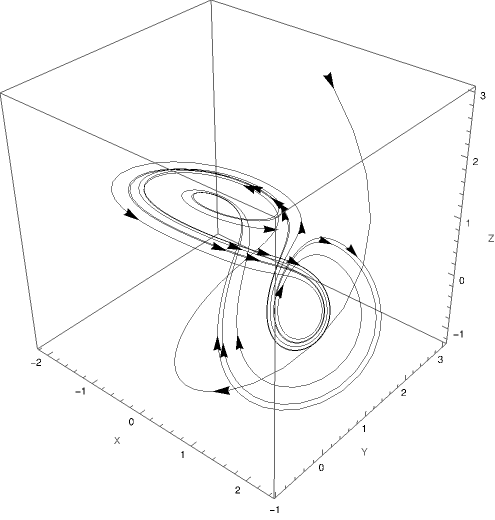
ParametricPlot3D[{fx[t], fy[t], fz[t]}, {t, 0, 500}, ImageSize -> Large, AxesLabel -> {"X", "Y", "Z"}]
I did not know that Euler was dealing with interest rates, etc., but interesting though!
Does that help? Regards – Henrik
Of course, it helps! But I am trying to use the Improved Euler Method to solve this problem, too
Athanasios,
sorry - obviously I misunderstood your question!
As far as I could understand on the quick the “improved Euler method” I simply would do it like so:
\[Alpha] = 0.9;
\[Beta] = 0.2;
\[Gamma] = 1.2;

f[{x_, y_, z_}] := {z + (y - \[Alpha])*x, 1 - \[Beta]*y - x^2, -x - \[Gamma]*z}

h = 0.1;
impEuler[v_List] := v + h/2 (f[v] + f[v + h f[v]])

data = NestList[impEuler, {1, 2, 3}, 1000];
Graphics3D[{Arrowheads[{.03, #} & /@ Range[0, 1, .05]], Arrow[data]},
 BoxRatios -> Automatic, Axes -> True, AxesLabel -> {"X", "Y", "Z"}]
I do hope that this now is more helpful! At least my “solution” above can be used as reference.
Best regards – Henrik
[1]: https://community.wolfram.com//c/portal/getImageAttachment?filename=impEuler.png&userId=32203
Thank you that was very useful for sure. At my master with have an assignment and we study the Dynamic analysis and control of a new hyperchaotic finance system. For this reason we use Improved Euler’s Method
That works but it is not accurate as your solution
Another Way I have thought is the following
Hello,
impEuler[v_List] := v + h/2 (f[v] + f[v + h f[v]]) - Henrik Schachner, Radiation Therapy Center, Weilheim, Germany
So, initially we have a function with 3 parameters: x, y, and z (f[{x _, y _, z _}]), and then we call the function only with one single parameter: v (f[v]).
Could you explain what is the meaning of v _List, and how f[v] is related to f[{x _, y _, z _}]?
Formula for improved Euler method:


So, initially we have a function with 3 parameters: x, y, and z (f[{x
, y , z _}])
No, it is a function that takes a single parameter, which is a List of 3 elements that are locally bound to the symbols x, y, and z.
f[{x_, y_, z_}]
If it took three parameters it would be
f[x_, y_, z_]
This question is unrelated to this thread. You should have asked a new question.