I have put up a series of webpages built from Mathematica notebooks, describing a new idea about how to model price returns:
Financial Data Analysis
The Mathematica notebook for each page may be downloaded and explored in detail. There is a notebook which can be used to fit the stable 2:3 OrderDistribution.
The central idea, which needs more more research, is that the process of price formation is driven by the two-tailed power law distribution in the limit order books of the continuous double auction . Research has shown that this distribution is heavy tailed. The thought is that a price formation distribution might arise from summation of the random variables found in the order book log return distribution across slices of time. The limiting distribution would be a stable distribution having alpha determined by the lowest alpha in the order book distribution. But this resulting price formation would be a distribution of prices which potentially could occur. The distribution of prices which ultimately flow from the CDA would be a subset of these price log returns.
A way to get this subset while resolving the tension between buyers and sellers would be to assume symmetry in the expectations of buyers and sellers and that they might each submit order prices with an expectation that half of the orders will never be executed. The prices in the price formation distribution which are actually executed would then come from the middle third of the distribution where the buyer and seller prices (modelled as log returns) overlap. The way to get the random variables for this distribution might be to sort the random variables from the price formation distribution, taking them three at a time and selecting the median return. If the price formation distribution resulting from sums of returns across slices of time from the limit orders is a stable distribution then then the distribution of price returns might be well modeled by a stable 2:3 order statistic distribution.
I try to articulate this better on this page:
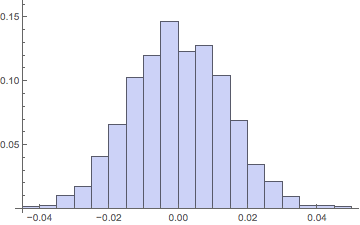
The fits to financial log returns to this distribution are remarkably good even at the one minute level, and it seems the hypothesis here could be tested by analyzing a source of high frequency level II quotes. I don’t have access to that but if anyone is interested in researching the idea I would be happy to collaborate.