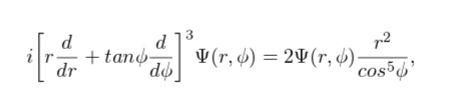
PDE solving - which solver is best?

Hello, I am trying to find the best solver for this problem described above. The equation is given in Mathematica commands:

  K1 = i;
  V = Tan[x];
  P = r^2/(Cos[y])^5

  eq = K1*r^3*D[u[r, y], {r, 3}] + r^2*D[u[r, y], {r, 2}] + r*K1*D[V^2*u[r, y], {r, 1}] + V*r*K1*D[u[r, y], {r, 1}] + V*r*K1*D[V*u[r,y], {r,1}]+ V^2*r*K1*D[u[r, y], {r, 1}] + 
V^3*K1*D[u[r, y], {r, 1}] == 2*u[r,y]*P

and the I.C.s are set to:

u(r,0)=1
u(0,y)=1

u’(0,y)=0
u’'(0,y)=10

Which solver and method and form of input is best?

Thanks

Il the cube power the composition of the differential operator three times? If so, your expanded equation should be something like

op = Function[r*D[#, r] + Tan[\[Phi]] D[#, \[Phi]]];
I*Nest[op, \[CapitalPsi][r, \[Phi]], 3] == 
 2 \[CapitalPsi][r, \[Phi]]*r^2/Cos[\[Phi]]^5

provided that i means the imaginary unit.

Yes, it the cubic of the differential operator. Is # really nr 3 ? A typo?

The # is the argument of the operator, where it receives the Psi. Try op[\[CapitalPsi][r, \[Phi]]]

Thanks for the hint. I tried your form in the previous command:

op = Function[r*D[#, r] + Tan[\[Phi]] D[#, \[Phi]]];I*Nest[op, \[CapitalPsi][r, \[Phi]], 3] ==  2 \[CapitalPsi][r, \[Phi]]*r^2/Cos[\[Phi]]^5
	
 sol = u[r, y] /. 
 NDSolve[{op,
 u[0, y] == 1,
 Derivative[1, 0][u][0, y] == 0, 
 Derivative[2, 0][u][0, y] == 10, 
 Derivative[3, 0][u][0, y] == 0, 

 u, {r, 0, 3}, {y, 0, 3},
 MaxSteps -> Infinity, PrecisionGoal -> 1,
 AccuracyGoal -> 1, 
 Method -> {"MethodOfLines", 
 "SpatialDiscretization" -> {"TensorProductGrid", 
 "MinPoints" -> 32, "MaxPoints" -> 32, "DifferenceOrder" -> 2},
 Method -> {"Adams", "MaxDifferenceOrder" -> 1}}] // 

 Plot3D[sol, {r, 0, 3}, {y, 0, 3}, AxesLabel -> Automatic]

I got the same error.

How can I start with some basic and simple I.C. that are completely arbitary, and work from there?

Can you propose a model with some arbitrary conditions, so I see what is wrong here?

op is only a component of the equation. The equation is

I*Nest[op, \[CapitalPsi][r, \[Phi]], 3] == 
 2 \[CapitalPsi][r, \[Phi]]*r^2/Cos[\[Phi]]^5

op = I*Nest[op, [CapitalPsi][r, [Phi]], 3] == 2 [CapitalPsi][r, [Phi]]*r^2/Cos[[Phi]]^5

 sol = u[r, y] /. 
 NDSolve[{op,
 u[0, y] == 1,
 Derivative[1, 0][u][0, y] == 0, 
 Derivative[2, 0][u][0, y] == 10, 
 Derivative[3, 0][u][0, y] == 0, 

 u, {r, 0, 3}, {y, 0, 3},
 MaxSteps -> Infinity, PrecisionGoal -> 1,
 AccuracyGoal -> 1, 
 Method -> {"MethodOfLines", 
 "SpatialDiscretization" -> {"TensorProductGrid", 
 "MinPoints" -> 32, "MaxPoints" -> 32, "DifferenceOrder" -> 2},
 Method -> {"Adams", "MaxDifferenceOrder" -> 1}}] // 

 Plot3D[sol, {r, 0, 3}, {y, 0, 3}, AxesLabel -> Automatic]


and I still get this strange message:

0.00021449999999999998` cannot be used as a variable.

Can you try it, and see how it can be given some test-initial conditions to give completion of the command?

Thanks in advance!