Retrieve expression in a less simplified form w/ partial derivs unsolved

My print out for rct (ricci curvature tensor) attempts to partially differentiate some terms however for my work i need my solution to be in terms of partial derivatives (hopefully this makes sense). It’s towards Birkhoffs uniqueness theorem if this adds context. thankyou in advance

d = 4 ; y = {t, r, \[Theta], \[Phi]} ; 

G = {{-(E^(2 X[t, r])), 0, 0, 0}, {0, (E^(2 Y[t, r])), 0, 0}, {0, 0, 
    r^2, 0}, {0, 0, 0, r^2  Sin[\[Theta]]^2}};

IG = Inverse[G];

\[CapitalGamma] = 
  Table[1/2*
    Sum[IG[[i, 
       l]]*(D[G[[j, l]], y[[k]]] + D[G[[k, l]], y[[j]]] - 
        D[G[[j, k]], y[[l]]]), {l, 1, d}], {i, 1, d}, {j, 1, d}, {k, 
    1, d}];
Rct = Table[
   D[\[CapitalGamma] [[i, l, j]], y[[k]]] - 
    D[\[CapitalGamma] [[i, l, k]], y[[j]]] + 
    Sum[\[CapitalGamma] [[i, k, a]]*\[CapitalGamma] [[a, l, j]], {a, 
      1, d}] - 
    Sum[\[CapitalGamma] [[i, l, b]]*\[CapitalGamma] [[b, k, j]], {b, 
      1, d}], {i, 1, d}, {j, 1, d}, {k, 1, d}, {l, 1, d}];
rct = Table[Sum[Rct[[c, i, c, j]], {c, 1, d}], {i, 1, d}, {j, 1, d}];
rct

Maybe Inactivate[<some expression>, D] is what you are looking for:

\[CapitalGamma] = 
  Inactivate[
   Table[1/2*
     Sum[IG[[i, l]]*(D[G[[j, l]], y[[k]]] + D[G[[k, l]], y[[j]]] - 
         D[G[[j, k]], y[[l]]]), {l, 1, d}], {i, 1, d}, {j, 1, d}, {k, 
     1, d}], D];
Rct = Inactivate[
   Table[D[\[CapitalGamma][[i, l, j]], y[[k]]] - 
     D[\[CapitalGamma][[i, l, k]], y[[j]]] + 
     Sum[\[CapitalGamma][[i, k, a]]*\[CapitalGamma][[a, l, j]], {a, 1,
        d}] - Sum[\[CapitalGamma][[i, l, b]]*\[CapitalGamma][[b, k, 
         j]], {b, 1, d}], {i, 1, d}, {j, 1, d}, {k, 1, d}, {l, 1, d}],
    D];

This just keeps throwing up errors unfortunately

Well, of course you have to execute the whole code - I posted above the changed part only! OK, it then reads:

ClearAll["Global`*"]
d = 4; y = {t, r, \[Theta], \[Phi]};
G = {{-(E^(2 X[t, r])), 0, 0, 0}, {0, (E^(2 Y[t, r])), 0, 0}, {0, 0, 
    r^2, 0}, {0, 0, 0, r^2 Sin[\[Theta]]^2}};
IG = Inverse[G];
\[CapitalGamma] = 
  Inactivate[
   Table[1/2*
     Sum[IG[[i, l]]*(D[G[[j, l]], y[[k]]] + D[G[[k, l]], y[[j]]] - 
         D[G[[j, k]], y[[l]]]), {l, 1, d}], {i, 1, d}, {j, 1, d}, {k, 
     1, d}], D];
Rct = Inactivate[
   Table[D[\[CapitalGamma][[i, l, j]], y[[k]]] - 
     D[\[CapitalGamma][[i, l, k]], y[[j]]] + 
     Sum[\[CapitalGamma][[i, k, a]]*\[CapitalGamma][[a, l, j]], {a, 1,
        d}] - Sum[\[CapitalGamma][[i, l, b]]*\[CapitalGamma][[b, k, 
         j]], {b, 1, d}], {i, 1, d}, {j, 1, d}, {k, 1, d}, {l, 1, d}],
    D];
rct = Table[Sum[Rct[[c, i, c, j]], {c, 1, d}], {i, 1, d}, {j, 1, d}];
rct
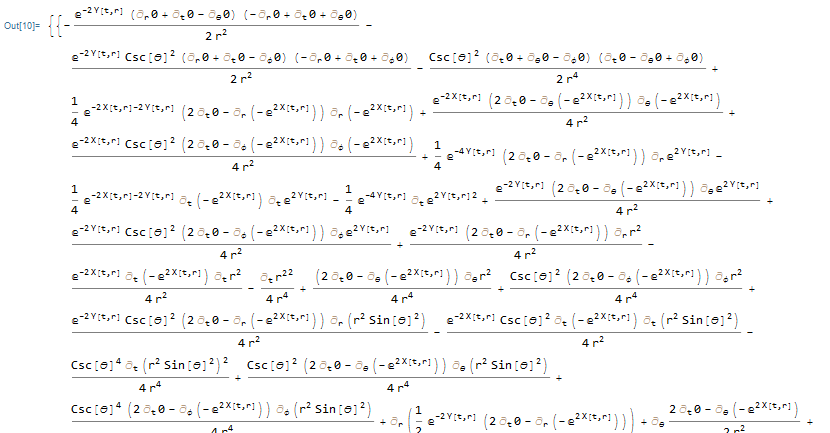
This gives a lengthy result, but with unresolved partial derivatives. Is it this you want?

Sorry im really not great with mathematica, and it’s along the right lines, basically my result is the following

But i was hoping i could have things such as the the 2nd to last line, the 3rd term, ideally id like it to read (sin2?)e?2Y(?1 +e2Y?r?rX+r?rY) instead, i know its correct but for my future calculations it would be nice if in my appendix, the code would print exactly that, thankyou for your time

I cannot reproduce your result. When I do not do anything else but execute my code from above I get something like:

which does contain the unresolved derivatives you are asking for.
[1]: https://community.wolfram.com//c/portal/getImageAttachment?filename=partial.png&userId=32203