Group Abstract Group Abstract

Message Boards Message Boards

[WSG23] Daily Study Group: Introduction to Discrete Mathematics

A Wolfram U Daily Study Group on Introduction to Discrete Mathematics begins on October 16th 2023.

Join me and a group of fellow learners to learn about the mathematics behind the innovations of computer science using the Wolfram Language. Our topics cover the most well-known branches of discrete mathematics, including logic, sets, discrete functions, sequences, combinatorics, algorithms, proofs, recursion and graphs.

This study group aims to develop a broad understanding of discrete mathematics, with a focus on concepts useful in computer science, software engineering and programming, and make this rich and useful domain accessible for any college student, professional or interested hobbyist. A basic working knowledge of the Wolfram Language is recommended but not necessary. We are happy to help beginners get up to speed with Wolfram Language using resources already available on Wolfram U.

Please feel free to use this thread to collaborate and share ideas, materials and links to other resources with fellow learners.

REGISTER HERE

2 Dimensional Cellular Automaton rule 907486931

Wolfram U Banner

POSTED BY: Marc Vicuna
60 Replies
Posted 2 years ago

May I ask how to understand this result in Lesson 11 Binomial Identity? enter image description here

POSTED BY: Tianyi Hu

Hi Tianyi,

Honestly don't try to understand it, it seems to be a mistake. It took me a while to understand what was going on. I'm a mathematician in discrete mathematics, so I have limited knowledge of complex analysis. When I wrote that lesson, I was told this is the complex variant of the Vandermonde identity, related to the Chu-Vandermonde identity. After some digging, it seems this summation is wrong. I'll inform the Summation team to fix this.

Best, Marc Vicuna

POSTED BY: Marc Vicuna
Posted 2 years ago

In lesson 7, it says "Intersection is a higher priority operation than union."

Anyone can please explain why?

POSTED BY: Tianyi Hu
Posted 2 years ago

"Intersection is a higher priority operation than union."

Operator precedence in the Wolfram Language is comprehensively listed on this help page. It shows intersection has a higher precedence than union. That's a good catch: perhaps the text should be using "precedence" rather than "priority".

If you're asking why intersection should have a higher precedence than union, I cannot say. This answer in a Physics Forums discussion notes that "When people generalize intersections and unions to Boolean algebra, intersection is multiplication and union is addition."

I asked Google Bard (an AI) why intersection had higher precedence than union. Here is what it had to say. It sounds reasonable to me; YMMV. If that's not satisfactory, you could ask Devendra Kapadia or course instructor Marc Vicuna. Hope that helps.

Reference: https://www.physicsforums.com/threads/order-of-operations-in-sets.571188/

POSTED BY: Phil Earnhardt

Hi Tianyi,

I can confirm Phil's answer.

First, it's important to understand precedence is a convention, not a theorem. We need precedence so that our expressions behave as intended. PEDMAS is a convention that is followed for common operations, but it does not covers all mathematical operations. Mathematics contains many rings outside of the set of reals with addition and multiplication. It is good practice to follow a similar precedence in all rings.

To help you see the similarities between intersection and multiplication, we can ask:

Consider the equality {} ∩ A = {1}. What is the set A? This is indeterminate, as this is equivalent to a division by 0.

Overall, precedence is a convention rooted in group theory. The precedence of set operations has to do with its definition in group theory and its relation to the PEDMAS convention.

Best, Marc Vicuna

POSTED BY: Marc Vicuna

After 7 Inputs, I can't see the input line anymore of the Scratch Notebook while I try the exercises of the course. Any idea ? Thank you for your patience

POSTED BY: Roberto Catanuto

I'm pleased to announce Introduction to Discrete Mathematics is now available on Wolfram U, including all course videos, exercises, quizzes and the final exam! Click Track My Progress to chart your certification progress. Go to the free course by visiting the course landing page and signing in using your Wolfram ID. Congratulations to Marc Vicuna and the Algorithms R&D team on this wonderful course, and kudos to the Wolfram U team for bringing it to fruition. Read Marc's blog post about the launch of the course: https://blog.wolfram.com/2023/11/29/dont-be-discreet-and-learn-discrete-mathematics-with-wolfram-language

POSTED BY: Jamie Peterson
Posted 2 years ago
POSTED BY: Soomi Cheong

A reminder to the Discrete Math Study Group participants that the deadline to pass the six quizzes for your course completion certificate is Friday, November 10. The exam can be taken anytime from the course framework. Refer to your Study Group emails for a link to the pre-release framework and to recording links from Study Group sessions. We heard a lot of positive feedback from Friday's review session. You might want to watch that recording, in particular.

POSTED BY: Jamie Peterson

Hi Phil Earnhardt,

I just wanted to answer your question from the feedback. In a few words, the goal is usually to have the course framework available at the launch of the study group, and have the course officially released at the end of the study group.

However, having the framework beta coincide with the planned start of the study group a month or two in advance can be difficult. The course in my view is ready at beta, but the study group is given a privileged view into the course material given.

That said, we always aim to improve our courses, and this methodology is subject to change from course to course. Your comments have reached the Wolfram U team and will be considered. At the very least, I believe future courses will try to better communicate course framework status.

Thank you for your feedback and happy learning, Marc

POSTED BY: Marc Vicuna
Posted 2 years ago

Hi Marc,

I have a problem reproducing the hypergraph in Lesson 24 notebook, section "Final States". If I run

ResourceFunction[
  "WolframModel"][{{x, y}, {y, z}} -> {{x, y}, {z, y}, {y, w}, {w, 
    x}}, {{0, 0}, {0, 0}}, 11, "FinalStatePlot"]

The result is this hypergraph
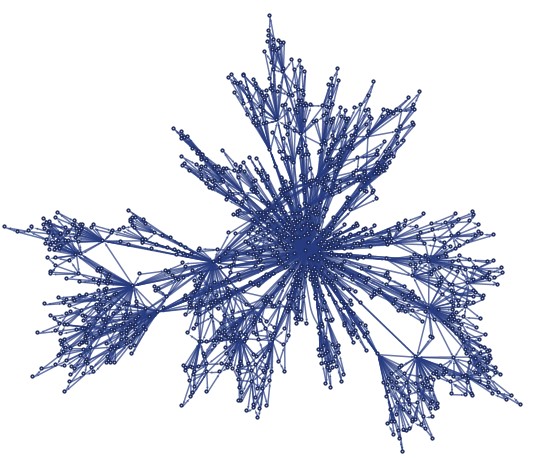
enter image description here

Where I used the same rule as the example in the section before:

rule = {{x, y}, {y, z}} -> {{x, y}, {z, y}, {y, w}, {w, x}};

I suspect another rule was used when the notebook was created; probably similar to the one in the example of the ResourceFunction["WolframModel"] documentation: https://resources.wolframcloud.com/FunctionRepository/resources/WolframModel/

ResourceFunction[
  "WolframModel"][{{x, y}, {x, z}} -> {{x, z}, {x, w}, {y, w}, {z, 
    w}}, {{0, 0}, {0, 0}}, 11, "FinalStatePlot"]

Which gives the plot shown in the lesson notebook:
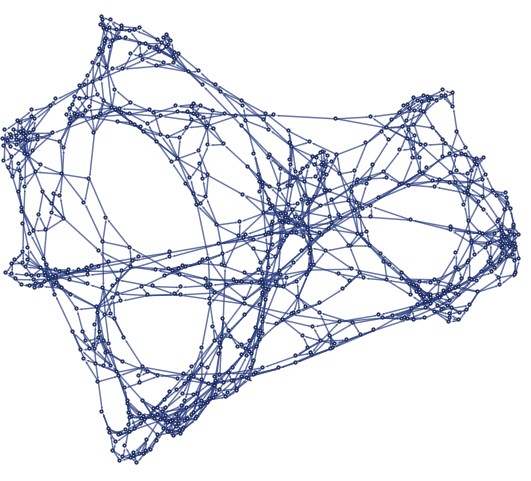
enter image description here

POSTED BY: Dave Middleton
POSTED BY: Marc Vicuna

Hello Study Group,

To confirm, the last question of lesson 22 lead to some confusion with reason, as the definition given for the vertex degree was wrong, or more precisely, only appliable to simple graphs. Therefore, the definition will soon be changed to "The number of incident edges to v is its degree.", since it's the number of edges that is important. This will be corrected.

Thank you for noticing and sorry for the confusion,

Marc

POSTED BY: Marc Vicuna
Posted 2 years ago
POSTED BY: Phil Earnhardt
POSTED BY: Marc Vicuna
Posted 2 years ago

I am watching video recording of first day: set & logic

Anyone knows, for De-Morgan's Law of quantifiers:

enter image description here

Is this Axioms since it's so obvious. If not, how it can be deduced?

POSTED BY: Tianyi Hu

Hi Tianyi,

This rule has many different proofs, which may depend on the equivalences you have access to in this context. I would generally use a proof by contradiction for both sides, as seen in this proof, where the perpendicular lines represent a contradiction: enter image description here

This proof and other proofs are available here.

Best, Marc

POSTED BY: Marc Vicuna
POSTED BY: Ray Chandler
Posted 2 years ago

I'm not seeing that, Ray. Today's (Monday, 10/23) link worked just fine for me. enter image description here

POSTED BY: Phil Earnhardt

Cassidy reported the link has been fixed.

POSTED BY: Ray Chandler
Posted 2 years ago
POSTED BY: Phil Earnhardt
POSTED BY: Marc Vicuna
Posted 2 years ago
POSTED BY: Dave Middleton
POSTED BY: Ray Chandler

Hello Ray,

Yes I see that file also, I'll remove it. It will be corrected.

Thank you, Marc

POSTED BY: Marc Vicuna

Thanks.

POSTED BY: Ray Chandler
POSTED BY: Marc Vicuna

I'm curious why the community page for this study group has WSG23 in the name rather than WSG46.

POSTED BY: Ray Chandler

Hello Ray,

Indeed, it should be 46. Thank you for bringing attention to that.

Best, Marc

POSTED BY: Marc Vicuna
Posted 2 years ago

@ray chandler Why should the tag be WSG46? I thought the tags for the WSG were always WSGYY where YY are the last 2 digits of the year when the WSG was held. This pattern has been followed for dozens of WSGs over the last 5 years.

What is the significance of the tag WSG46, Mark? What does that stand for?

POSTED BY: Phil Earnhardt

@Phil Earnhardt, you're correct, we mixed up our tagging system for Wolfram Daily Study Groups. The community tag has usually referenced the year, but we also use WSG code numbers (mostly internally) to track our Study Groups in the order they are scheduled and organized by Wolfram U staff. The Introduction to Discrete Mathematics is our 46th Wolfram Study Group, so that's where that tag came from. Thanks for being an active participant in this initiative.

POSTED BY: Jamie Peterson
POSTED BY: Ray Chandler

Hello Ray,

It seems strange you don't have access to Lesson 1, I see it on the shared folder for the study group. In the mean time, here is lesson 1 is here in cloud and attached too.

Best, Marc

Attachments:
POSTED BY: Marc Vicuna
POSTED BY: Ray Chandler
Posted 2 years ago

WRT resources in the course, one excellent resource I have found is Wolfram Mathworld: the web's most extensive mathematics resource. For definitions of terms, it's quite a winner. It's far superior to the Wikipedia: a small number of curators help insure high quality. I've stumbled across a fair number of wrong entries in the Wikipedia -- even in science articles -- but I've never seen anything but top-shelf data in Wolfram Mathworld. Note: all of the entries are Wolfram Language notebooks (!!!) available for download and manipulation.

Like many things associated with Stephen Wolfram or Wolfram Research, there's no good reason for Mathworld to exist. An individual created it in the 1990s, and Wolfram bought it in 1999. Entries continue to be added and enhanced. I first stumbled across the encyclopedia earlier this year when I as looking for a particular 3D Curve and found Viviani's Curve in the entries.

POSTED BY: Phil Earnhardt
POSTED BY: Marc Vicuna
Posted 2 years ago
POSTED BY: Updating Name
POSTED BY: Marc Vicuna
POSTED BY: Jürgen Kanz
POSTED BY: Marc Vicuna
POSTED BY: Jürgen Kanz

Hello Jürgen,

I'd argue this is the right output. In mathematics, usually, we usually indeed write: enter image description here

However, in code, the Wolfram Language uses a different but equivalent notation, where the variable is written as a subscript. This will still evaluate as you would expect. For example, Reduce[Exists[x, x == -x]] return True.

POSTED BY: Marc Vicuna
Posted 2 years ago

Think I heard somebody was looking for references. Here is a general document about Discrete Mathematics found at Yale and distributed under Creative Commons Attribution-ShareAlike 4.0 International license. The link: Notes on Discrete Mathematics

POSTED BY: José Dordá

Hello.

POSTED BY: Richard Charette

Hello!

Marc

POSTED BY: Marc Vicuna

Hello Marc!

I'm here to learn and to offer feedback.

Most of the lessons seemed fine in yesterday's recording. However, there was an issue with the photo of the woman chosen to portray "disorientation" and "confusion" at the 31:41 time stamp. The photo is misogynistic and inappropriate. Instead, try using a more generic image, such as a stick figure or a confused puppy with question marks all over it. This would be more appropriate and add a touch of humor to the presentation.

See you at 11AM.

Lori

POSTED BY: Lori Johnson

Thank you, Lori.

This is noted. The poll questions are only used for the study group, so this will not appear on the course framework. However, my courses do tend to use a lot of images. It will be corrected. If you notice any similar problems in the lessons, exercises, or quizzes, feel free to tell us when we don't catch those mistakes ourselves.

Best, Marc

POSTED BY: Marc Vicuna

Thank you, very, very much for understanding!

POSTED BY: Lori Johnson
Posted 2 years ago

A real "Traveling Salesman" problem!

Recently, good friend Gil Hedley started his Nerve Tour, a series of presentations in 111 cities. Gil is conducting the tour over two years; he and his wife are traveling to all the North American cities with a camper. If you look on the tour page, you'll see the cities are laid out in a [rather boring] table; I thought it would be fun to map them out. I copied his data and used GeoListPlot to plot it out:

The tour length was 21,447 miles! All things equal, an optimized tour was 12,520 miles. But all things are never quite equal: Gil arranged to be in northern latitudes in warm months and southern cities in cooler months. I tried to draw the optimized map; I'm still wrestling with GeoListPlot. I'll update the forum when I have that map.

POSTED BY: Phil Earnhardt
Posted 2 years ago
POSTED BY: Dave Middleton

Hello Dave,

The Wolfram Language does not have symbolic set computations available. In fact, the Wolfram language intentionally does not have a proper theoretical set implementation, since it would require many implementation choices on definitions that may not fit the user. However, you can implement set manually easily with Sort and DeleteDuplicates.

In a sense, this is one major use of boolean expressions: you may simplify and analyze set expressions in logical form, then, when comes to computing actually sets, you may transfer your logical expression to a set expression. The equivalences between set theory and logic guarantee this. See this post for example.

Best, Marc

POSTED BY: Marc Vicuna
Posted 2 years ago

Thank you Marc,

I will explore the route to simplify and analyze set expressions in logical form and transfer them to sets later.

POSTED BY: Dave Middleton
Posted 2 years ago
POSTED BY: Dave Middleton

Hello Dave,

For the versioning, we're working on changing it to the correct Mathematica version. For dynamics, there is not much we can do about it, unfortunately.

For the mistakes in the slides, that is correct, thank you, it will be corrected.

Best, Marc

POSTED BY: Marc Vicuna

Hello Wolfram community!

This course will start in 15 minutes! If you're interested, join us now with the link above!

Happy learning to all!

POSTED BY: Marc Vicuna
Posted 2 years ago

Registered! The best Group Theory thing I ever figured out on my own: the late Skwish Toy inventor Tom Flemons pointed out to me that his manufacturing operation made the toy with a single elastic line that was segmented when the balls were glued to the end of the rods. That makes the lines of Skwish an Eulerian Cycle. In my University class, all of the groups used as examples for cycles, etc., were flat (and boring!) drawings on a page; I suggested to my prof to use the Skwish geometry on a problem set to mix things up a bit. The Manhattan Toy product is the best-selling tensegrity model on the planet, but most of the customers seem to just chew on it. :)

enter image description here

POSTED BY: Phil Earnhardt

Marc Vicuna has done a great job in developing this thoroughly up-to-date introduction to Discrete Mathematics.

I strongly recommend the Study Group to everyone!

POSTED BY: Devendra Kapadia

Hi Davendra!

I've enjoyed three of your courses. Nice to 'see' you again :-D

POSTED BY: Lori Johnson

Hello Lori,

Thank you very much for your active participation and support for these online courses!

POSTED BY: Devendra Kapadia

Well, Mathematica is addictive nerd candy and you Wolfram folk are pretty nice, online and in person. It's hard to stay away!

POSTED BY: Lori Johnson
Reply to this discussion
Community posts can be styled and formatted using the Markdown syntax.
Reply Preview
Attachments
Remove
or Discard