Notebook attached.
 Attachments:
|
|
|
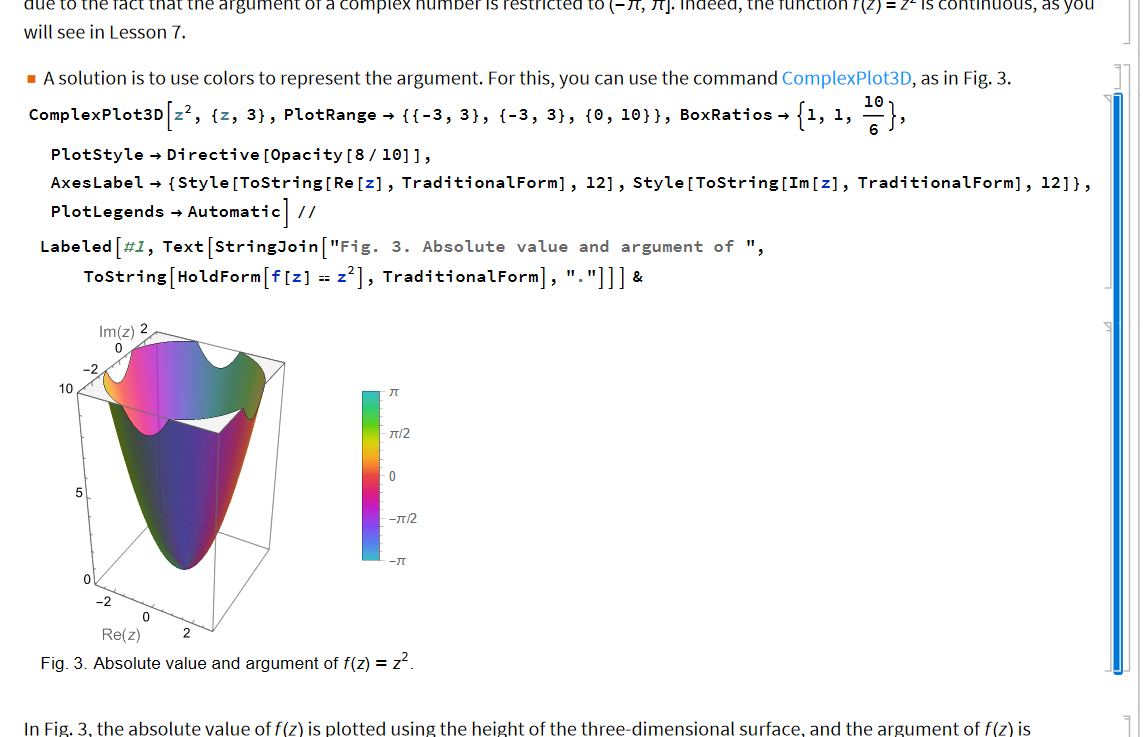
All code can already be seen, including that for images and animations. You just have to double click on the bracket that hides the input, identifiable by the little upward-pointing arrow: 
Double clicking will expand the code:
|
|
|
Thanks so much for your response!
|
|
|
In Lesson 3, why does the Postfix instruction //Labeled[#,Text[ ...]& result in just one Text for the entire row rather than a separate text for each of the 3 ComplexPlot3D[...] entries in the Row[...] for the following code?
Row[{
ComplexPlot3D[z,{z,3},PlotRange->{{-3,3},{-3,3},{0,6}},BoxRatios->{1,1,1},PlotStyle->Directive[Opacity[0.8`]],AxesLabel->{Style[ToString[Re[z],TraditionalForm],12],Style[ToString[Im[z],TraditionalForm],12],Style[ToString[Abs[z],TraditionalForm],12]},ImageSize->160],
ComplexPlot3D[Conjugate[z],{z,3},PlotRange->{{-3,3},{-3,3},{0,6}},BoxRatios->{1,1,1},PlotStyle->Directive[Opacity[0.8`]],AxesLabel->{Style[ToString[Re[z],TraditionalForm],12],Style[ToString[Im[z],TraditionalForm],12],Style[ToString[Abs[Overscript[z, _]],TraditionalForm],12]},ImageSize->160],
ComplexPlot3D[1/z,{z,3},PlotRange->{{-3,3},{-3,3},{0,6}},BoxRatios->{1,1,1},PlotStyle->Directive[Opacity[0.8`]],AxesLabel->{Style[ToString[Re[z],TraditionalForm],12],Style[ToString[Im[z],TraditionalForm],12],Style[ToString[HoldForm[Abs[1/z]],TraditionalForm],12]},ImageSize->160,PlotLegends->Automatic]
}]//Labeled[#,Text[StringJoin["Fig. 4. Plots of the functions ",ToString[z,TraditionalForm],", ",ToString[Overscript[z, _],TraditionalForm],", ",ToString[1/z,TraditionalForm],"."]]]&
|
|
|
In that code, Labeled applies to the whole Row object,
(Row[...]) // Labeled[#, "......"]&
Consider the difference between:
Row[{a, b, c}] // Labeled[#, "mylabel"] &
and
Map[Labeled[#, "mylabel"] &, Row[{a, b, c}], {2}]
Hope this helps
|
|
|
I think I see the answer to my question. The Postfix code is just a function; no Map (/@) is specified.
|
|
|
Marco, Thanks. Our replies crossed. I came to the same conclusion as indicated in your reply.
|
|
|
For figure 2 lesson 3, is the caption correct?
|
|
|
You are right, I'll have the caption fixed.
|
|
|
Trying to catch up here. Surely this is a simple question. When plotting Re[z] and Im[z], shouldn't these plots be confined to either the {z, Re[z]} or the {z,Im[z]} planes? I don't see why these plots appear to be surfaces in 3 dimensions. Thanks!
Attachments:
|
|
|
The idea behind that plot is to look at the function f(z)=z^2 as a complex function of the complex variable z. The horizontal plane is the z plane, so if you write z = x + I * y, the x axis corresponds to Re[z] and the y axis to Im[z]. Remember that Re[f(z)]=Re[z^2] is real-valued. So, it will be a surface in the plot, constructed as follows: the height of the surface at coordinates (x,y) is Re[(x+I*y)^2]. Don't confuse the meaning of z (a complex number) with the vertical axis of the plot.
For example, try calculating the height of the yellow curve at the point (1,2) which corresponds to z=(1+2* I) . It will be Re[(1+2* I)^2] = -3.
|
|
|
I am wondering about the history of complex numbers, Girolamo and Rafel, in 16C. How did they find the need, and what profession both were in? Did mathematician careers exist in 16C?
|
|
|
They found the need when studying cubic equations. From Wikipedia, it looks like Girolamo Cardano had a tortured life, which he described in an autobiography. The front page of the autobiography on Wikipedia describes him as a "medical philosopher and man of letters". He was a medical doctor, engineer, mathematician and philosopher. The "Cardanic joint" bears his name. Less is known about Rafael Bombelli's life; he was an architect and civil engineer.
I don't think that the career of professional mathematicians in the modern sense existed at the time. People studied multiple disciplines which today we treat as distinct. They would perhaps use terms like "natural philosopher" or "scholar" to describe themselves, even if today we remember them for their mathematical contributions. Often, mathematics was a hobby and they had a practical profession in commerce, law or other fields. Fermat was famously a lawyer.
|
|
|
Thxs, Marco. I am wondering how you got into complex number analysis. What trigger made you enter this field?
|
|
|
I studied physics at the university and complex analysis was a required course.
|
|
|
In the European tradition of philosophy, Plato famously asked (demanded?) a knowledge of mathematics from his students. At that time, I think, mathematics was considered as part of Logic which was an essential component of philosophy. The Pythagorean School (much earlier than Plato) also took mathematics very seriously, but the school looks quasi religious by today's (western) standards.
|
|
|
Although I have encountered and used complex numbers over the decades, I never understood what motivated their introduction until your first lecture. Thanks.
|
|
|
Can you comment on the significance or the application of the Riemann sphere concept? Why should it matter how lines or circles in the complex plane map to the sphere?
|
|
|
About applications of the Riemann sphere and the stereographic projection, others in this forum have mentioned cartography, but that does not require complex numbers.
The only "practical" application of the Riemann sphere I know of is to Lorentz transformations.
The situation is this: imagine two observers moving at very large relative velocities. By a relativistic effect, the two observers will see the stars in different positions. How to relate these positions? In this problem it can actually be useful to think of the sky as a Riemann sphere for the purpose of calculation. Then, the position of a star will be given by a complex number and the problem becomes how to relate the position of the same star as seen by the two observers, or to relate the two complex numbers.
More precisely, the Lorentz transformations of the "celestial sphere" can be described by conformal transformations of the Riemann sphere. So the theorems about the stereographic projection (circles mapped to circles etc.) become useful to derive properties about Lorentz transformations. For example, a perfectly circular constellation should remain circular as seen by the second observer.
Anyway I am no expert, so I refer you to Chapter 1 of Vol. 1 of "Spinors and Spacetime" by Penrose and Rindler, or perhaps to Chapter 18 of "The road to reality" by Penrose (and I apologize for any wrong statements).
|
|
|
Wow. That needs to find itself into some SciFi story about space travel. Love it. Thanks.
|
|
|
I was also going to recommend Penrose's book; it's a good read!!
|
|
|
Hi Joseph, The Riemann sphere is a way to understand the role of infinity in complex analysis. To understand functions of a complex variable is a mathematical application, but it is important and the one for which the Riemann sphere was invented. To fully understand it, one needs to know some (differential) topology, which I will not attempt to explain. I will state some facts and hope they will be intelligible enough that they will be motivating. The upshot is this: The Riemann sphere is a really good, accurate model for understanding analytic, complex-valued functions. Every point on a sphere looks the same by symmetry. Via the Riemann sphere we can define limits, derivatives etc. at infinity and treat infinity just like any other complex number. Every nonconstant rational function
$R(z)=P(z)/Q(z)$, with
$P$ and
$Q$ polynomials, maps every point on the Riemann sphere to another point on the sphere; and further, every point is the value of
$R(z)$ for at least one point
$z$.
-
$R(z)=1/z$ maps
$0$ to
$R(0)=\infty$ and
$\infty$ to
$R(\infty)=0$.
-
${1 + 2z^2 \over 12 - 3 z^2}$ maps both
$\pm2$ to
$R(\pm2)=\infty$ and
$\infty$ to
$R(\infty)=-2/3$.
To get to another part of your question, it turns out that the only differentiable symmetries (a.k.a. "diffeomorphisms" in differential topology) of the Riemann sphere as a model of complex analysis are fractional linear transformations, a.k.a Möbius transformations:
$$z \mapsto {az+b \over cz + d}$$
Fractional linear transformations map circles and lines in the complex plane to circles and lines. Circles and lines in the complex plane correspond to circles on the Riemann sphere, and so the Riemann sphere gives a unified look to them. It's not incorrect to think of a line as a circle with an infinite radius in this context. Symmetries play an important role in understanding how things are related. For instance,
$1/(z-2)$ is just the function
$1/z$ translated over two units. What one knows about
$1/z$ corresponds to the same facts about
$1/(z-2)$ translated over. Likewise, knowledge about
$1/z$ corresponds to the same facts about
$(1+i)/z$, but with function values scaled by
$1+i$. Fractional linear transformations, then, are the ways that one can translate facts about the derivatives etc. of a given function
$f(z)$ to other functions. If
$f(z)$ and
$g(z)$ are related by such symmetries, then they are essentially the same function, with locations and values connected by the symmetries. A particular class of functions that is important in this context is the class of functions that can be represented by power series. You should get to that later in the course. You will also see other ways that infinity is important in this course (poles, residues, to name two). Going beyond the course, in topology I learned why the first type of integral below is easy and taught in first-year calculus and why the second has books written about them:
$$(1)\ \int {dx \over \sqrt{\text{quadratic polynomial}}}
\qquad (2)\ \int{dx \over \sqrt{\text{cubic polynomial}}}$$ The characterization of fractional linear transformations in terms of lines and circles makes even more geometric (and visual) the projection connecting the Riemann sphere and the complex-number plane. That possibility of visualization also makes WL/Mathematica a particularly good tool to use to explore complex analysis.
|
|
|
Hi Michael,
What references (texts) would you recommend for studying the topics "(differential) topology" and integrals of the form (2) that you referred to?
|
|
|
Hi Gerald, I learned these things back in the 1980s, some facts as an undergraduate but mainly in graduate school from lectures. The professors sometimes recommended books as ancillary materials, but only a few used books as textbooks and followed them. Further, I've been at an institution teaching only 1st and 2nd year students for 30 years, so I haven't taught this or related material for a long time. Nonetheless, I can give you some recommendations, but I personally have not field-tested them, so to speak. Integrals of the form (2) first showed up for me as an undergraduate in physics. Integrals with the square of 3rd and 4th degree polynomials are called elliptic integrals. The arc length of an ellipse can be expressed with such an integral, hence the name, and they first came to the attention of mathematicians in the mid 18th century. They were studied somewhat intensely in the early 19th century by Gauss, Jacobi, Legendre, and in particular by Abel, who extended the scope to include integrals involving square roots of higher degree polynomials. These are called hyperelliptic or "Abelian* integrals. Much knowledge of them was developed before the Riemann sphere or topology was even invented. These facts give you some keywords to google, but they also warn you that you will find a lot of information about (2) not relating to my remarks above. I came to know more about elliptic integrals from a sideways direction. I was studying number theory and algebraic geometry in grad school; in particular, "elliptic curves" was a hot topic. They come from the square-roots in the elliptic integrals, that is, curves of the form
$y^2 = \text{cubic or quartic}$. In the 1980s, they were thought to hold a key to proving Fermat's Last Theorem (which turned out to be the case). They also yielded a powerful factorization algorithm, which was important because of the then relatively new RSA encryption algorithm. It's truly amazing the connections the integral (2) has to seemingly unrelated branches of mathematics. It turns out there is a book that "does it all", or almost: Elliptic Curves: Function Theory, Geometry, Arithmetic by McKean and Moll The book was recommended to me by a friend, and on that basis, I am recommending it here. It gives an explicit construction of the differential manifold structure on the Riemann sphere, which is fairly simple, considering. It also gives a definition of manifold. So it covers everything that is necessary. However, it is question in my mind whether, having given someone the needed tool, they will know why, when, and how to use it. But it's less likely to be a problem than the general case, because the goal is to understand this manifold, namely the Riemann sphere, not manifolds in general. That aside, it covers elliptic integrals, elliptic functions, elliptic curves (though not the connections to Fermat's Last Theorem and factorization), and a few other things. For differential topology, it's a bit harder to suggest a book. Many assume the reader is familiar with topology, especially manifolds. General introductions to topology include manifolds and much else that isn't strictly necessary for the question at hand. The following was my undergraduate textbook. I remember liking it and using it as a reference in grad school from time to time. And it seems to have the right scope, at least through, say, Chapter 5, which covers differentiable manifolds: Singer and Thorpe, Lecture Notes on Elementary Topology and Geometry. This Math.SE Q&A contains some good recommendations: https://math.stackexchange.com/questions/46482/introductory-texts-on-manifolds These two have a good reputation:
- L. Tu, An Introduction to Manifolds (includes differentiable a.k.a. smooth manifolds†)
- John M. Lee, Introduction to Smooth Manifolds
†Note: Usually there is a slight difference between these two; however, every smooth manifold is a differentiable manifold. I hope that helps.
|
|
|
Quiz 1 Question 3: Is the stereo graphic representation of z1=1/2+i*(3^1/2)/2 in the northern (upper?) or southern (lower?) hemisphere?
The text says: "Numbers with absolute value less than 1 are mapped to the southern hemisphere, and 0 to the south pole. Numbers with absolute value greater than 1 are mapped to the northern hemisphere." Abs[z1] = 1, but the answer "in the upper hemisphere" comes back wrong. Can you explain?
|
|
|
You are right, I'll have to fix the exercise. Thank you
|
|
|
Lesson 2 The Complex Plane There might be an error in the proof for the formulas of the stereographic projection:
"... And because the triangles (0,z,N) and (z',z,Overscript[z, ^]) are similar, then |z'|/|z|=1/(1-Z)...." correct: |z|/|z'|=1/(1-Z) <--- This formula was used for the rest of the proof. The formulas itself are valid.
|
|
|
You are correct, thank you!
|
|
|
Attached is an updated list of the References provided, with a link to the publisher’s page first and then a link to the corresponding Amazon page.
Attachments:
|
|
|
Thxs, Gerald for the updated references. Do any books cover aerospace applications that use complex numbers?
|
|
|
This is not a specific answer to your question...but The Schaum's Outline text gives some physical examples relating to fluid flow in the chapter on Conformal Transformations.
|
|
|
So, I asked this question during the lecture and Marco did not have an answer for it. I had never heard of the stereographic projection of complex numbers. I was wondering if anybody knows of a practical application for it. It seemed to me that it might be used in modulation/coding theory or maybe image recognition problems but I'm just shooting in the dark. Anybody know?
|
|
|
I think maybe complex vectors on a unit sphere?
|
|
|
This method is used to produce a map from a sphere to a cartesian plane. Say for example to show a flat map of the spherical Earth.
|
|
|
I tried to describe the only application I know of in a reply to Joseph Smith, above.
|
|
|
Oooo, bro set x = s + t so that he can cancel the imaginary numbers in certain conditions. Noice!
|
|
|
I find the projection of the Reimann sphere is extremely distorted. I prefer that both sides of the sphere be projected on the inner disk separately so that the two projections have symmetry.
|
|
|
Please look at the 3rd question in Quiz 1. The question asks whether a given point is stereographically projected into the lower or the upper hemisphere of the Riemann sphere. In fact, the magnitude of the point is exactly 1, so that the given point lies on the equator. But that's not an available answer. So, what's the right response?
|
|
|
Yes, I have the same answer as you.
|
|
|
yeah, I noticed that too. I picked North since the equator was not available. It said it was the wrong answer.
|
|
|
You are right, I'll have the exercise fixed. Thanks
|
|
|
Marco has worked hard to create this superb introduction to complex analysis which is one of the most beautiful and useful branches of mathematics. I strongly recommend this study group to everyone!
|
|
|
Reply to this discussion
in reply to
|