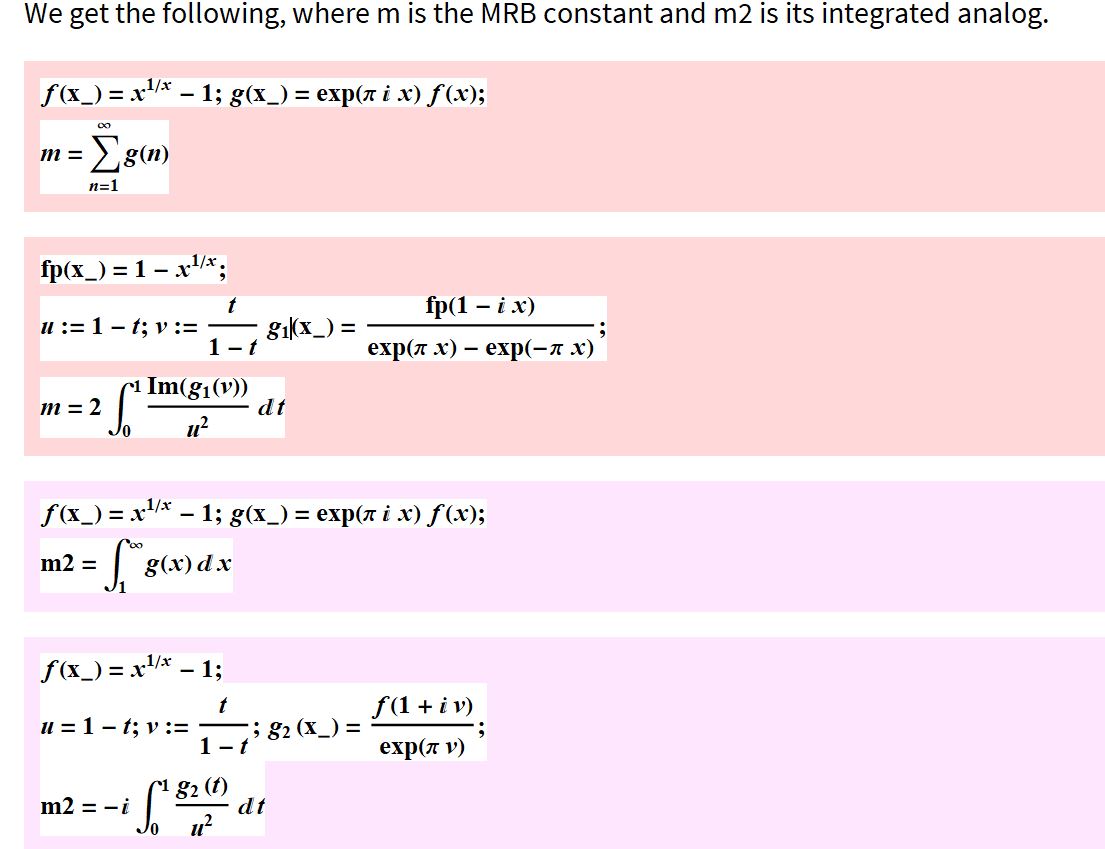
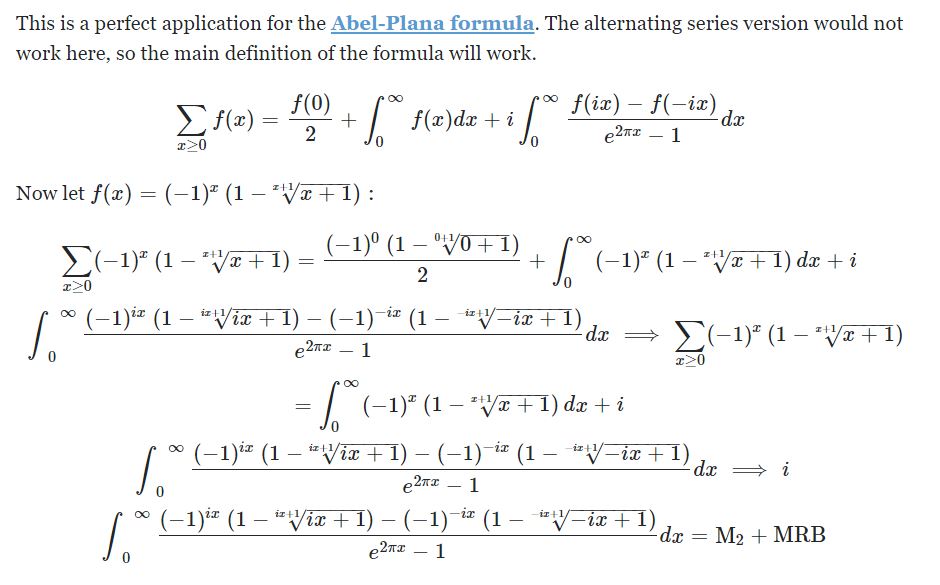
MRB=$\sum _{x=0}^{\infty } e^{i \pi x} \left(1-(x+1)^{\frac{1}{x+1}}\right) $ vs M2= $\int_0^\infty e^{i \pi x} \left(1-(x+1)^{\frac{1}{x+1}}\right) dx$ in proper integrals
See this notebook. I got an interesting co-answer here.
I won't bring the subject of numerical computation into this discussion, but I spent several years learning to compute the digits of $\int_0^\infty{e^{i \pi x} \left(1-(x+1)^{\frac{1}{x+1}}\right)}dx.$ You can read about my adventure at How to calculate the digits of the MKB constant. If you like numeric computations, of much interest is the story of how I came across this integral, by investigating $\sum _{x=0}^{\infty } e^{i \pi x} \left(1-(x+1)^{\frac{1}{x+1}}\right)$ since the 1990s, at Try to beat these MRB constant records!