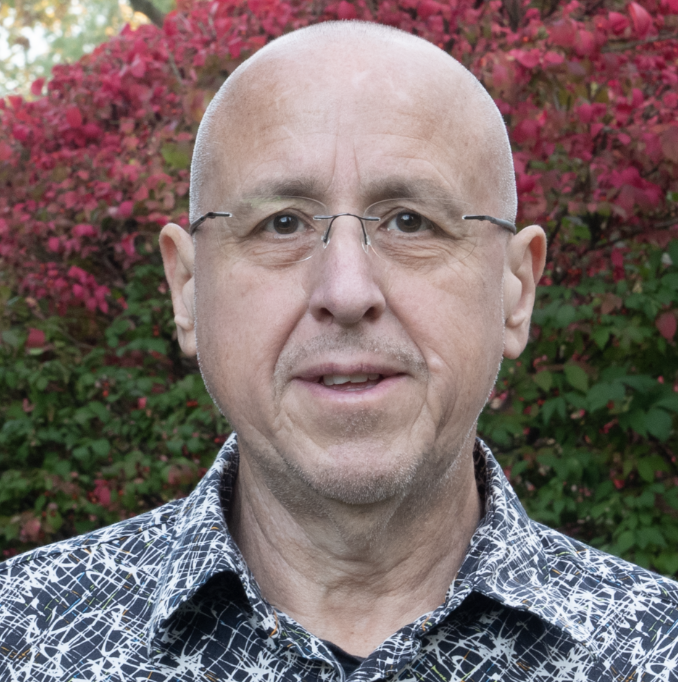
Michael Trott was more than a brilliant scientist, he was a mentor, a friend, and a truly unique human being. For those of us lucky enough to work closely with him, his absence leaves a deep void. He brought an irreplaceable blend of curiosity, creativity, and humility to everything he did. Our long meetings, where we'd dive into unconventional ideas in physics and find ways to implement them in Mathematica, often stretched past hours, but no one ever minded. With Michael, even the most abstract idea could spark a new direction, a novel prototype, or an unexplored corner of science.
He didn't just think outside the box, he rebuilt it entirely, quietly and kindly. His codes weren't always optimized for performance, but they were original and beautiful. I have never seen anyone so professional in prototyping novel ideas computationally; and this was our joint passion for Mathematica, as we believed it is one of the best tool, if not the best, for this purpose. One can find a few examples of Michael's style of thinking in the Wolfram Blog, Wolfram Demonstration Project, or Wolfram Community. He was also the author of four seminal books: "The Mathematica GuideBooks" (four volumes).
He had a deep grasp of the history and architecture of Mathematica, with a passion for physics, especially quantum theory, and a genius for applying technology in unexpected ways. Michael Trott joined Wolfram Research in 1994 and was a cornerstone of the company for over 30 years. As Chief Scientist of Wolfram|Alpha, his fingerprints are on thousands of algorithms and innovations, from computational art to physical constants, from parsing human input to building bridges between theoretical physics and computation. The Wolfram Quantum Framework, as a small example, would not have been possible without his support and contributions.
Michael was encyclopedic in knowledge, yet endearingly humble. He read hundreds of papers, built massive daily digests on LLMs, mentored researchers across physics, math, and engineering; and still worried whether he had anything "original" to offer before a scheduled talk at the University of Vienna (see the material he'd prepared for this talk from this link; we even had a dry-run together, to discuss the content repeatedly). His presence was magnetic. He showed up early to Zoom calls (Wolfram Research has many remote employees, including myself, even before COVID pandemic) and sparked thoughtful conversation before meetings began. He didn't just build things but he shared them generously. He brought humanity to everything he touched. Whether discussing quantum fields or life under East Germany's Stasi, he made space for your story too. He helped others grow, quietly and consistently, always leading by example.
Toward the end, we spoke about the multiverse; you were certain we'd meet again. In those final days, lying in your hospital bed, we found ourselves deep in conversation about the quantum-to-classical transition and nonlinearities. Thank you, Michael, for everything. You showed so many of us what it truly means to be both a scientist and a human being.