Group Abstract Group Abstract

Message Boards Message Boards

Time travel through the atmosphere: replaying historical weather from 1940 to today

Time travel through the atmosphere: replaying historical weather from 1940 to today

A 24-hour reanalysis of Hurricane Katrina making landfall on 29 August 2005, reconstructed hour-by-hour from ERA5 alone — no satellite imagery involved. Below: the mechanism behind it, an explanation of why the same trick works for any date since 1 January 1940, and a walk through Apollo 11's launch morning, the 1953 North Sea Flood, the 1987 UK Great Storm, the 2003 European heatwave, Hurricane Katrina, Stephen Wolfram's birthday in 1959, and the winter inside the Stalingrad pocket.

Attachment

Attachment

POSTED BY: Marco Thiel
3 Replies

This is absolutely spectacular, @Marco! Thank you so much for sharing this. I just started playing with this. It would be insanely interesting to do what you suggested -- something during the D-Day. I tried to see if I can get cloud cover. Not sure what's interesting. Definitely something that did not exist at that time wrt to space program. I think continents should be somehow different form seas visually and lines a bit thicker. I also saw a tiny bug with UK border polygon ordering - not sure - maybe that was me who messed it up. I am attaching .wl I ended up using for this screenshot.

SetDirectory[NotebookDirectory[]];
Get["HistoricalWeather_2.wl"];
ddayLoc = {50.0, -1.0};  
ddayTime = "1944-06-06T06:00";
halfWidth = 8;
HistoricalWeatherMap[
    ddayLoc,
    ddayTime,
    halfWidth
  ]

enter image description here

Attachments:
POSTED BY: Vitaliy Kaurov

Dear @Vitaliy Kaurov ,

great catch! Thank you and thank you for your kind words. The country borders come out much better the way you do it. Much of what I do is an experiment in getting LLMs to use the Wolfram Language as a tool, and I use it to "explain certain ideas to the LLM", but the actual programming is nearly exclusively done by the LLM. I have developed a special setup for that. The skeleton for such a calculation is done within minutes now for me. If you look at my Moving Sofa Problem post, or the ENSO one, it was really just discussing the project with the AI and the rest was automated. It seems that something happened at the end of last year which changed my workflow completely. Before I had trouble "vibe-coding" with LLMs in the Wolfram Language, but now that is not an issue any more. It has very much changed how I use the Wolfram Language, but I produce much (!) more code. Sometimes the code is not ideal and does not use some of the high level functions. For example in the post on textured 3D objects I use an FEM approach when simulating the mug being filled with and submerged in hot water. Oliver Ruebenkoenig​ kindly pointed out (among other things) that I had not used VonMisesStress which would have been more elegant. I guess that we need one or two more LLM iterations so that they know all of the high level functions that MMA already has.

Regarding this post, you are right D-Day is, in fact, an interesting event to look at in relation to the weather. I asked GPT for battles after 1940 where the weather played a crucial role and it gave me :
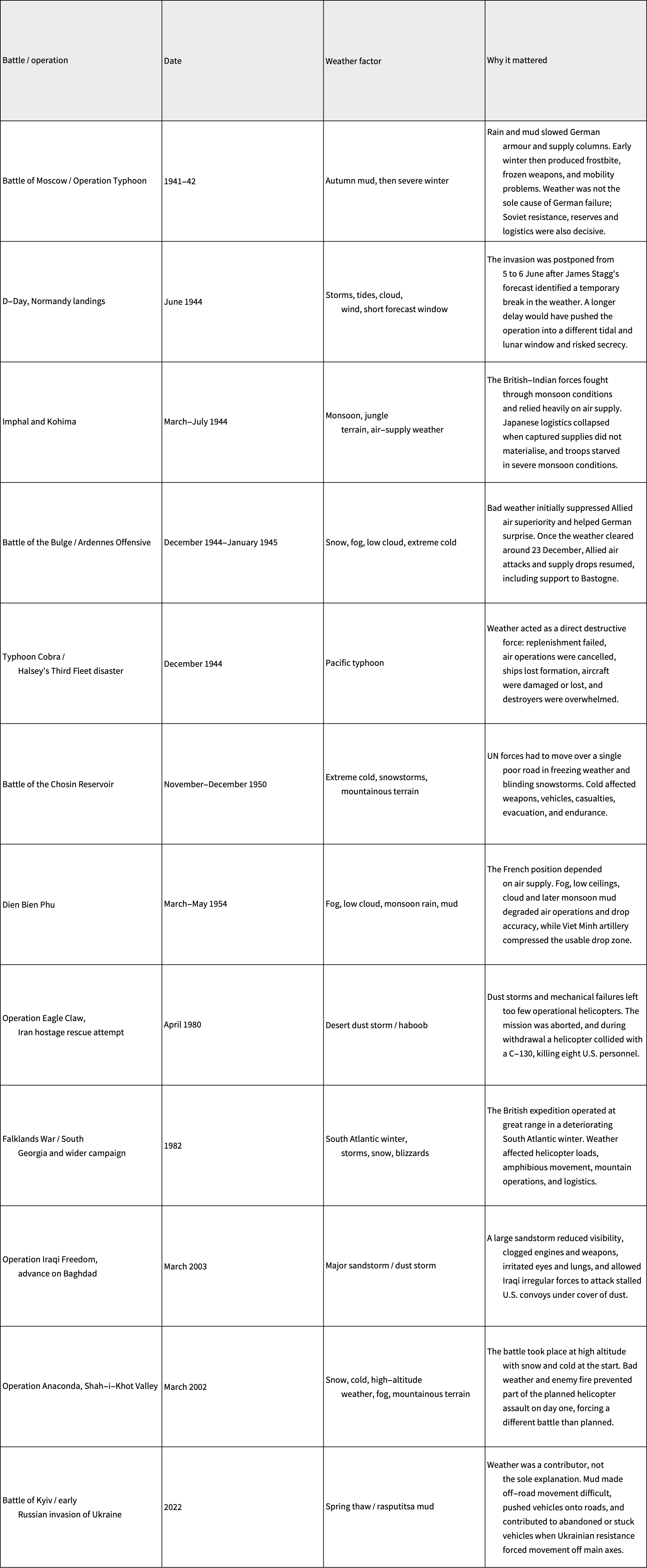
enter image description here

I have a couple of posts liked up, but if possible, I will look at some of these battles.

Thanks again.

POSTED BY: Marco Thiel

enter image description here -- you have earned Featured Contributor Badge enter image description here Your exceptional post has been selected for our editorial column Staff Picks http://wolfr.am/StaffPicks and Your Profile is now distinguished by a Featured Contributor Badge and is displayed on the Featured Contributor Board. Thank you!

POSTED BY: EDITORIAL BOARD
Reply to this discussion
Community posts can be styled and formatted using the Markdown syntax.
Reply Preview
Attachments
Remove
or Discard