Group Abstract Group Abstract

Message Boards Message Boards

0
|
10.6K Views
|
4 Replies
|
5 Total Likes
View groups...
Share
Share this post:

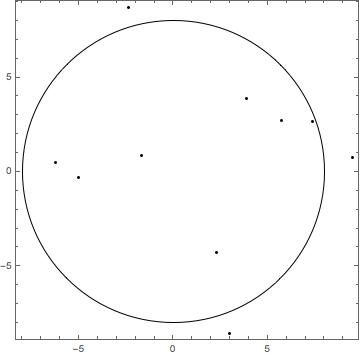
Counting points in a Graphic

Posted 12 years ago
POSTED BY: Lewis Millar
4 Replies
Posted 12 years ago
(* a list of 1000 points in a range *)
points = RandomReal[{-100, 100}, {1000, 2}];

(* select all points within distance of a point and count them *)
count[center_, distance_] := 
 Length[Select[points, Norm[# - center] <= distance &]]

(* make a table of these counts over a range and plot them *)
Table[{d, count[{0, 0}, d]}, {d, 1, 250, 5}] // ListPlot

enter image description here

(* choose a different center and do it again *)
Table[{d, count[{50, 50}, d]}, {d, 1, 250, 5}] // ListPlot

enter image description here

POSTED BY: David Keith
POSTED BY: David Reiss
Posted 12 years ago

Thanks for the reply! Is there any chance you could explain some of the terms in the part of the code that reads:

pointsInR[points : {{, } ..}, r_ /; r > 0] := Select[points, Sqrt[#.#] < r &]

I am not too sure what the {{, } ..}, r_ /; actually refers to, nor the #.# or &.

Thanks!

POSTED BY: Lewis Millar

Sure. I threw some of that in there in case you were not familiar with them so you could ask ;-)

In the left hand side of the function definition

pointsInR[points : {{_, _} ..}, r_ /; r > 0]

the

points : {{_, _} ..}

is indicating that the first argument, points, should have the pattern (http://reference.wolfram.com/language/tutorial/PatternsOverview.html) where it is a list of lists, each of which is a pair of values -- i.e., a list of cartesian pairs to comprise the coordinates of the points. It just restricts the function to only working when such a pattern is supplied. If you don't supply that pattern then the function will return unevaluated.

In a similar way, the second argument pattern

r_ /; r > 0

is just demanding that the radius argument be greater than zero--a sensible argument constraint given that the radius should be positive for the circle.

I could have written the function simply like this:

pointsInR[points_, r_] := Select[points, Sqrt[#.#] < r &]

but then, if you give it arguments of the wrong form, all sorts of havoc might be the result.

The

Sqrt[#.#] < r &

is an example of a pure function:

http://reference.wolfram.com/language/tutorial/PureFunctions.html

It is a way of defining a function to be used without having to name it. David Keith similarly uses a pure function in his discussion.

The # and the & are a shorthand for implementing a pure function. Another way of writing this, using the full Function form would be

Function[z,Sqrt[z.z] < r ]

I understand that this may give you a bunch of stuff to chew on, but it will be well worth learning these bits.

I hope this helps.

POSTED BY: David Reiss
Reply to this discussion
Community posts can be styled and formatted using the Markdown syntax.
Reply Preview
Attachments
Remove
or Discard