Group Abstract Group Abstract

Message Boards Message Boards

0
|
8K Views
|
13 Replies
|
1 Total Like
View groups...
Share
Share this post:

Because the domain of the following function with positive real 5x ^ (2/3)

Because the domain of the following function with positive real 5x ^ (2/3)

13 Replies

Hi David, Hi Rosa,

If I understand the OP right, the question is why another piece of software says that the domain consists of all reals, whereas MMA says it consists of the non-negative numbers only. What David's plot shows is that indeed MMA only plots the positives, because the Power function calculates the principal root. If you use Surd instead you get:

Plot[5 Surd[ x, 3]^2 - Surd[x, 3]^5, {x, -5, 10}]

enter image description here

Which is defined for all Reals.

Cheers,

Marco

POSTED BY: Marco Thiel

Hello Marco,

Thank you very much for all the explanations. They have helped me a lot

Cheers,

Rosa María

Hello Marco,

The explanation that you give enough clarify the situation.

Cheers,

Rosa María

Hello Marco

Now, my question is, When should I use Surd? Which functions should I use Surd?

I introduce my students the outcome of the plot, stationary points, domain without using Surd, and a polemic was formed, and they showed me the results that give other software, and was not the same.

Cheers, Rosa María

Here is another way to represent this.

domain = Range[-5, 10, 0.1];
sols1 = Table[5 Surd[ x, 3]^2 - Surd[x, 3]^5, {x, -5, 10, 0.1}];
sols2 = Table[5 x^(2/3) - x^(5/3), {x, -5, 10, 0.1}];
sols3 = Conjugate /@ sols2;
ListPointPlot3D[{Flatten /@ 
  Transpose[{domain, {Re[#], Im[#]} & /@ sols2}], 
  Flatten /@ Transpose[{domain, {Re[#], Im[#]} & /@ sols3}], 
  Flatten /@ Transpose[{domain, {Re[#], Im[#]} & /@ sols1}]}, 
 AspectRatio -> 1, AxesLabel -> {"x-Axis", "real", "imaginary"}, 
 LabelStyle -> Directive[Bold, Medium]]
enter image description here

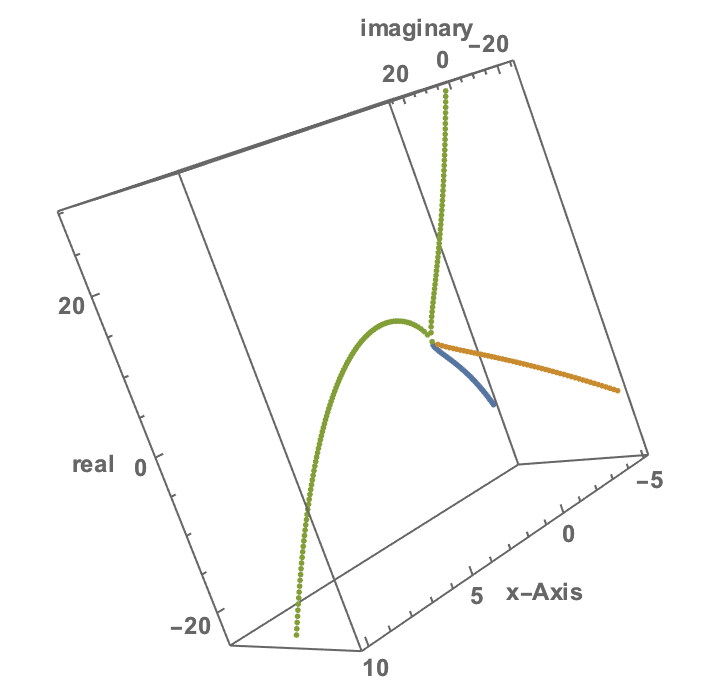
The domain-variable just is input to our function. sols1 computes the real-values of the root (green curve in the picture). sols2 and sols3 are the principal (complex) solutions to the roots together with the conjugate complex solutions. Because the roots of negative numbers are not unique in general, we can get more than one "solution". If other pieces of software assume that we want only the real roots, they do not have issues with this, but do make some potentially critical assumptions that we might not want to make.

Cheers,

M.

PS: The figure is actually not easy to read this way. It shows how much better it is to have Mathematic than a static document. If you take compute it and rotate it, it becomes much clearer.

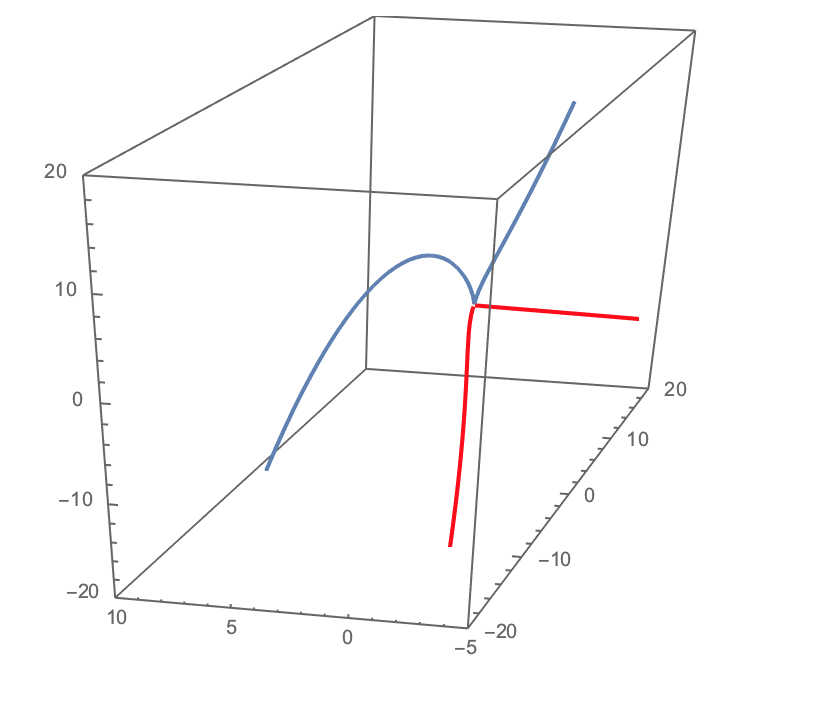
PPS: If you dislike the awkward way of plotting the lists of points you can, of course, also use ParametricPlot3D

Show[ParametricPlot3D[{x, Re[5 x^(2/3) - x^(5/3)], 
   Im[5 x^(2/3) - x^(5/3)]}, {x, -5, 10}, AspectRatio -> 1, 
  PlotStyle -> Red, PlotRange -> {{-5, 10}, {-20, 20}, {-20, 20}}], 
 ParametricPlot3D[{x, 
   Re[5 x^(2/3) - x^(5/3)], -Im[5 x^(2/3) - x^(5/3)]}, {x, -5, 10}, 
  AspectRatio -> 1, PlotStyle -> Red], 
 ParametricPlot3D[{x, Re[5 Surd[x, 3]^2 - Surd[x, 3]^5], 
   Im[5 Surd[ x, 3]^2 - Surd[x, 3]^5]}, {x, -5, 10}]]
enter image description here

The blue line is the "real" solution and the other two correspond to "complex and conjugate complex solutions".

POSTED BY: Marco Thiel
Posted 10 years ago

Marco, that is most enlightening!

In[4]:= Reduce[5 Surd[x, 3]^2 - Surd[x, 3]^5 > 0]

Out[4]= x < 0 || 0 < x < 5
POSTED BY: David Keith
POSTED BY: Marco Thiel
Posted 10 years ago

Hi Rosa,

If you mean the domain such that the last expression is positive and real, here is a Mathematica solution:

In[1]:= Reduce[5 x^(2/3) - x^(5/3) > 0]

Out[1]= 0 < x < 5

In[2]:= Plot[5 x^(2/3) - x^(5/3), {x, -5, 10}]

enter image description here

The Reduce expression also works in Alpha.

Kind regards,

David

POSTED BY: David Keith

Hello Marco, I do not understand. That means that when I put Plot, or calculate the maximum and minimum, have to put that command. I'm confused, in other mathematical software, I put me the correct function and graphic appears and the graph appears mathematicas me only positive real

Hi Rosa,

try to look up the difference between

x^(2/3)

and

Surd[x,3]^2

If in Mathematica you type

FunctionDomain[5 Surd[x, 3]^2 - Surd[x, 3]^5, x]

which evaluates to True, or use this wolfram alpha request you get what you expect. Note that for example

5 Surd[x, 3]^2 - Surd[x, 3]^5 /. x -> -4.

gives 22.6786 and

5 x^(2/3) - x^(5/3) /. x -> -4 // N

gives -11.3393 + 19.6402 I. Surd chooses the positive root. The "^" is for the Power function which calculates principal roots.

Cheers,

M.

POSTED BY: Marco Thiel

I do not ask for the command. But other mathematical software in the domain of this function is all real and wolfram alpha is positive real

Dear Rosa,

I am not really sure what your question is. Your two posts are not identical and the question seems to be in complete somehow.

In Mathematica / the Wolfram Language you would type:

FunctionDomain[5 x^(2/3) - x^(5/3), x]

Something similar works in Wolfram|Alpha, see here. I am not sure whether that helps.

Cheers,

M.

POSTED BY: Marco Thiel

Because the domain of the following function with positive real 5x ^ (2/3) - x ^ (5/3). This result we get in wolfram alpha

Reply to this discussion
Community posts can be styled and formatted using the Markdown syntax.
Reply Preview
Attachments
Remove
or Discard