Group Abstract Group Abstract

Message Boards Message Boards

0
|
26.3K Views
|
28 Replies
|
2 Total Likes
View groups...
Share
Share this post:

Play any sound, i.e: piano type sound, at any desired frequency?

Posted 9 years ago
28 Replies
Posted 9 years ago
POSTED BY: David Keith
Posted 3 years ago

Thanks a lot for your reply and information.

POSTED BY: k Lu
Posted 3 years ago

Is the txt file there? I can not see it.

POSTED BY: k Lu

Note: Never use blank spaces for your filenames. Never¡

It would be great if mathematica could improve the time response for the PLAY command when using functions.

I know that by previously using the table command the time response is reduced, however I didn't find the way to use that in this dynamic case, I just have to directly use large piecewise functions within the play command.

I am attaching again the SYNTHESIZER code with some minor changes, just copy the contents, paste and run.

Attachments:

No, it is just that I was trying to paste the code directly into the screen (I didn't notice there is a button for uploading files but just for images), so I previously converted it to a .txt file. Later I realized the button was there.

By the way, the number of sound buttons of this app could be increased and they could be arranged as piano keys icons, or guitar string icons. I hope to see people contributing to this open project, mainly on improving the time response of the PLAY command.

This is great! Is there a reason you did not attach the notebook itself but a .TXT file?

POSTED BY: Sam Carrettie

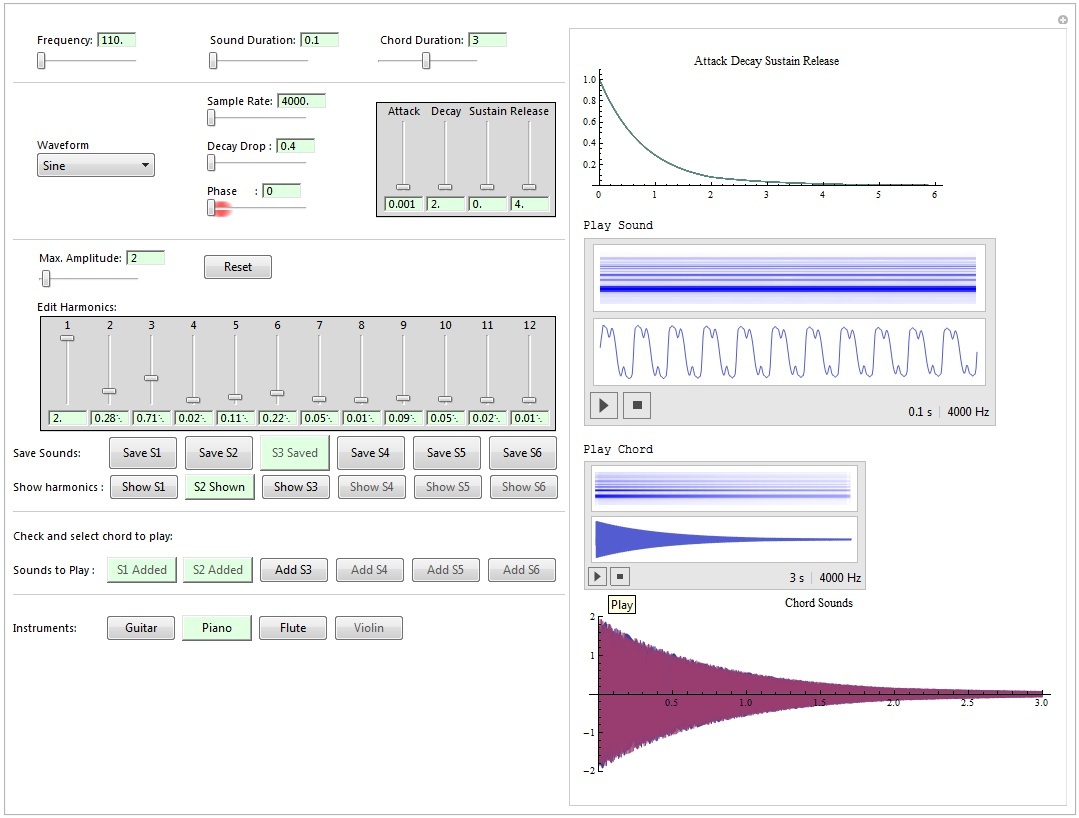
As promised, I am attaching an image of the console (Manipulate output) and the source code (.txt file) of the new project: 'FREE MUSIC, FREE SOUNDS' SYNTHESIZER

Just copy an paste the code of the .txt file into mathematica, and run.

Please also kindly read the text included at the top of the code and share any ideas, harmonics database, and comments on this project. Remember, this is a new open project.!

Best regards, https://domingogomezmorin.wordpress.com

enter image description here

Attachments:

In the mean time, if you are willing to check the code and make some suggestions to improve this project, please kindly let me know your email address and I will send to you the whole code.

enter image description here

My webpage is: https://domingogomezmorin.wordpress.com

Ok, I'll try to send it to wolfram demonstrations project.

Could you please share the code?

POSTED BY: Vitaliy Kaurov

Excelent suggestion. Many thanks for your help,

I suggest that you send Wolfram a suggestion that AudioGenerator should accept instrument names ("Piano") as well as standard waveforms ("Sawtooth"). I'm pretty sure that this is possible -- hard for us, but perhaps not so much for the developers.

If they can do this, then Wolfram Language would have a shot at replacing General MIDI as a more flexible and general music generator.

The more people who suggest this, the more likely it will happen.

Well, many thanks to all of you for your comments. I'll try to find function by myself, it is a hard task, but it seems there is no other way.

Best Regards

According to the documentation, you can use any ratio. There are ways of adjusting the pitch by multiples of semitones, but you don't need to do this.

This 'technique' is a bit of a hack. What we really want to do is to use AudioGenerator with a suitable envelope (model). The documentation lists several models that are built-in. One promising one is to use a Time Series. You could create a function that would duplicate the harmonics and decays of any arbitrary sound. This is non-trivial, of course.

As I said, this is on my list of things to do.

at this point, another important question emerges:

The shift factor used in the audiopitchshift is an arbitrarily chosen numerical factor, or is it a restrictive musical ratio (semitone units)?.

If the later then this shifting is definitely not an option to follow. The chords need to be totally free from any pre-established ratios.

It seems, you need to previously convert the sound into an audio file, that's the meaning of the command AudioPitchShift

this is getting quite interesting...

Many thanks George, interesting, I'll try this one. I am desperately looking to achieve this, because it also deals with a math research I am working on. It seems to be a choice, let's see...

p.d. By the way, pretty nice your wolfram demonstration on linear equations system

SoundNote[] uses standard MIDI. By default, the pitches are Equal temperament, A = 440 hz. The MIDI standard allows you to alter the pitch, but I have found no (easy) way to do this.

MIDI should be an obsolete standard, mostly because it defaults to Western, equal tempered scales, which is really appropriate for Western (Eutorpean) music since 1760 or so. (Bach's Well-Tempered Clavier was written to exhibit the utility of a well-tempered scale, not equal temperament.) Indian, Chinese, and older Western Music (e.g. Baroque and Renaissance and before) use different scales.

Looking at the new audio functionality is on my list of things to do. I haven't checked this out, but you might be able to create an audio entity using SoundNote[], specifying the instrument, and then manipulate the pitch using AudioPitchShift[]. If that works, then you could wrote a function that would wrap up the code and have as an input one of the various MIDI instruments.

POSTED BY: Frank Kampas

The Mathematica Command SoundNote uses internal functions to develope those complex sounds, however, to my disgrace mathematica does not show those special functions and the command only uses the frequencies of known musical notes. Besides, the point is that I am not making a research on how to construct those string-type sounds but on analysing chords of string-sounds at any chosen frequency, so I guess somewhere I could finally find those functions instead of trying to contruct them by myself which no doubt would be a so hard task.

Posted 9 years ago

Often these complex instrument sounds consist of the fundamental and a set of harmonics at amplitudes related to that of the fundamental. So one approach to simulating such sounds is to determine these additional components, either through available writings or by Fourier analysis of examples. Then you could write a function which accepts a fundamental frequency and outputs a sum of notes representing the full set of components. The fundamental could then be any frequency, not just those of standard notes.

POSTED BY: David Keith

Hi Frank, It seems I didn´t explain my point as I should. I didn´t ask for sine-type waves.
I am looking for arbitrary chords using string-type sounds (piano, violin, guitar) at any frequency. That is, chords that do not follow the ratios of the musical notes of any existing musical scale. The frequencies of the sounds must be choosen at will directly using Herzt units (not musical notes).

So to do so, I would need either the wave equation for simulating the string-type sound along with the Play Command, or any existing mathematica program code (or commands). Got it? Many thanks in advanced for any help on this matter. I have been struggling on this for some time and I am frankly frustrated, I am not quite sure if mathematica has any synthesizer code that could help, or if there is any other synthesizers out there that could do the job.

The mathematica command SoundNote does not do the job, it only works with the frequencies of musical notes, not with any frequencies chosen at will

Play[Sin[256*2 \[Pi] t] + Sin[1.25*256*2 \[Pi] t] + 
  Sin[1.5*256*2 \[Pi] t] + Sin[2*256*2 \[Pi] t], {t, 0, 1}]
POSTED BY: Frank Kampas
Reply to this discussion
Community posts can be styled and formatted using the Markdown syntax.
Reply Preview
Attachments
Remove
or Discard