Group Abstract Group Abstract

Message Boards Message Boards

Networks' complexity measures with Wolfram Language?

Posted 11 years ago

I would like to measure how complex various networks are. There are certainly many approaches, but I am interested in what we can do with tools available in the Wolfram Language. There are many discussions in the New Kind of Science book about networks. But since its publication Wolfram Language evolved significantly.

Imagine we have something more general, like a mixed multi-edge graph:

network[v_, e_] := Graph[RandomInteger[{1, v}, {e, 2}] /.
   {x_Integer, y_Integer} :> RandomChoice[{DirectedEdge[x, y], UndirectedEdge[x, y]}]]

SeedRandom[131]; g = network[20, 60]

enter image description here

Symmetries should affect complexity, and some general measure should detect that in, say, pure trees or symmetric and/or planar graphs:

TreeGraph[RandomInteger[#] <-> # + 1 & /@ Range[0, 100], GraphLayout -> "RadialDrawing"]

enter image description here

GraphData["IcosahedralGraph"]

enter image description here

Does anyone know or have any ideas for some complexity measure that we can quickly compute with Wolfram Language?

Perhaps @Hector Zenil, @Todd Rowland or @Marco Thiel could point to the right direction. Maybe there were some Wolfram Science Summer School projects about this.

POSTED BY: Vitaliy Kaurov
13 Replies
POSTED BY: Hector Zenil

Not related to the complexity of the graph but to the time complexity of determining graph isomorphism. For example, to generate the isomorphism group may be only feasible by brute force, but the algorithmic complexity of the whole process is minimal because the size of the program that runs the brute force search is of fixed small size.

POSTED BY: Hector Zenil
Posted 11 years ago

It looks very relevant.

I hope to find out as soon as Babai's algorithm in Mathematica is available.

POSTED BY: Buck Field

I wonder how relevant this will turn out to be: Mathematician claims breakthrough in complexity theory

László Babai, a mathematician and computer scientist at the University of Chicago in Illinois, has developed a mathematical recipe or "algorithm" that supposedly can take two networks—no matter how big and tangled—and tell whether they are, in fact, the same, in far fewer steps than the previous best algorithm. ... Babai has shown that a problem that was thought to be on the harder NP end of the spectrum is closer to the easier P end, instead.

POSTED BY: Vitaliy Kaurov

Following up on Charlie's post, there is a close relation to Kolmogorov randomness and other types of randomness, so any of the measures he mentions will satisfy Vitaliy's original question.

POSTED BY: Todd Rowland

Statistical physicists have focused on random models of networks. You could construct a "null model" that capture some aspect of the network (such as all graphs that have the same degree distribution) and see how different your network is to that null model on certain dimensions (e.g., clustering, motifs, path length distribution, hierarchical structure, or whatever you think might be important for your network). If your network is not statistically significantly different from your null model, then your network is a "simple" as your null model (which may have few parameters and hence is quite "simple"); otherwise, you have a lower bound on the "complexity" of your network.

POSTED BY: Charlie Brummitt

I meant something like Kolmogorov complexity or similar. I was hoping @Hector Zenil will comment something - he has been doing research in this domain.

POSTED BY: Vitaliy Kaurov
POSTED BY: Augusto Carreira
POSTED BY: Marco Thiel

Somehow I find it very strange that real-world networks would have any non-trivial symmetries. I'll need to take a look at that paper when I have time. For a real-world network (i.e. something having a lot of noise) I would expect the only symmetries to arise either from "exchangeable" degree-1 nodes connected to the same other node, or maybe sometimes from complete subgraphs.

As for ExampleData[{"NetworkGraph", "MetabolicNetworkSaccharomycesCerevisiae"}], the Bliss algorithm available through IGraph/M handles this easily:

g = ExampleData[{"NetworkGraph", "MetabolicNetworkSaccharomycesCerevisiae"}];

<< IGraphM`

group = IGBlissAutomorphismGroup[g];

These are the generators of the group:

PermutationCycles /@ group

{Cycles[{{200, 249}, {201, 250}}], 
 Cycles[{{480, 484}, {481, 485}, {1041, 1042}, {1113, 1449}}], 
 Cycles[{{536, 539}, {537, 540}, {610, 615}, {611, 616}, {1262, 
    1268}, {1263, 1269}, {1264, 1270}}], 
 Cycles[{{541, 557}, {617, 642}, {949, 1271}, {952, 1272}}], 
 Cycles[{{1315, 1438}}], Cycles[{{1497, 1498}}]}

BTW there are some interesting papers on how graph symmetries affect synchronization networks: http://arxiv.org/abs/1211.5390

EDIT:

Indeed if we look at which nodes of this metabolic network participate in the symmetries, they all turn out to be low-degree periphery nodes, as I would expect. Below you can see the neighbourhood of these nodes.

In[155]:= vi = Flatten /@ First /@ PermutationCycles /@ group

In[156]:= Table[
 vv = VertexList[g][[ind]];
 HighlightGraph[
  NeighborhoodGraph[g, vv, 2],
  vv
  ],
 {ind, vi}
 ]
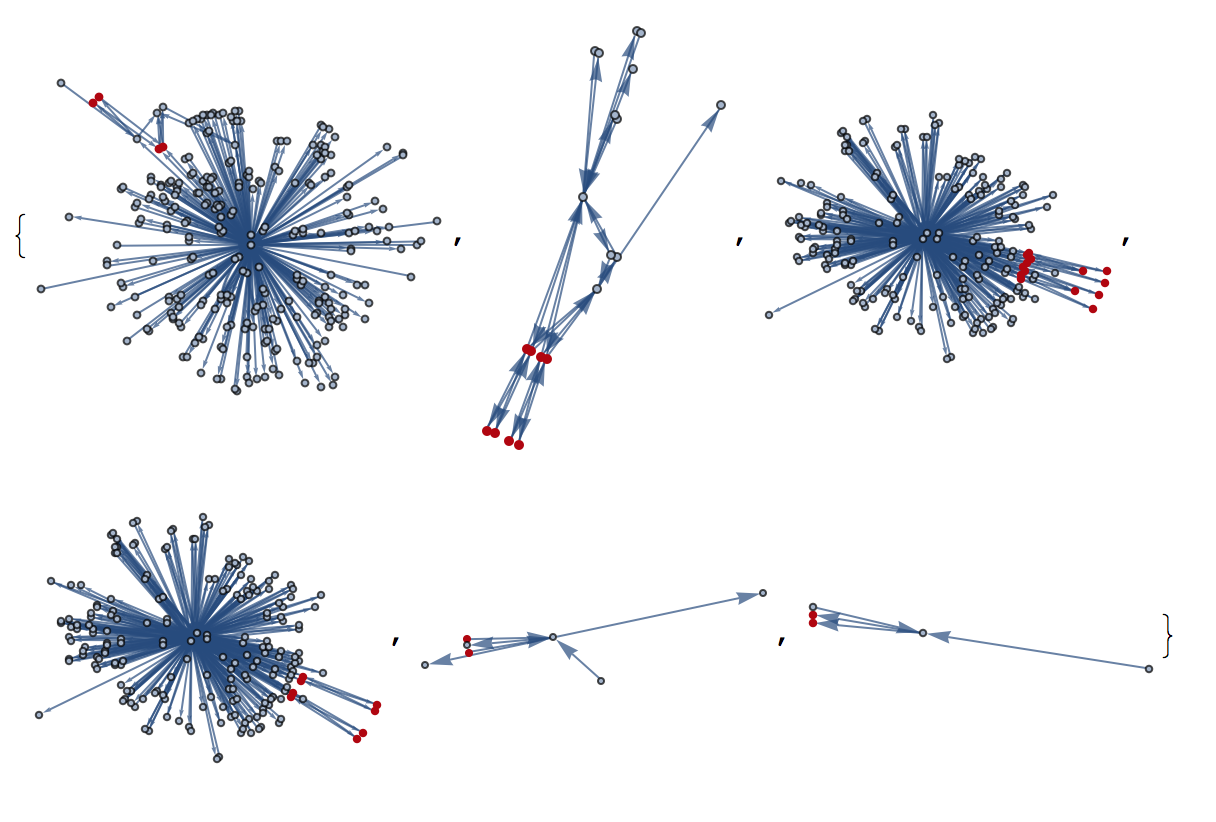

enter image description here

POSTED BY: Szabolcs Horvát
POSTED BY: Marco Thiel
POSTED BY: Todd Rowland
Reply to this discussion
Community posts can be styled and formatted using the Markdown syntax.
Reply Preview
Attachments
Remove
or Discard